TheDPDPAct.com -
Official WhatsApp Channel
Stay updated with the latest DPDP Act news, compliance insights, updates, and resources.
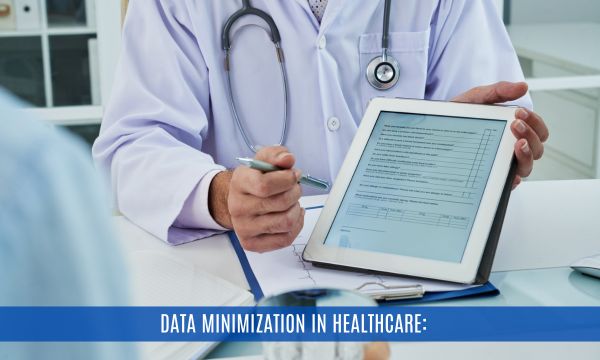
Join Our WhatsApp Channel →In healthcare, protecting patient information doesn't always begin with stronger security. Sometimes, it begins with collecting less.
A patient visits a hospital for what seems like a straightforward consultation.
Before meeting the doctor, they complete a registration form, upload identity proof, enter insurance details, provide emergency contacts, share previous medical records, and consent to various digital services. By the time the consultation begins, the healthcare provider has already accumulated a substantial amount of personal information.
Now consider a simple question:
How much of that information was genuinely required to treat the patient?
It is a question that surprisingly few healthcare organizations ask.
Across hospitals, diagnostic laboratories, telemedicine platforms, health-tech startups, insurance providers, and wellness applications, the tendency to collect information has grown far faster than the discipline to question its necessity. Digital transformation has made data easy to gather, inexpensive to store, and readily available for analysis. As a result, many organizations have unconsciously adopted a "collect first, decide later" mindset.
The challenge is that every additional piece of personal information carries a responsibility. It must be protected, governed, retained appropriately, and eventually disposed of securely.
This is where one of the most fundamental principles of modern privacy engineering becomes indispensable—Data Minimization.
The Problem Isn't a Lack of Security—It's Often Too Much Data
Healthcare is among the most data-intensive sectors in the world. Industry studies estimate that it contributes nearly 30% of global data generation, driven by electronic health records, connected medical devices, telemedicine, genomics, imaging systems, wearable technologies, and AI-enabled healthcare solutions.
For many organizations, collecting more information feels like a strategic advantage. The assumption is simple: if more data is available, future clinical decisions, analytics, research, or artificial intelligence initiatives will naturally become more effective.
However, quantity does not always translate into quality.
In privacy consulting engagements, it is common to find registration forms, mobile applications, and backend databases capturing significantly more information than operational teams actively use. Some fields remain untouched after the initial registration. Others exist simply because they have "always been there."
From a privacy perspective, unused personal data is not an asset.
It is a liability waiting to be managed.
The Principle Is Simpler Than It Sounds
Data minimization is not about restricting innovation or limiting patient care.
It is about asking a disciplined question before collecting any information:
"Do we genuinely need this data to achieve the purpose for which it is being collected?"
If the answer is uncertain, the information probably does not belong in the system.
This mindset shifts organizations away from collecting information "just in case" and towards collecting information "just enough."
The distinction is subtle, but its impact is profound.
Every unnecessary field added to a registration form, every optional document uploaded without purpose, and every duplicate database created within an organization expands the amount of information that must be secured, governed, monitored, and retained.
Privacy risks often grow quietly—not because organizations fail to encrypt their databases, but because they accumulate far more information than they actually need.
Digital Healthcare Has Changed the Rules
Modern healthcare rarely depends on a single application.
A patient's information may flow through appointment systems, Electronic Health Records (EHRs), Hospital Information Systems (HIS), Laboratory Information Systems (LIS), pharmacy software, radiology platforms, payment gateways, insurance portals, telemedicine solutions, mobile health applications, and cloud infrastructure.
Each additional platform creates another copy, another transfer, or another processing activity involving personal information.
Now introduce Artificial Intelligence into this ecosystem.
Clinical documentation tools, voice transcription platforms, diagnostic support systems, patient engagement applications, and predictive analytics engines all rely on data to deliver value.
The temptation is obvious.
If AI performs better with larger datasets, why not collect everything?
Because responsible AI is not measured by how much data it consumes.
It is measured by how intelligently that data is governed.
The most mature healthcare organizations are beginning to recognise that better algorithms do not always require more identifiable information. Privacy-enhancing technologies such as anonymisation, pseudonymisation, synthetic datasets, and privacy-preserving analytics allow innovation while significantly reducing privacy exposure.
In many cases, smarter governance creates better outcomes than larger databases.
When Small Decisions Create Large Consequences
Privacy incidents do not always originate from sophisticated cyberattacks.
Sometimes they begin with ordinary operational choices.
* A registration form requests demographic information that no department ever uses.
* A diagnostic centre stores scanned identity documents long after the test has been completed.
* A health application requests access to contacts, location, camera, and microphone despite offering services that require none of them.
* An insurer retains historical medical records long after regulatory or contractual obligations have ended.
Individually, these decisions appear insignificant.
Collectively, they create an expanding repository of sensitive information that must be protected indefinitely.
Every unnecessary record becomes another asset requiring cybersecurity investment, access control, backup management, retention policies, incident response planning, and regulatory oversight.
The cost of collecting data is rarely limited to storage.
It extends throughout the entire information lifecycle.
DPDP Encourages a Different Way of Thinking
India's Digital Personal Data Protection (DPDP) Act represents more than a compliance requirement.
It encourages organizations to become intentional about how personal information is handled.
Rather than asking, "What else can we collect?" organizations should begin asking, "What information is genuinely necessary for this purpose?"
This shift has practical implications across the healthcare ecosystem.
* Hospitals can review patient registration workflows to eliminate redundant fields.
* Health-tech companies can reassess mobile application permissions.
* Diagnostic laboratories can evaluate whether every identifier collected contributes to clinical accuracy.
* Telemedicine providers can streamline onboarding processes without compromising patient care.
* Insurance providers can examine retention practices to ensure historical information is not preserved without justification.
These changes rarely require significant technology investments.
They require thoughtful governance.
Less Data Can Create More Value
There is a common misconception that collecting less information limits business potential.
The opposite is often true.
Organizations that adopt data minimization frequently experience tangible operational benefits.
Smaller datasets are easier to secure, faster to process, simpler to govern, and less expensive to store. Compliance efforts become more manageable because fewer records require oversight. Incident response becomes more effective because organizations understand exactly what information they hold and where it resides.
Perhaps most importantly, patient confidence increases.
People are becoming increasingly aware of how their personal information is collected and used. Healthcare providers that demonstrate restraint in data collection communicate a powerful message: we value your privacy as much as your health.
In an era where trust has become a competitive differentiator, that message carries significant weight.
The Future of Privacy Begins Before Data Is Collected
Healthcare has invested heavily in cybersecurity technologies—firewalls, encryption, endpoint protection, identity management, threat monitoring, and security operations centres.
All of these remain essential.
But there is another question that deserves equal attention:
What if the safest information is the information that never needed to be collected in the first place?
Data minimization is not about reducing the quality of healthcare.
It is about reducing unnecessary exposure while preserving clinical value.
As digital health ecosystems continue to expand and Artificial Intelligence becomes deeply embedded in patient care, organizations that embrace this principle will find themselves better prepared—not only for regulatory expectations under the DPDP Act but also for the evolving expectations of patients.
The healthcare organizations of tomorrow will not be recognised simply by the amount of data they possess.
They will be recognised by the wisdom with which they decide what not to collect.
Because in privacy, as in medicine, prevention has always been more effective than cure.