TheDPDPAct.com -
Official WhatsApp Channel
Stay updated with the latest DPDP Act news, compliance insights, updates, and resources.
Join Our WhatsApp Channel →Somewhere in most organizations right now, there's a network diagram nobody worries about anymore — not because the network stopped mattering, but because it gets tested. Annual penetration tests, continuous vulnerability scanning, a red team that shows up periodically to try to break in. The network isn't safe because nothing threatens it. It's calm because the organization stopped wondering and started checking.
Now consider the AI model sitting one layer up the stack — the one making credit decisions, powering the customer-facing chatbot, or scoring risk for a partner API. Ask the same question of it: when was the last time anyone actually tried to break it?
For most organizations today, the honest answer is never. Not because leadership doesn't care, but because nobody has quite worked out whose job that is yet.
The Thread Running Through Everything We've Discussed
As we've discussed throughout this series, this threat doesn't announce itself. It doesn't trip an alarm, breach a firewall, or show up in an incident report shaped like anything security teams have historically trained for. It arrives disguised as ordinary traffic, asks ordinary-looking questions, and leaves with something far less ordinary than what it appeared to be requesting.
What's become clear across these conversations is that this isn't one narrow vulnerability with one narrow fix. It's a blind spot with several faces — competitive, technical, architectural, and legal — and most organizations have only ever had eyes on one of them at a time, if that.
Most organizations have spent years hardening the infrastructure around their AI, and comparatively little time hardening the AI itself.
That gap has a name in the standards world now, and it's worth knowing.
Borrowing a Structure That Already Works
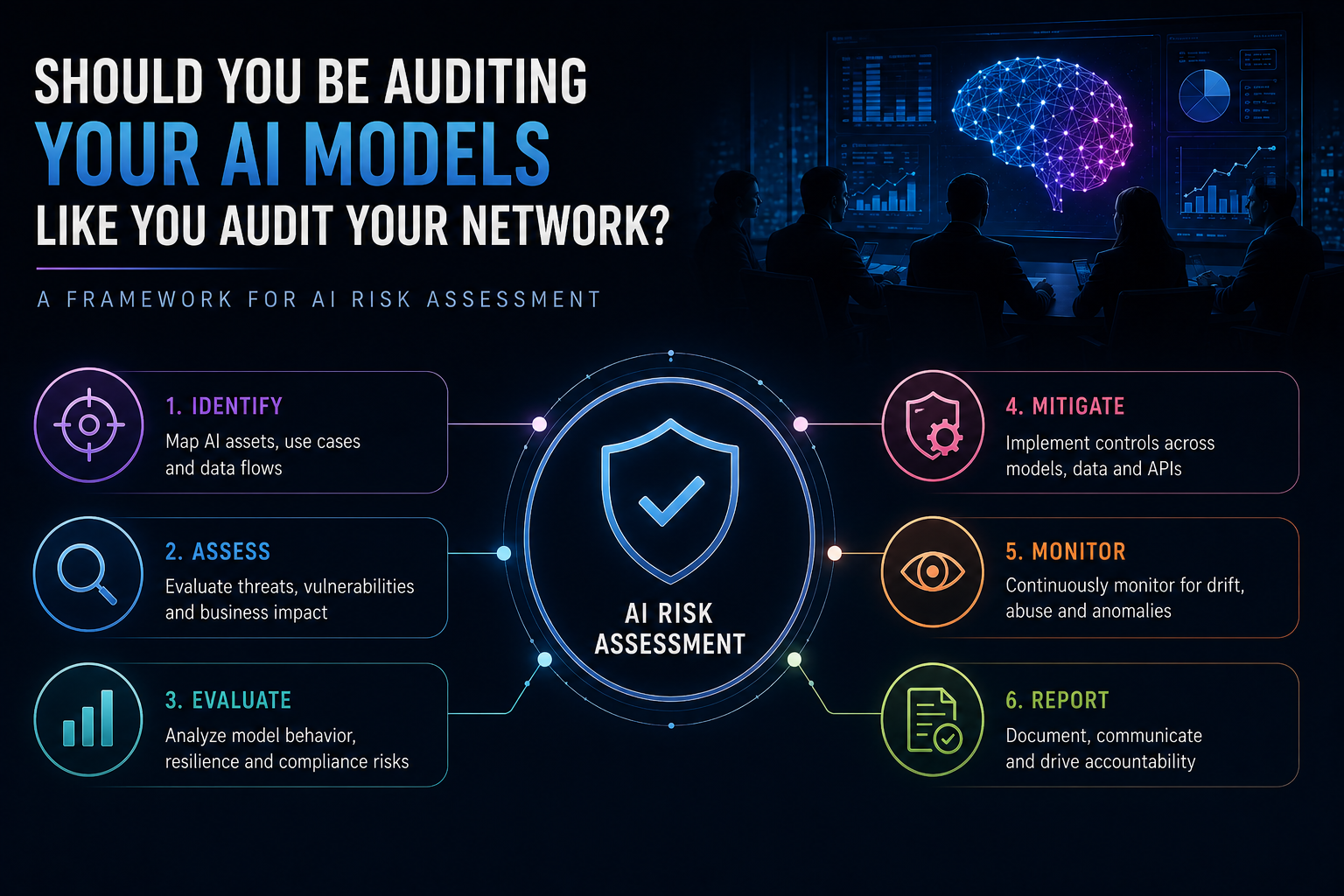
You don't need to invent a governance model from scratch to start closing this gap — and you shouldn't, because two credible ones already exist and are rapidly becoming the reference point regulators and enterprise auditors point to.
The NIST AI Risk Management Framework, released by the U.S. National Institute of Standards and Technology, organizes AI risk work into four functions — Govern, Map, Measure, Manage. It's voluntary in name only; regulators including the FTC, the CFPB, and the SEC increasingly reference its principles in enforcement guidance, and it has become the closest thing the industry has to a common language for talking about AI risk. ISO/IEC 42001, the first certifiable international standard for AI management systems, gives that same work an auditable, externally verifiable structure — the same role ISO 27001 has long played for information security. A companion standard, ISO/IEC 23894, goes further still, offering a detailed methodology specifically for identifying, analyzing, and treating AI risk — a technical playbook that sits neatly underneath the governance layer both of the larger frameworks establish. Organizations increasingly don't have to choose between these standards; a growing body of formal crosswalk documentation maps NIST's functions directly onto ISO's controls, letting a single risk assessment satisfy both.
What makes this genuinely useful, rather than just another compliance acronym to file away, is how cleanly each function maps onto the risk this series has walked through:
1. Govern — Does anyone in your organization formally own model extraction and distillation risk? Not "is it someone's problem in theory" — is it written into a role, a policy, a risk register line item, the way network security ownership already is? Governance without a name attached to it tends to quietly become nobody's job the moment things get busy.
2. Map — For every model you expose through an API — internal, partner-facing, or public — do you know what it would take to clone it? What does the API return? What's rate-limited, and against what threat model? Has anyone actually mapped which of your AI systems were trained on personal or sensitive data, and therefore carry the harder compliance exposure we discussed earlier in this series? Most organizations discover, once they actually do this exercise, that they're running more exposed models than anyone in the room realized — simply because AI adoption has outpaced anyone's effort to inventory it.
3. Measure — Has anyone tried, under controlled and authorized conditions, to actually extract one of your models? Measured how many queries it took? Tested whether your monitoring noticed? This is the step almost every organization skips — not from negligence, but because it requires a specific, unusual skill set: people who understand both offensive security testing and how machine learning models actually behave under adversarial querying. It's also the step that turns everything abstract in this series into something concrete and specific to you: not "extraction attacks are a risk" in general, but "your credit-scoring model can be cloned to 89% accuracy in roughly 4,000 queries, and your current monitoring wouldn't flag it" — a finding with a number attached, a severity rating, and a fix.
4. Manage — Once you know where you stand, are the defensive measures already discussed in this series — output design, calibrated rate limiting, behavioral monitoring, watermarking — actually implemented, or still sitting in a slide deck from a meeting six months ago? Manage is where a finding turns into a prioritized remediation roadmap: which gaps get closed first, which controls are quick wins, and which require a longer architectural conversation.
Most organizations we talk to are strong on Govern in theory and completely untested on Measure in practice. That gap between "we have a policy" and "we have ever actually checked" is exactly where risk quietly accumulates — and it's exactly where a structured AI risk assessment engagement earns its keep. In practice, that kind of engagement typically produces three concrete things a leadership team can actually act on: a model inventory that flags which systems carry meaningful extraction or data-exposure risk, a hands-on extraction and privacy-attack simulation against your highest-priority models with clear pass/fail findings, and a remediation roadmap that turns those findings into a sequence of fixes your engineering team can actually execute — not a hundred-page report that gets read once and shelved.
The Real Starting Point Isn't a Framework. It's a Question.
Frameworks are useful, but they don't answer the one question every leadership team eventually has to sit with: if someone tried this against us today, what would actually happen?
That's not a rhetorical question, and it's not one you can answer by reading five blog posts — including this one. It's answered by putting a specific model, a specific API, and a specific team of people who know how to test for exactly this, in a room together. That's what a structured AI risk assessment is: a controlled, authorized attempt to answer the question your competitors, your regulators, or a far less friendly party will eventually try to answer for you.
The organizations that come out of that exercise ahead aren't the ones with the most sophisticated models. They're the ones who found out where they stood on their own terms, while there was still time to do something about it.
The Wall Was Never the Point
Every security discipline eventually learns the same lesson at its own pace. Networks learned it through decades of breaches before penetration testing became routine instead of remarkable. Applications learned it once enough companies got burned by SQL injection that code review stopped being optional. AI is having its own version of that lesson right now — except this time, the industry has the benefit of watching it happen to others first, in public, in the form of the OpenAI-DeepSeek dispute we opened this series with.
That's a rare position to be in. Most security lessons get learned the expensive way, after the fact, in a postmortem nobody wanted to write. This one is still being learned in real time, which means there's still a window where "we tested for this before anyone asked us to" is a sentence an organization can actually say, instead of a regret it has to explain.
The model sitting behind your API right now doesn't know it's being watched, tested, or worried about. It's simply answering the next question it's asked, as helpfully as it possibly can — to whoever happens to be asking. Whether that's a customer, a curious researcher, or something far less friendly isn't something the model can tell the difference between. That distinction is entirely up to what you build around it.
Consider this series that invitation — not to worry, but to look closely, on your own schedule, before someone else decides to look for you.