Identify and address privacy risk before you launch a new product, process, or system — not after a Data Principal or the Board raises it.
Some data processing activities carry more risk than others — a new AI-driven feature, a large-scale profiling exercise, or processing involving sensitive personal data can expose your organisation in ways a general compliance programme won't catch. A Data Protection Impact Assessment identifies that risk before it becomes a real problem, evaluating the necessity, proportionality, and safeguards of a specific processing activity. ILLUME's DPIA service is built for real decision-making — not a compliance formality — giving your team a clear risk picture and concrete mitigation steps before a new initiative goes live, and a documented assessment ready if the Data Protection Board ever asks for it.
What Data Protection Impact Assessment Service Is?
A structured evaluation of a specific data processing activity's privacy risk — assessing necessity, proportionality, and safeguards — resulting in a documented DPIA report with identified risks and mitigation measures, aligned to DPDP Act requirements.
The Role Data Protection Impact Assessment Service Plays — and Why It's Required
A DPIA is the risk gate that sits before a decision, not after one — it exists to catch problems while a new product, feature, or system is still on the drawing board, when fixing them is cheap, rather than after launch, when fixing them means a redesign, a breach, or a complaint. Its role is to answer a concrete business question — is this processing activity safe to proceed with, and if not, what needs to change — with documented reasoning behind the answer. It's required because the Act mandates it outright for Significant Data Fiduciaries, and because for everyone else, launching a high-risk activity without one means proceeding on assumption rather than assessed risk. A DPIA on file is also the clearest evidence an organisation can produce that risk was considered and addressed before something went wrong, not invented afterward to explain it.
Who This Is For
* Significant Data Fiduciaries, for whom DPIAs are a mandatory, recurring obligation
* Businesses launching new products, features, or systems involving personal data processing
* Organisations introducing AI, automated decision-making, or profiling capabilities
* Companies processing sensitive personal data or data at scale
* Teams needing documented risk sign-off before a project proceeds
What's Covered
* Processing activity scoping — purpose, data categories, and volume involved
* Necessity and proportionality evaluation against the stated purpose
* Risk identification across data subjects, business, and regulatory dimensions
* Assessment of existing safeguards and controls against identified risks
* Mitigation recommendations for unaddressed or high-severity risks
* Documentation formatted to DPDP Act and Rules expectations
* Sign-off support for internal stakeholders or leadership approval
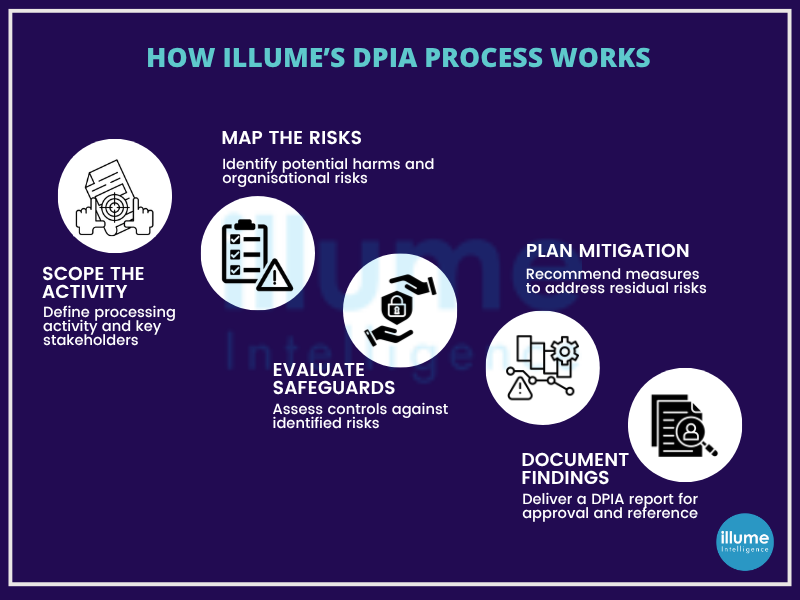
How ILLUME's DPIA Process Works
1. Activity scoping — define the specific processing activity under review with relevant stakeholders
2. Risk mapping — identify potential harms to Data Principals and the organisation from the activity
3. Safeguard evaluation — assess whether existing controls adequately address identified risks
4. Mitigation planning — recommend specific measures to close residual risk gaps
5. Documentation — deliver a DPIA report formatted for internal approval or regulatory reference
What You'll Receive
* A completed DPIA report specific to the processing activity assessed
* A documented risk register with severity ratings
* Concrete mitigation recommendations mapped to each identified risk
* Sign-off documentation suitable for internal governance or leadership approval
* A reusable DPIA template adapted to your organisation for future assessments