Turn a legal obligation into a predictable, audit-proof process — so a mishandled request never escalates into a Data Protection Board complaint.
Every Data Fiduciary is required to give individuals a working way to request access, correction, or erasure of their data, and to resolve grievances through a designated officer — but "required" and "actually functioning" are two different things. Most organisations have no defined process for who handles a request, how fast, or how it's verified, which is exactly how a routine request turns into an escalated complaint with the Data Protection Board. ILLUME's Grievance Redressal service builds and operationalises that process for you — a Grievance Officer setup, a defined response workflow, and a timestamped audit trail that proves you handled every request the way the law requires.
What This Service Is
An operational service that sets up and runs the machinery behind your Data Principal rights and grievance obligations — appointing a Grievance Officer role, defining response workflows, and maintaining an auditable record of every request handled, so your legal obligation becomes a functioning business process.
The Role This Service Plays — and Why It's Required
This service is the operational layer between what the law requires and what actually happens when a real request lands on someone's desk. The Act gives individuals the right to access, correct, or erase their data, and requires a functioning Grievance Officer mechanism to handle those requests — but a right on paper only means something if there's a defined process behind it: who owns it, how fast it moves, and how it's verified. It's required because an unhandled or mishandled request doesn't stay a small, internal problem — it's exactly the kind of thing that escalates into a formal complaint with the Data Protection Board, which is already active and taking cases. Without this operational layer, a business can have a technically correct policy and still fail the moment a real person actually exercises their rights.
Who This Is For
* Businesses with no defined process for handling data access, correction, or erasure requests
* Organisations that have appointed a Grievance Officer on paper but lack an operational workflow
* Companies receiving customer or employee data requests with no consistent turnaround tracking
* Significant Data Fiduciaries needing a documented, auditable grievance process
* Support and customer service teams that need clear escalation paths for these requests
What's Covered
* Grievance Officer role definition and appointment support
* Intake process design for access, correction, erasure, withdrawal, and nomination requests
* Identity verification protocol to prevent fraudulent or unauthorised requests
* Defined response timelines and escalation paths for each request type
* Response template library covering every Data Principal right under the Act
* Timestamped logging and audit trail system for every request received
* Staff training so front-line teams recognise and route requests correctly
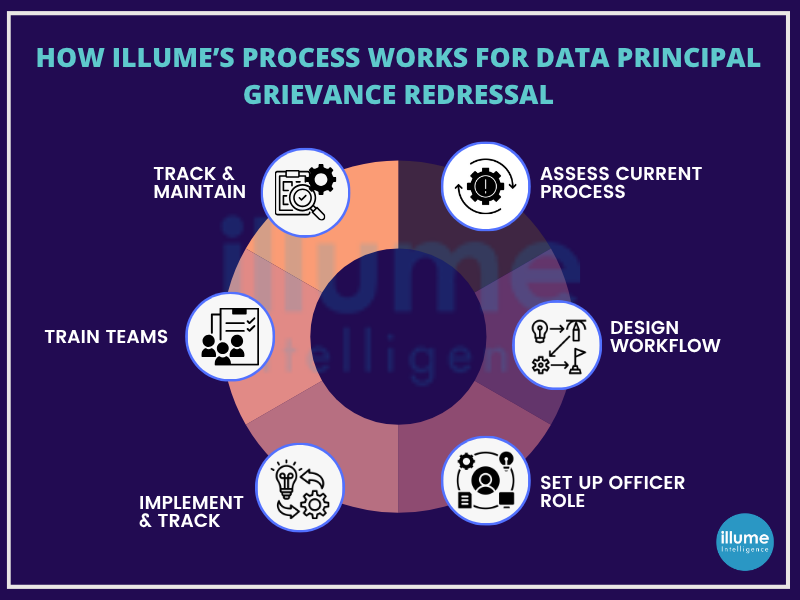
How ILLUME's Process Works
1. Assessment — review current request volumes, channels, and any existing (informal) handling process
2. Design — build the intake, verification, and response workflow tailored to your organisation
3. Officer setup — define the Grievance Officer role, responsibilities, and reporting line
4. Implementation — deploy response templates, tracking systems, and escalation paths
5. Training — equip front-line and support staff to identify and route requests correctly
6. Ongoing tracking — maintain a logged, timestamped audit trail of every request and resolution
What You'll Receive
* A fully defined Grievance Officer role and appointment documentation
* A documented intake-to-resolution workflow for every request type
* A response template library ready for immediate use
* A tracking and logging system with full audit trail capability
* Trained staff able to route requests without escalation delays
* Periodic review support to catch requests before they slip through gaps