You didn't build the model, the data, or half the code running your AI — but you own every risk hiding inside it. Time to find out what you inherited.
Every AI system you deploy is built on someone else's work — a base model you didn't train, a dataset you didn't curate, an open-source library you didn't audit, a fine-tuning service you trust by default. That's your AI supply chain, and it's almost certainly larger and less visible than you think. AI Supply Chain Security from ILLUME Intelligence maps every dependency behind your AI systems and tests it for the risks that matter — poisoned training data, compromised model weights, vulnerable open-source components, and licensing exposure. You can't secure what you can't see, so we start by making the invisible visible.
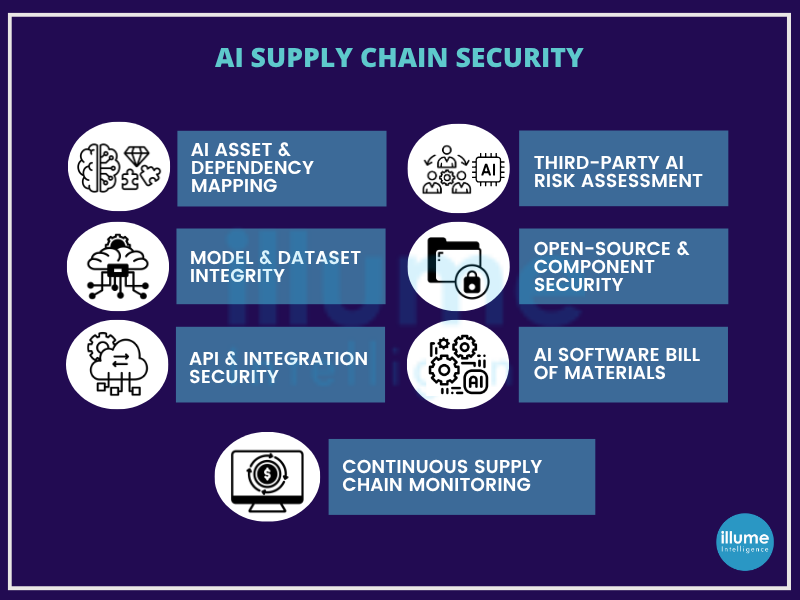
What AI Supply Chain Security Covers
Your AI system's risk doesn't start at deployment — it starts at every point something entered the pipeline from outside your organization.
* Third-Party & Foundation Model Risk — Assessing the base models, APIs, and providers your AI systems are built on for known vulnerabilities, security track record, and data handling practices.
* Training Data Provenance — Reviewing where training and fine-tuning data originated, whether it was properly licensed, and whether it could have been tampered with or poisoned.
* Open-Source Component Auditing — Identifying vulnerable, outdated, or unmaintained open-source libraries and frameworks embedded in your AI pipeline.
* Model Weight & Artifact Integrity — Verifying that model files, checkpoints, and artifacts haven't been tampered with or substituted between training and deployment.
* Fine-Tuning & MLOps Pipeline Review — Examining the security of the tools, platforms, and pipelines used to fine-tune, version, and deploy your models.
* License & IP Exposure — Flagging licensing conflicts or intellectual property risks introduced by third-party models, datasets, or components.
How ILLUME Maps and Secures Your AI Supply Chain
Supply chain risk hides in dependencies nobody remembers agreeing to. Our process is built to surface exactly that.
1. Full Dependency Discovery — We trace every model, dataset, library, and third-party service feeding into your AI systems, including dependencies your own teams may have lost track of.
2. Provenance Verification — Each component is checked against known vulnerability databases, licensing terms, and available provenance documentation.
3. Integrity Testing — We verify that model artifacts and weights match their expected, untampered state through checksum and integrity validation.
4. Risk Scoring — Every dependency is scored by exploitability, business criticality, and how difficult it would be to replace if compromised.
5. Remediation Planning — You receive a prioritized plan for patching, replacing, or adding compensating controls around high-risk dependencies.
6. Continuous Monitoring Setup — Where needed, we help establish ongoing monitoring so new vulnerabilities in your AI supply chain don't go unnoticed after the engagement ends.
What's Offered Under AI Supply Chain Security
* Full AI dependency mapping and inventory
* Foundation model and API provider risk assessments
* Training data provenance and poisoning risk review
* Open-source component vulnerability scanning
* Model artifact integrity verification
* MLOps pipeline security review
* Licensing and IP risk assessment
* Ongoing supply chain monitoring setup
Why This Risk Gets Overlooked
Most security programs are built to protect what an organization builds internally — not what it inherits from outside. AI accelerates this blind spot because teams move fast, pull in pre-trained models and open-source tools to ship quickly, and rarely document every dependency along the way. The result is an AI system with a security posture only as strong as its weakest, least-visible link — and most organizations genuinely don't know where that link is until something breaks.
How This Connects to Your Broader AI Security Program
AI Supply Chain Security works best alongside our other AI services — AI Red Teaming and AI VAPT test how your AI system behaves and holds up under attack, while this service ensures the foundations underneath it are trustworthy in the first place. Findings here also feed directly into AI Compliance & Governance documentation, since regulators increasingly expect organizations to demonstrate they understand and manage third-party AI risk.
What Makes ILLUME's Approach Different
* We go deeper than a dependency list. Many providers stop at generating an inventory. We test integrity, verify provenance, and assess real exploitability — not just what's present, but what's actually risky.
* We understand AI-specific supply chain risk. Traditional software supply chain security doesn't account for training data poisoning, model weight tampering, or foundation model rsk — we built this service specifically for those AI-native threats.
* We prioritize by what you'd actually lose. Findings are ranked by business criticality and replacement difficulty, so your team fixes what matters most first, not just what's easiest to patch.
What You Will Receive
* A complete AI dependency and supply chain inventory
* A risk-scored report covering models, data, and components
* Model artifact integrity verification results
* A prioritized remediation and replacement roadmap
* Licensing and IP exposure summary
* Recommendations for ongoing supply chain monitoring
Why This Matters Now
As organizations increasingly build on foundation models, open-source frameworks, and third-party AI services, supply chain risk has quietly become one of the largest, least-managed categories of AI exposure. A single compromised open-source dependency or a poisoned public dataset can undermine every safeguard built on top of it. Regulatory frameworks are beginning to catch up too — expecting organizations to demonstrate they understand what's inside their AI systems, not just how those systems behave on the surface.