TheDPDPAct.com -
Official WhatsApp Channel
Stay updated with the latest DPDP Act news, compliance insights, updates, and resources.
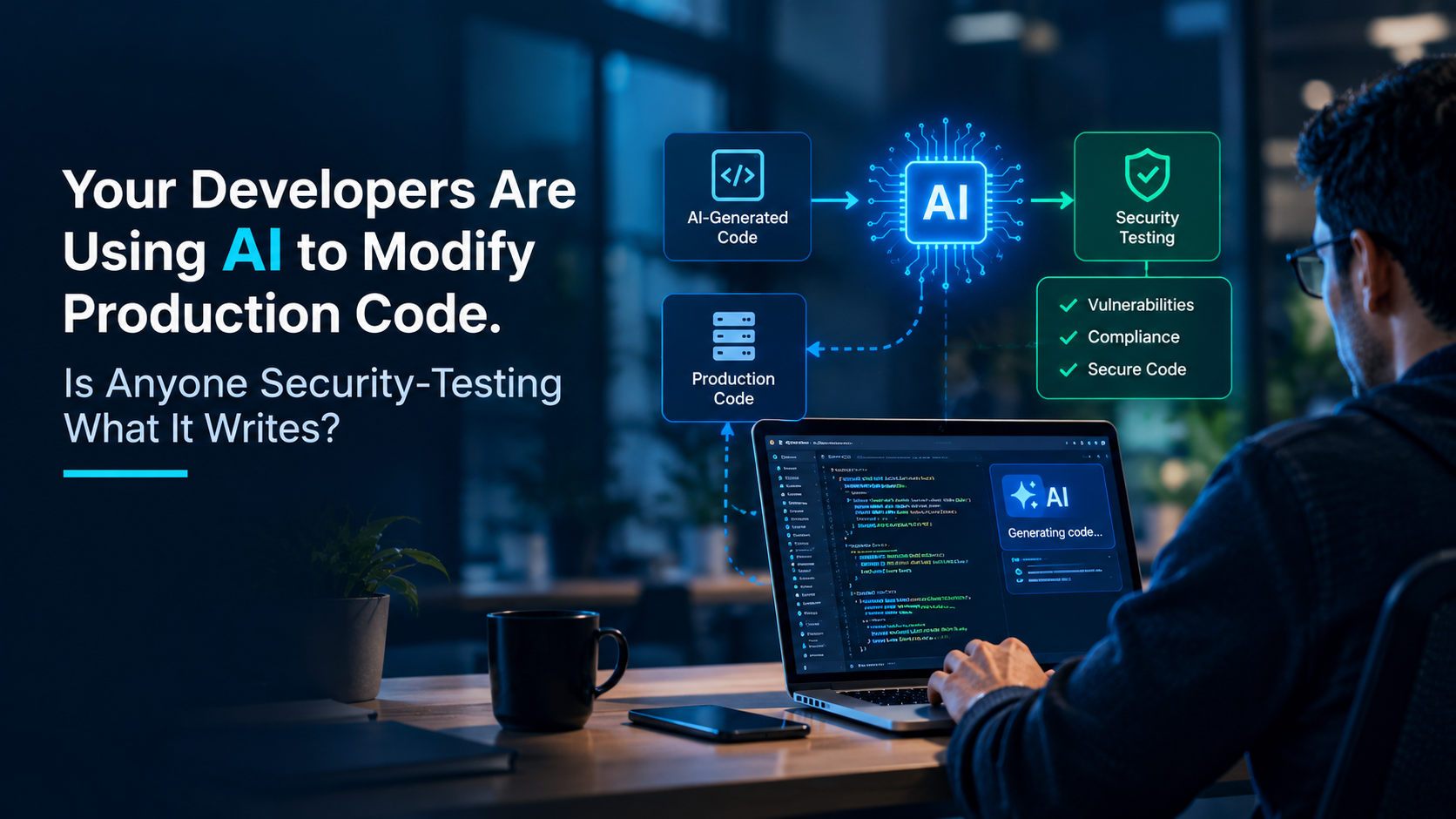
Join Our WhatsApp Channel →The adoption curve for AI coding assistants in software development teams has been steep enough that most security programs haven't caught up with it. A developer who used to write a function manually now describes what they want and accepts what the tool produces. A team that used to review every line of new code now reviews AI-generated code at the same depth they review internally authored code — which often means, in practice, that they review it for whether it does what it's supposed to do, not for whether it introduces something it shouldn't.
That gap has a measurable cost. A 2026 Cloud Security Alliance research note found that 45% of AI-generated code contains security vulnerabilities. Separate analysis of applications built predominantly with AI coding assistance found security issues in 91.5% of tested apps. These aren't hypothetical risks from theoretical edge cases. They're empirical findings from production systems, already deployed, already handling real user data and real business transactions.
The question for security teams is not whether their developers are using AI coding tools — they almost certainly are. The question is whether the security testing program that existed before those tools arrived is adequate for what's being produced now.
What Changes When AI Writes the Code
AI coding assistants are not replacements for developers. They're tools that produce outputs based on pattern recognition across large training datasets — code that looks right, compiles correctly, and often functions as expected. What they're not doing is reasoning about security context.
A developer writing an authentication flow draws on explicit knowledge of what could go wrong: what happens if session tokens are predictable, what the implications of a missing authorization check on a specific endpoint are, how the function interacts with the rest of the access control model. They're bringing security awareness to the design, even if imperfectly.
An AI coding assistant is optimizing for functional correctness. It produces code that accomplishes what was described. Whether that code handles edge cases securely, whether it creates implicit trust relationships that shouldn't exist, whether it exposes data through an API response that should be filtered — these are questions that aren't part of the optimization process unless the developer explicitly asks them.
The result is code that passes functional review and fails security review. And in teams where AI-generated code has become the norm, the security review step is frequently the one that hasn't been adequately adjusted to match.
The Production Code Problem Is More Specific Than It Sounds
Discussing AI-generated code security in the abstract understates where the real risk lives. The higher-risk scenarios aren't new features written from scratch by an AI assistant — those typically go through some kind of review before deployment. The higher-risk scenarios are modifications to existing production code.
A developer uses an AI assistant to fix a bug in an authentication module. The fix works. The bug is gone. What the AI also introduced was a subtle logic change in the session validation path that, under specific conditions, allows a session token to be accepted beyond its intended expiry window. The change wasn't visible in the bug fix — it was a consequence of how the model rewrote the surrounding logic to make the fix work.
A developer uses an AI assistant to refactor a billing function for readability. The refactored code is cleaner. It also removed a conditional check that was enforcing a billing tier restriction. The check wasn't labeled as a security control — it was unlabeled business logic. The AI didn't know it was important.
A developer uses an AI assistant to add a new API endpoint. The endpoint does what it's supposed to do. It also doesn't enforce the authorization checks that every other endpoint in the application applies, because the model didn't have context about the application's authorization architecture when it generated the endpoint.
These aren't exotic scenarios. They're the ordinary consequences of applying a pattern-matching tool to code whose security properties depend on context the tool doesn't have.
Why Standard Review Processes Don't Catch This
Most development teams have code review processes. Most development teams doing modern application development also have some automated security scanning — SAST tools, dependency checkers, security-focused linters. These are valuable. They're also not sufficient for the specific failure modes AI-generated code introduces.
Static analysis tools catch known-bad patterns: SQL injection constructs, hardcoded credentials, known insecure function calls. What they don't catch is logic that is syntactically correct but functionally wrong from a security perspective. A session validation function that accepts expired tokens doesn't look broken to a static analyzer — it's valid code that happens to have insecure behavior under specific conditions.
Code review catches what reviewers are looking for. When a change is framed as a bug fix, reviewers evaluate whether it fixes the bug. They're rarely applying a fresh security review to the entirety of the surrounding code that the AI modified to make the fix work. That surrounding code looked fine before the change — nobody reads it as new code that needs security scrutiny, because it isn't labeled as new code.
The review process that works for human-authored modifications doesn't map cleanly onto AI-assisted modifications, because the scope of what changed isn't always obvious from the diff. An AI assistant asked to fix three lines of code may have rewritten thirty in the process of producing a coherent output.
What Adjusted Security Testing Looks Like
The adjustment isn't rebuilding the security program — it's extending it to address what AI-assisted development actually produces.
1. Treat AI-modified code as new code for security review purposes. A diff that shows twenty lines changed should be reviewed with the same scrutiny as twenty lines of newly written code, regardless of whether the change was fixing a bug or adding a feature. The fact that the surrounding code existed before the change doesn't mean it hasn't changed in ways that matter.
2. Apply security testing to logic, not just syntax. Behavioral testing of authentication and authorization flows — verifying that access controls behave correctly under edge cases, that session handling enforces the intended restrictions, that API responses filter the data they should — catches the class of vulnerability that AI-generated code most reliably introduces and that static analysis most reliably misses.
3. Establish security review gates for high-sensitivity code categories. Not all AI-assisted changes carry equal risk. Authentication logic, authorization checks, billing calculations, data handling functions, and compliance-relevant code represent the areas where a logic error introduced by an AI assistant has the highest potential impact. These categories warrant explicit security sign-off before deployment, separate from the functional review.
4. Test AI-assisted features against the application's authorization model. New endpoints and functions generated by AI assistants need to be tested against the access control model as a whole — not just whether they perform their intended function, but whether they enforce the same authorization requirements as the rest of the application. Authorization testing with multiple account contexts, verifying that the new code can't be used by roles that shouldn't have access to it, is the check that catches the endpoint-without-authorization-checks failure mode before it ships.
5. Include AI-generated code in application security assessments. An application security assessment or VAPT engagement that was scoped before the team adopted AI coding tools is testing a different codebase than what now exists. The assessment scope should account for the fact that significant portions of production code may have been generated or substantially modified by AI tools — and that the security properties of that code warrant fresh evaluation, not reliance on assessments that predate it.
The Security Debt Is Already Accumulating
The organizations adapting to this change are moving faster than the security programs designed to oversee them. Development teams using AI coding assistants are shipping features and fixes at a rate that existing review processes weren't built to match. The code is in production. The testing designed for a different development model is trailing behind.
The research findings — nearly half of AI-generated code containing vulnerabilities, 91.5% of AI-assisted applications showing security issues — represent what happens when adoption outpaces assessment. They're not an indictment of AI coding tools. They're a description of the current gap between what's being used and what's being tested.
Closing that gap doesn't require slowing development. It requires testing programs that have caught up to what development now looks like.