Systematic vulnerability assessment and exploitation testing for your AI applications, APIs, and infrastructure — before attackers find the gaps first.
AI applications introduce a layered attack surface — the model itself, the APIs that serve it, the data pipelines feeding it, and the infrastructure hosting it. AI Penetration Testing (AI VAPT) from ILLUME Intelligence delivers a structured, evidence-based assessment across every one of these layers. Unlike open-ended adversarial red teaming, AI VAPT follows a defined methodology to systematically identify, verify, and exploit vulnerabilities — from insecure API endpoints and misconfigured model-serving environments to authentication flaws around AI features. You get a comprehensive vulnerability inventory, validated through real exploitation, so your team knows exactly what to fix and in what order.
What's Covered Under This Service
AI VAPT examines the full technical stack surrounding your AI systems, not just the model in isolation:
* API & Endpoint Security — Testing authentication, authorization, rate limiting, and input validation on APIs that expose model functionality.
* Model Serving Infrastructure — Assessing configurations of model-hosting environments, inference servers, and containerized deployments for misconfigurations and exposure.
* RAG Pipeline & Vector Database Security — Identifying vulnerabilities in retrieval-augmented generation setups, including unauthorized access to vector stores and embedding leakage.
* Authentication & Access Control — Verifying that AI features respect user roles, permissions, and tenant isolation, particularly in multi-tenant SaaS AI products.
* Data Storage & Transmission — Reviewing how training data, embeddings, and conversation logs are stored, encrypted, and transmitted.
* Third-Party & Plugin Integrations — Testing connectors, plugins, and tool integrations that extend AI functionality for injection, privilege escalation, and data exposure risks.
* Output Handling Vulnerabilities — Assessing whether AI-generated output is properly sanitized before being rendered, executed, or passed downstream (e.g., insecure output leading to XSS or command injection).
How ILLUME's AI VAPT Works
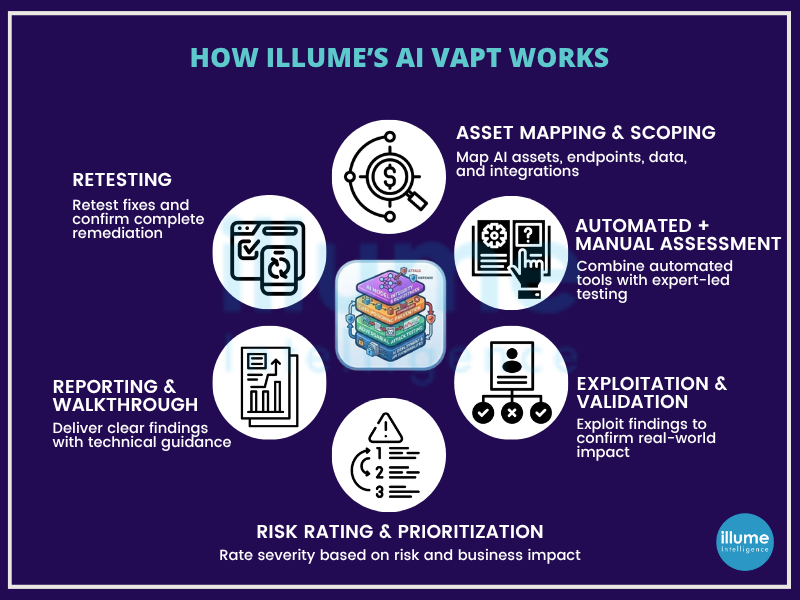
Our process follows a structured, phase-based methodology designed for repeatability and audit-readiness:
1. Asset Mapping & Scoping — We identify every component in your AI stack — APIs, model endpoints, data stores, integrations — and define testing boundaries with your team.
2. Automated & Manual Vulnerability Assessment — We combine tooling with manual technique to identify vulnerabilities across the AI application layer, going beyond what scanners alone can catch.
3. Exploitation & Validation — Identified vulnerabilities are manually exploited in a controlled manner to confirm real-world impact and eliminate false positives.
4. Risk Rating & Prioritization — Each finding is scored using CVSS-aligned severity ratings combined with business-context impact analysis.
5. Reporting & Walkthrough — We deliver a detailed report and walk your technical team through every finding, ensuring nothing gets lost in translation.
6. Retesting — Once fixes are deployed, we retest to confirm vulnerabilities are fully remediated.
What's Offered Under AI VAPT Service
* Black-box, grey-box, and white-box AI VAPT engagements
* API and endpoint-focused testing for AI-powered applications
* Infrastructure and model-serving environment assessments
* RAG pipeline and vector database security testing
* Multi-tenant AI SaaS access control testing
* Compliance-aligned reporting for audit and regulatory purposes
* Periodic and retainer-based testing for continuously evolving AI products
How Illume's Service Is Different
* Full-stack coverage, not just the model. Many providers test the LLM in isolation and stop there. We assess the entire AI application ecosystem — APIs, infrastructure, data layers, and integrations — because that's where most real-world breaches actually occur.
* Validated exploitation, not just scan results. Every vulnerability we report has been manually verified through controlled exploitation, so your team isn't chasing false positives or theoretical risks.
* Methodology built on established AppSec rigor. Our AI VAPT process extends proven penetration testing frameworks into the AI context, giving you assessments grounded in mature, audit-recognized practice rather than experimental approaches.
What You Will Receive
* A comprehensive vulnerability assessment report with CVSS-aligned severity ratings
* Proof-of-concept evidence for each validated finding
* A prioritized remediation roadmap for engineering teams
* An executive summary for leadership and stakeholders
* Compliance-mapped documentation (ISO 27001, SOC 2, GDPR-relevant findings where applicable)
* A retest report confirming closure of identified vulnerabilities
Why AI VAPT Matters Now
As AI features move from experimental to production-critical, the infrastructure supporting them becomes a high-value target. A single misconfigured API endpoint or an exposed vector database can leak proprietary data or customer information at scale. Enterprise buyers and compliance auditors are increasingly requiring documented AI VAPT reports before approving vendor AI integrations — making this a practical prerequisite for enterprise sales and regulatory readiness, not just a security best practice.