Regulators are catching up to AI faster than most boardrooms expected. Get ahead of the EU AI Act, ISO 42001, and NIST AI RMF before they get ahead of you.
The rules governing AI are no longer theoretical. The EU AI Act is now enforceable, ISO/IEC 42001 has become the reference standard for AI management systems, and regulators across sectors are asking hard questions about how organizations govern the AI they deploy.
ILLUME's AI Compliance & Governance service helps you build a defensible, audit-ready AI governance framework — not a slide deck that sits in a drawer. We assess your current AI usage against relevant regulatory and industry frameworks, close the gaps that matter, and give your leadership team a governance structure that holds up under real scrutiny, from customers, auditors, and regulators alike.
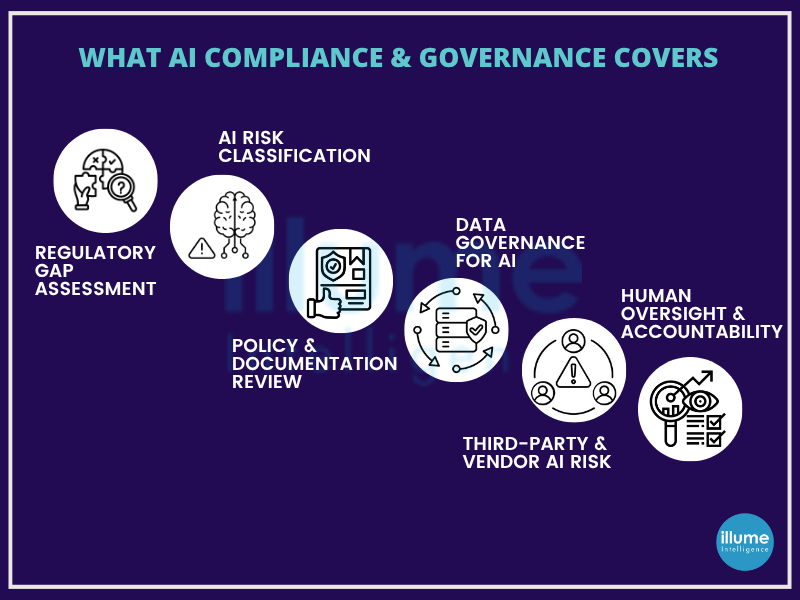
What AI Compliance & Governance Covers
Governance isn't a single document — it's a system. Our assessments span the areas regulators and auditors actually examine:
* Regulatory Gap Assessment — Benchmarking your AI systems against the EU AI Act, ISO/IEC 42001, NIST AI RMF, and sector-specific regulations relevant to your industry.
* AI Risk Classification — Categorizing your AI use cases by risk tier (as required under frameworks like the EU AI Act) to determine which obligations actually apply to you.
* Policy & Documentation Review — Evaluating existing AI policies, model cards, data governance documentation, and usage guidelines for completeness and audit readiness.
* Data Governance for AI — Assessing how training data, personal data, and third-party data used in AI systems are sourced, consented, and protected.
* Third-Party & Vendor AI Risk — Reviewing the AI tools and vendors your organization relies on for compliance gaps you may be inheriting unknowingly.
* Human Oversight & Accountability Structures — Confirming your organization has documented accountability, escalation paths, and human-in-the-loop controls where regulations require them.
How ILLUME Approaches AI Governance Assessments
Compliance work only has value if it produces something your organization can actually defend. Our process is built around that outcome.
1. Discovery & AI Inventory — We map every AI system in use across your organization, including shadow AI tools teams may have adopted without formal sign-off.
2. Framework Mapping — Each AI use case is assessed against the specific regulations and standards that apply to it — not a generic, one-size-fits-all checklist.
3. Gap Analysis — We identify precisely where your current policies, documentation, and controls fall short of what's required.
4. Governance Roadmap — You receive a prioritized action plan, sequenced by regulatory deadline and business risk, not just theoretical best practice.
5. Documentation Support — We help draft or refine the policies, risk assessments, and model documentation your governance framework requires.
6. Ongoing Advisory — As regulations evolve, we keep your governance framework current, rather than leaving you to track amendments alone.
What's Offered Under AI Compliance & Governance
* EU AI Act readiness assessments and risk classification
* ISO/IEC 42001 gap analysis and certification support
* NIST AI RMF alignment reviews
* AI vendor and third-party risk assessments
* AI policy drafting and documentation support
* Board and leadership-level AI governance briefings
* Ongoing regulatory monitoring and advisory retainers
Where Governance Meets Security
Compliance and technical security aren't separate conversations — they inform each other. Findings from our AI Red Teaming and AI VAPT engagements often surface directly in governance documentation, giving you evidence-backed risk assessments instead of assumptions. Clients frequently pair this service with our technical AI security offerings to build a governance framework that's grounded in tested reality, not just policy language.
Why ILLUME's AI Governance Work Holds Up Under Scrutiny
* Built by people who understand both law and systems. Our team combines regulatory fluency with technical understanding of how AI systems actually work — so rcommendations are grounded in reality, not generic legal language repurposed for AI.
* Evidence-based, not template-based. We don't hand you a boilerplate policy pack. Every recommendation is tied to your specific AI inventory, use cases, and risk profile.
* Built for audits, not just internal review. Documentation is structured the way auditors and regulators actually expect to see it, reducing friction when scrutiny arrives.
What You Will Receive
* A complete AI inventory and risk classification report
* A regulatory gap analysis mapped to applicable frameworks
* A prioritized governance roadmap with clear ownership and timelines
* Draft or refined AI policy and governance documentation
* An executive/board-ready summary of your AI compliance posture
* Ongoing advisory access as regulations evolve
Why This Matters Now
AI governance has moved from "good practice" to "regulatory requirement" faster than almost any compliance domain in recent memory. Non-compliance under the EU AI Act carries penalties that rival GDPR. Enterprise customers are adding AI governance questions to vendor security questionnaires. Cyber insurers are beginning to ask about it. Organizations that build governance structures now, proactively, avoid the far more expensive scramble that comes with reacting to an audit finding, a regulatory inquiry, or a lost enterprise deal.