TheDPDPAct.com -
Official WhatsApp Channel
Stay updated with the latest DPDP Act news, compliance insights, updates, and resources.
Join Our WhatsApp Channel →Most conversations about protecting AI models from extraction focus on what happens at the API layer — restricting outputs, rate limiting, monitoring query patterns. Those controls matter. But they share a common characteristic: they're all trying to secure a model after it's been built, at the point where someone is already interacting with it.
There's an earlier question worth asking. Can a model be designed, from the ground up, so that extraction is harder by the time it reaches the API — not just because of the controls surrounding it, but because of how it was built?
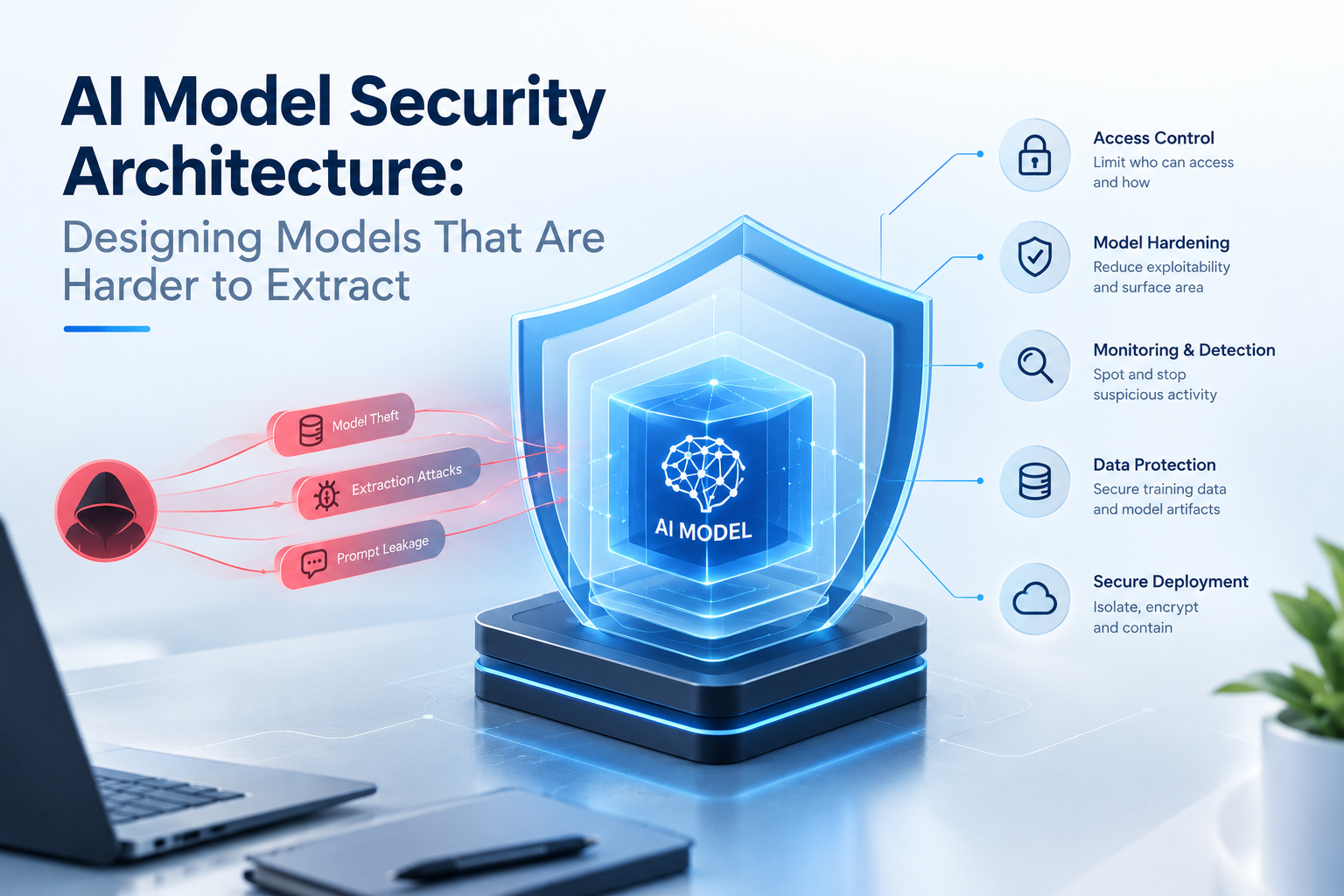
The answer is yes, and the discipline of AI model security architecture is where that question lives. This piece covers the key design decisions that make a model structurally harder to extract — written for security leaders evaluating how their organization's AI systems are being built, not just how they're being protected.
Why Architecture Matters Alongside API Controls
API controls raise the cost of extraction by limiting what an attacker learns per query. A model that returns hard labels instead of confidence scores forces more queries to extract the same information. Rate limiting forces the campaign to run slower. Behavioral monitoring creates detection risk.
But all of these controls work on the assumption that the model itself is fully extractable if an attacker has enough queries and enough patience. Architectural security changes that assumption — it makes the model less extractable not because the API is restrictive, but because the model's internal structure doesn't yield its full knowledge to systematic observation.
These aren't either/or approaches. The strongest AI security programs layer both, accepting that neither alone is sufficient against a determined, informed attacker.
Decision 1: How Much the Model Memorizes
The most fundamental architectural security decision is how much individual training data a model is allowed to encode. Models that strongly memorize specific training examples are vulnerable not just to extraction attacks — which try to clone the model's behavior — but to training data leakage attacks, which try to pull out actual data the model was trained on. The two risks are related: a model that memorizes deeply is easier to extract and more likely to reproduce sensitive training content when probed the right way.
The training-time approach to this is called differential privacy. Rather than hoping a model won't memorize individual training examples, differential privacy formally bounds how much any single example can influence the model's behavior — adding calibrated noise during training to ensure the model's outputs look essentially the same whether or not any particular record was in the training set.
The honest trade-off is worth naming upfront: stronger privacy guarantees come with some reduction in model accuracy. The right balance depends on how sensitive the training data is and how much accuracy the application can tolerate losing. But for any model trained on personal data — customer records, health information, financial data — differential privacy is the closest thing this field has to a formal guarantee that the model won't leak what it learned.
Decision 2: How Knowledge Is Distributed Across the Model
A conventional model encodes everything it's learned into a single set of parameters. That architecture is convenient for training and inference, but it also means that systematic extraction — querying the model across a wide range of inputs and observing the pattern of responses — can progressively map out the entire decision surface from a single API.
The architectural alternative is ensemble design: instead of one model trained on everything, multiple models trained on overlapping subsets of the data, combined at inference time. An attacker querying the ensemble is observing the combined output of several models, no one of which encodes the complete knowledge they're trying to reconstruct. The extraction campaign is now trying to approximate an ensemble from the outside — a harder problem that requires more queries and produces a less faithful copy.
This isn't a new idea in machine learning — ensembles have been used for accuracy and robustness for years. What's relatively newer is the explicit application of ensemble design as an extraction defense, recognizing that knowledge distribution across multiple components makes the model's full behavior harder to reconstruct from API observations alone.
Decision 3: How Outputs Are Shaped at Inference
Even with a well-designed model, what the API returns per query determines how much information each observation gives an attacker. This is the bridge between architectural design and API-layer security — a decision that should be made during design, but operates at inference time.
Two choices matter most here. The first is output granularity: returning a final answer or a small set of top answers, rather than full probability distributions across every possible output. Full probability distributions are genuinely useful to some applications, but they're also genuinely useful to someone trying to map a model's decision boundaries — they tell the attacker not just what the model thinks the answer is, but how confident it is and how close the alternatives were. Where the application doesn't require this richness, not exposing it is a straightforward architectural decision that meaningfully raises extraction cost.
The second is reasoning trace exposure. As AI systems increasingly expose their step-by-step reasoning as a feature, those traces reveal significantly more about how the model arrives at conclusions than the final output alone. From an extraction perspective, reasoning traces are essentially a running commentary on the decision process an attacker is trying to reconstruct. Restricting or abstracting these traces for external API consumers — while preserving full access internally where it's needed — is a design decision that often has a larger security impact than it receives credit for.
Decision 4: Adaptive Noise at the Output Layer
Output perturbation — adding noise to model responses to degrade the quality of information an attacker can extract per query — has been discussed in this series before. What belongs in an architecture discussion is the distinction between perturbation done uniformly and perturbation done adaptively.
Uniform perturbation applies the same noise to every response. It's relatively easy to partially defeat: an attacker who sends the same query many times and averages the responses gets a cleaner signal than any individual response provides.
Adaptive perturbation applies stronger noise specifically to queries that look like they're probing the model's behavior systematically — queries near decision boundaries, queries varying inputs methodically, queries that look different from what legitimate users generate. For ordinary queries from ordinary users, the output is essentially unmodified. For queries that look like part of an extraction campaign, the noise degrades the information value in ways that are harder to average away, because the noise is correlated with the attack behavior rather than random.
Building this into the model's inference architecture — rather than as a post-hoc API gateway addition — means it's applied consistently regardless of which interface or integration the query arrives through.
Decision 5: Watermarking as the Evidentiary Backstop
Watermarking doesn't prevent extraction. It ensures that if extraction succeeds, the original model owner can prove it.
The mechanism involves embedding verifiable signals into the model's behavior — signals that persist through the distillation process an attacker would use to train a surrogate. If a suspiciously similar model later appears, querying it with specific inputs can reveal whether it produces the watermark responses that only a model derived from the original would generate. More recent watermarking approaches use multiple independent signals rather than a single trigger, making removal attacks that need to target all signals simultaneously considerably harder and more likely to leave detectable traces.
Watermarking belongs in an architecture discussion because, like the other decisions above, it needs to be built in during model development — not added after a suspected theft has already occurred. A model that hasn't been watermarked can't retroactively have ownership evidence embedded in it. Like a trademark registered before a dispute, a watermark is most valuable when it predates the problem it's used to address.
The Architecture Conversation Most Programs Skip
What unites all five of these decisions is that they're made during design and training — the phase most security programs engage with least. Security reviews tend to happen before deployment (penetration testing, API configuration review) or during deployment (monitoring, incident response). The training pipeline, the model architecture, and the output design decisions made months earlier are often treated as engineering decisions that security has no role in.
That's a gap worth closing. A security architecture review that evaluates how a model was built — what privacy guarantees were applied during training, how knowledge is distributed, what the inference interface exposes by default, whether watermarking has been embedded — is a materially different engagement from one that only looks at the deployment environment. And it's the review that needs to happen before deployment, when the decisions it covers can still be changed without rebuilding from scratch.
At ILLUME Intelligence, AI model security architecture review is part of how we approach pre-deployment AI security assessment — evaluating the model's structural resistance to extraction alongside the API layer that surrounds it. If your organization is building or fine-tuning AI models that will be exposed through a public or partner-facing API, this is the conversation to have before the deployment conversation, not after it. Reach out to Illume to scope a pre-deployment security architecture review for your environment.