TheDPDPAct.com -
Official WhatsApp Channel
Stay updated with the latest DPDP Act news, compliance insights, updates, and resources.
Join Our WhatsApp Channel →In 2021, a team of researchers led by Nicholas Carlini set out to test something unsettling: could a language model be coaxed into repeating, word for word, pieces of the exact text it was trained on? They queried GPT-2 with carefully designed prompts, filtered the outputs, and found the answer was yes. The model reproduced verbatim sequences from its training data — including personally identifiable information, contact details, and passages that never should have resurfaced outside the documents they came from.
That paper, Extracting Training Data from Large Language Models, has become one of the most cited works in AI security for a reason. It proved something security and compliance teams need to sit with: querying a model isn't only a threat to the model's intellectual property. Under the right conditions, it can be a threat to the privacy of the people whose data trained it — and that data was never supposed to leave the building in the first place.
Two Different Attacks, One Underlying Problem
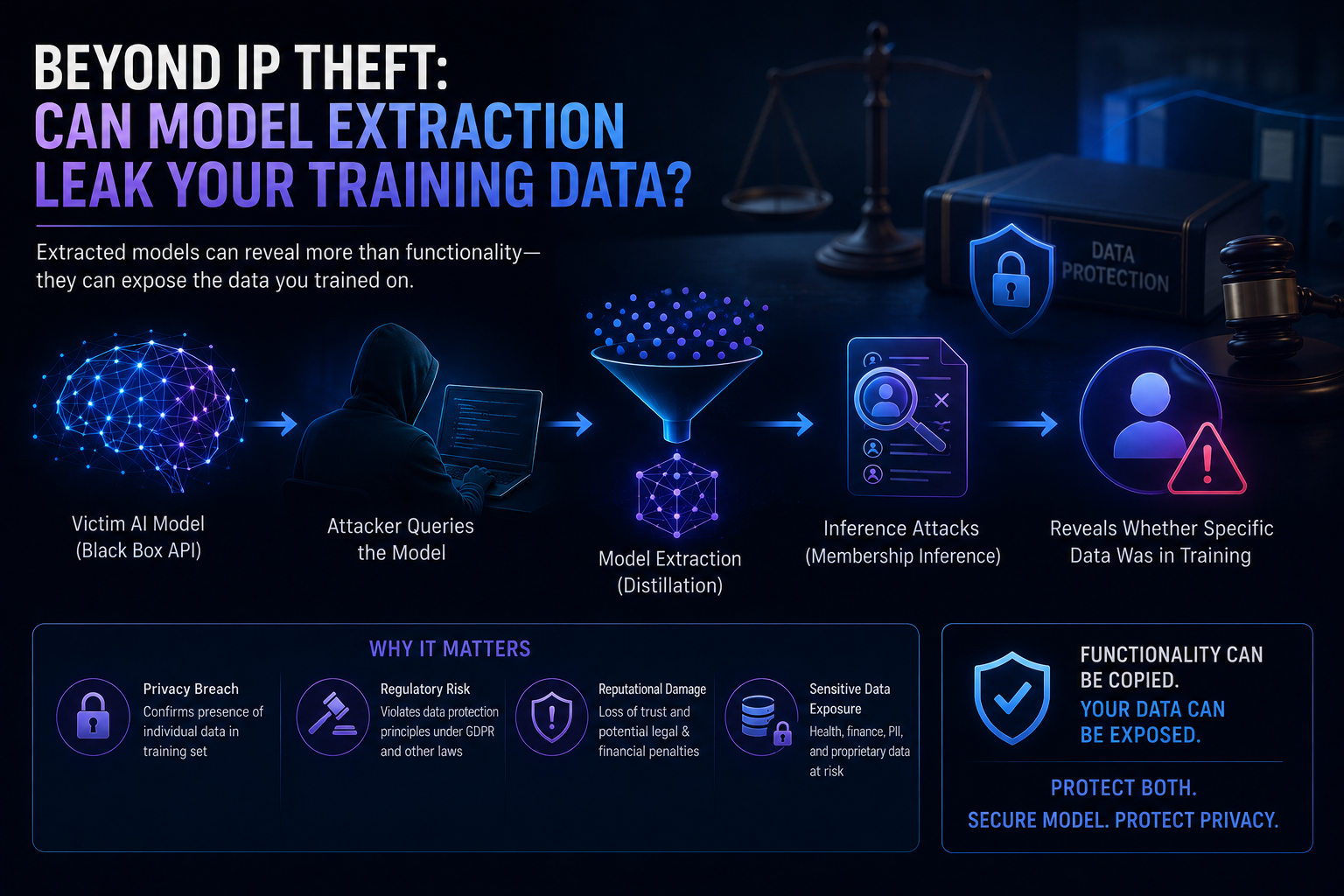
Everything discussed earlier in this series — surrogate models, cloned behavior, competitive risk — falls under the umbrella of model extraction. But there's a distinct, related family of attacks that targets something different: not what your model can do, but what it remembers.
Membership inference attacks ask a narrower, more surgical question: was this specific data point in the training set? First formalized in a landmark 2017 paper by Shokri, Stronati, Song, and Shmatikov, the technique exploits a simple pattern — machine learning models tend to behave subtly differently on data they were trained on versus data they've never seen. An attacker who can detect that difference doesn't need to see the training data directly. They only need to determine, with reasonable confidence, that a specific record — a person's medical file, a company's proprietary document, a private email — was part of what your model learned from.
Training data extraction attacks go a step further. Rather than asking "was this in the training set," they attempt to reconstruct the training content itself. Carlini's GPT-2 study is the clearest demonstration: the same underlying vulnerability — memorization — that allows a model to reproduce a well-known quote can also let it reproduce something that was never meant to be quoted at all. Follow-up research in 2023 demonstrated that this isn't a GPT-2-specific quirk that later models outgrew — researchers showed scalable extraction of memorized training data from production-grade language models still in active commercial use.
Both attacks tend to succeed for the same underlying reason: memorization. Models — especially ones trained on data that appears rarely or uniquely in the training set — sometimes don't generalize away specific examples the way we'd like them to. They keep a trace. And a well-designed query can sometimes pull that trace back out.
Why This Belongs on Your Compliance Radar, Not Just Your Security One
It's easy to file "AI attacks" under the security team's remit and move on. This particular risk doesn't sit neatly there. If a membership inference or extraction attack succeeds against a model your organization trained or fine-tuned, the consequence isn't just a technical vulnerability report — it can be a data protection incident.
Consider what a successful attack actually reveals:
* Confirmation that specific personal data was used in training — which, if that use wasn't properly disclosed or consented to, is itself a compliance gap now made externally provable
* Reconstruction of the underlying content — a customer record, a piece of correspondence, a health-related detail — surfacing in a context and to an audience it was never intended for
* Exposure of proprietary or confidential business data that was used to fine-tune a model, even if no individual's personal data was involved
Data protection regulators have started grappling directly with what this means for AI systems. Discussions around GDPR's Article 17 "right to be forgotten" have made clear that European data protection authorities generally take the position that if a trained model can be shown to store or reproduce personal information, that model falls within the scope of erasure obligations — not just the original database it was trained from. That's a meaningfully different compliance posture than most organizations assumed when they first started fine-tuning models on customer or operational data: the model itself, not just the data warehouse behind it, is now a place personal data can legally be said to "live."
The Uncomfortable Technical Reality: You Can't Just Delete It
Here's where this gets genuinely difficult, and where security and legal teams need to be aligned early rather than finding this out mid-regulatory-inquiry.
If a customer exercises their right to erasure, deleting their record from your database is straightforward. Deleting the influence of that record from a model you already trained on it is not. Personal data doesn't sit in a model the way it sits in a spreadsheet — it's diffused across millions or billions of parameters, entangled with everything else the model learned. Full retraining without the offending data is the only guaranteed fix, and for any model of meaningful size, that's an expensive, slow, and sometimes repeatedly-necessary process if erasure requests keep arriving.
This gap has given rise to an entire emerging research field called machine unlearning — techniques designed to approximate the effect of retraining without a model without actually having to retrain it from scratch. It's a genuinely active and promising area of research. It is not, however, a solved problem. Approximate unlearning methods can leave residual traces of the "forgotten" data behind, and verifying that an unlearning method actually worked — that the model truly no longer retains the influence of the removed data — is itself a hard, unresolved technical question.
The honest position for any organization fine-tuning models on personal or sensitive data today is this: assume that once data goes into training, getting it fully and verifiably out again is expensive, uncertain, and may not be completely achievable with current techniques. That should shape decisions made before training, not just after a deletion request arrives.
What This Means in Practice
This piece isn't meant to argue that every organization fine-tuning a model is sitting on a ticking compliance bomb. It's meant to argue that the risk is real, documented in peer-reviewed research against real production-grade systems, and currently underweighted in most AI governance conversations — which tend to focus heavily on model bias and output safety, and far less on what the model itself might be able to reveal about the data it learned from.
A few practical implications worth sitting with:
* Data minimization before training matters more than most teams realize. The least risky personal data to have extracted from a model is the personal data that was never put into the training set to begin with.
* Rare or unique records are the highest-risk ones. Research consistently shows memorization is worse for content that appears infrequently but distinctively in a training corpus — a single unusual customer complaint is more likely to be memorized verbatim than a common, repeated phrase.
* "We use commercial APIs, not our own models" doesn't fully remove this risk. Fine-tuning a third-party model on your own proprietary or customer data still creates a model that has learned that data, with the same underlying exposure.
* Governance conversations need a technical seat at the table. Whether a "right to be forgotten" request against a trained model is even technically achievable is not a question legal teams can answer alone — it requires people who understand what's actually happening inside the model.
The Model Remembers, Even When You'd Rather It Didn't
There's a particular kind of discomfort in realizing that the thing you built to be helpful might also be quietly keeping receipts. A model doesn't set out to memorize a customer's private complaint or a patient's unusual case note — it's simply doing what it was trained to do, finding patterns and holding onto the ones that stood out. The trouble is, "stood out" and "sensitive" are often the same data point wearing two different hats.
That's the part of this risk that doesn't show up on a typical security dashboard. A firewall can't tell you whether your model has secretly memorized something it shouldn't have. A penetration test built for web applications was never designed to ask that question in the first place. And by the time a regulator or a curious researcher asks it for you, the honest answer — "we're not sure, and finding out now means retraining" — is not the answer anyone wants to be giving.
The reassuring part is that this is a knowable risk, not an unknowable one. It can be tested for, deliberately and safely, before it becomes someone else's discovery. Whether that testing ever happens, though, tends to come down to a much simpler question than any of the technical ones in this piece: does anyone in the room own this risk yet, or is it still everyone's problem and no one's task?