TheDPDPAct.com -
Official WhatsApp Channel
Stay updated with the latest DPDP Act news, compliance insights, updates, and resources.
Join Our WhatsApp Channel →Most Indian businesses have done the hard work of going digital. The app is built, tested, and in the store. The website is live. The cloud infrastructure is running. The CRM is loaded with customer data. The analytics stack is tracking every click.
What most of them have not done is ask the next question — the one that now carries a penalty of up to INR 250 crore per violation.
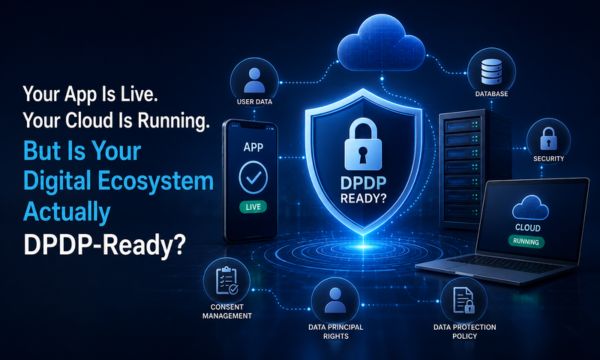
Is the digital ecosystem that powers your business actually compliant with India's Digital Personal Data Protection Act?
Not the policy document. Not the privacy page buried in your footer. The actual infrastructure — the app, the website, the cloud, the tools, and the people managing all of it. Because under the DPDP Rules notified on November 13, 2025, compliance is not a legal exercise. It is an engineering and governance reality that must live inside every layer of your digital stack.
The Data Protection Board is operational. The penalty framework — up to INR 250 crore per violation — is legally enforceable today. Full substantive enforcement begins May 13, 2027, with IT Secretary S. Krishnan confirming there will be no grace period after that date.
Your App: Built for Users, Not for DPDP
India has over 700 million smartphone users. Every app collecting any form of personal data — a phone number, a name, a device identifier, a location — is a Data Fiduciary under the Act. No revenue threshold. No minimum user count. A 500-user app carries the same legal obligations as a platform serving 50 million.
The consent architecture most Indian apps use today is already non-compliant. The classic one-click "Accept Terms" that bundles data collection, marketing permissions, and third-party sharing into a single toggle does not meet the DPDP standard. Consent must be free, specific, informed, unconditional, and unambiguous. Each distinct processing purpose requires its own independently withdrawable consent. If your app uses data for service delivery, push notifications, analytics, and personalisation — those are four separate consents, each requiring its own UI, its own audit trail, and its own withdrawal mechanism.
The language requirement compounds this. Consent notices must be accessible in English plus the official Indian languages substantially used by your user base. For apps with pan-India reach, this is not a translation task. It is a product infrastructure project.
Children's data carries the most stringent obligations in the Act. Anyone under 18 requires verifiable parental consent — self-declared age is explicitly insufficient. Behavioural tracking, targeted advertising, and profiling of minors are expressly banned.
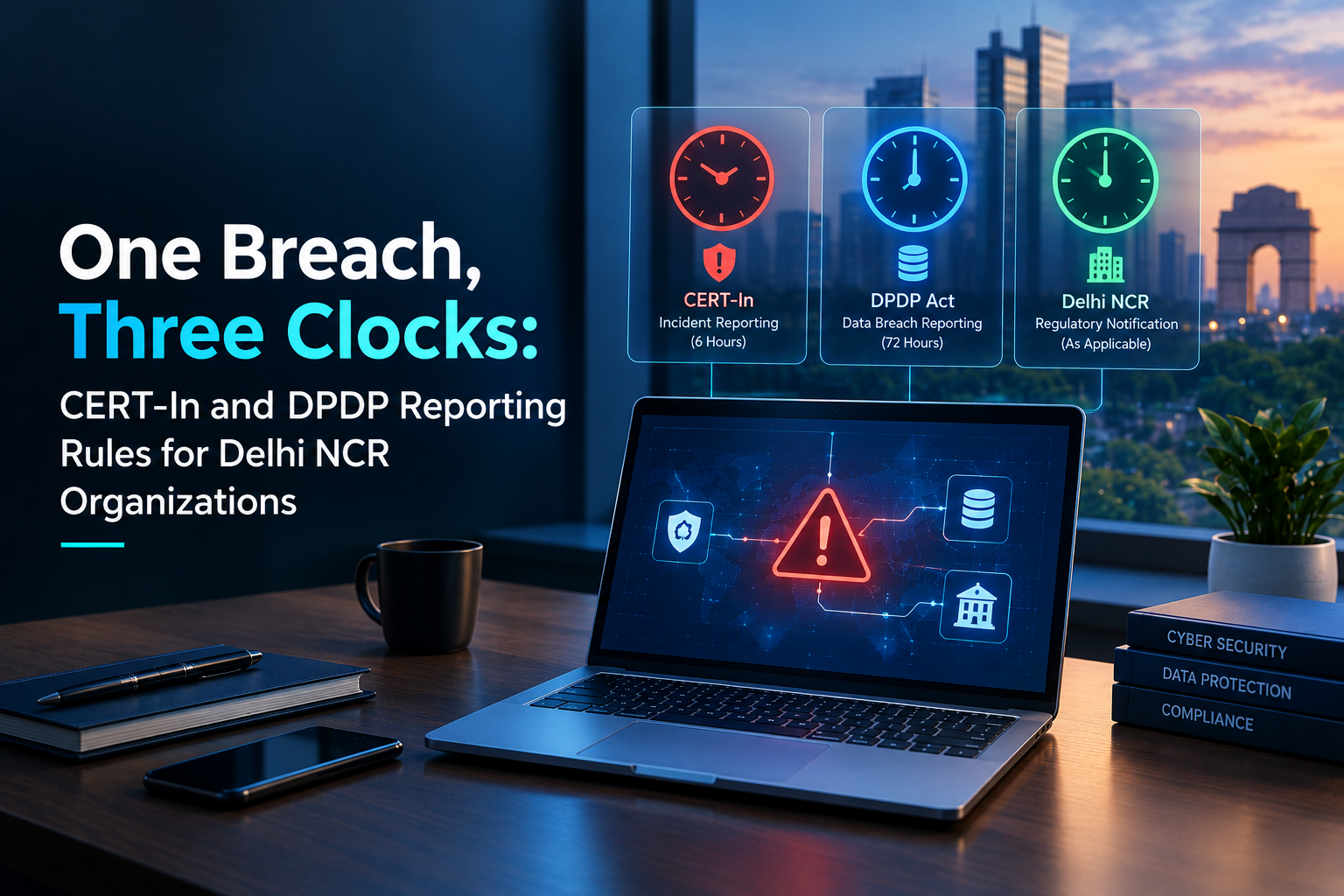
When a breach occurs, two regulatory clocks run simultaneously — a 72-hour notification to the Data Protection Board and a separate 6-hour CERT-In incident reporting requirement. They are parallel obligations, not alternatives. Most incident response playbooks in India are built for one. They need to be rebuilt for both.
The 7-day erasure window is the sharpest operational challenge of all. Most app backends have personal data scattered across production databases, backups, analytics systems, data warehouses, and third-party integrations. Honouring a deletion request across all of these within seven days requires deliberate engineering — not manual effort.
When enforcement lands in May 2027, three sectors face the steepest exposure. Fintech platforms risk double penalties — the same violation can simultaneously breach DPDP and RBI's Digital Lending Guidelines. Edtech platforms collecting student data face up to INR 200 crore for children's data violations alone. Gaming platforms, built on behavioural profiling and targeted engagement, must now rebuild their entire data architecture around consent. These are not hypothetical risks. They are the direct consequence of how these products were designed before the DPDP Act existed.
Your Website: More Than a Marketing Channel
Every form, every analytics pixel, every cookie, every lead generation flow on your website is a data collection event. Under the DPDP Act, each one is a potential compliance moment — and most Indian websites are failing several of them simultaneously.
The most visible failure is the privacy notice. The DPDP Rules require standalone, itemised notices at the point of data collection — specifying the exact categories of data being collected, the explicit purpose for each, the rights available to the user, and the mechanism to exercise them. A policy page in a website footer does not satisfy this requirement. A terms and conditions document with privacy clauses embedded inside it does not satisfy this requirement.
Purpose specificity is the other critical gap. Marketing, analytics, service delivery, and personalisation are four distinct processing purposes — each requiring independently manageable consent. Most Indian websites, even those that have added cookie banners, have no backend infrastructure to support this level of granularity.
By November 13, 2026 — the Consent Manager framework comes into force. Registered Consent Managers, India-incorporated entities with a minimum net worth of INR 2 crore, will enable users to manage consents across multiple platforms through a single interoperable interface. Every consumer-facing digital platform must be API-compatible with this framework by that date. That is not a minor update. It is a backend project that requires planning, development, and testing time that most organisations have not yet allocated.
EY India's January 2026 survey found that 80% of organisations have not updated or drafted DPDP-aligned privacy notices. That figure, mapped against live websites, represents an enormous volume of active compliance failures sitting in plain sight today.
Your Cloud: Running Is Not the Same as Compliant
The assumption that cloud compliance is the provider's responsibility is one of the most expensive misconceptions in the current DPDP landscape.
AWS, Azure, and GCP provide the infrastructure. They do not manage your consent flows, your data processing records, your erasure workflows, or your breach notifications. Organisations that attempt DPDP compliance using native cloud monitoring tools alone — AWS Security Hub, Azure Policy, GCP Security Command Center — are producing what security experts have described as compliance theatre, not compliance assurance. The controls must be validated continuously as infrastructure changes, not reviewed periodically through a static dashboard.
Data residency is the dimension most organisations have not operationalised. The DPDP Act permits cross-border data transfer unless the Central Government restricts specific jurisdictions under Section 16. As of July 2026, no restricted-jurisdictions list has been published — but it will be. When it arrives, organisations with personal data in US-region or European cloud tenants will face forced migration under regulatory pressure. Organisations already running on India-region infrastructure — AWS Mumbai, AWS Hyderabad, Azure Central India, Google Cloud Mumbai, or MeitY-empanelled providers — will confirm compliance with a memo.
Data residency is a deployment parameter, not a policy statement. The time to address it is before the list is published, not after.
The security baseline carries its own urgency. Ransomware attacks on Indian organisations increased 53% in 2025 according to CERT-In's Annual Report. The DPDP Act's penalty for failure to implement reasonable security safeguards reaches INR 250 crore — and it can be triggered even without an actual breach. Merely failing to have the required safeguards in place is sufficient for a penalty to apply.
Your Compliance Tools: Useful, But Only If the Foundation Exists
The DPDP compliance software market has matured quickly. Full-stack platforms now cover consent management, Records of Processing Activities, Data Principal Rights workflows, vendor compliance tracking, breach notification automation, and audit-ready reporting. Continuous cloud control monitoring tools flag deviations in real time across AWS, GCP, and Azure. Purpose-built Indian platforms have mapped their features directly to the DPDP Rules 2025.
These tools are genuinely useful. But they carry one critical dependency that vendors do not lead with: you cannot protect what you have not mapped.
Every point where personal data enters your systems — web forms, mobile apps, APIs, CRM tools, HR files, third-party integrations — must be identified and inventoried before a compliance tool can function with any accuracy. EY India found that 77% of organisations cite the inability to implement privacy technology in legacy environments as their biggest barrier. A compliance dashboard deployed over an unmapped data environment is infrastructure without a foundation. The platform cannot report on what it cannot see.
The data inventory is not a feature of any tool. It is a prerequisite for all of them.
Your People: The Gap Nobody Budgeted For
Every layer of your digital ecosystem — the app, the website, the cloud, the compliance tooling — requires people who understand what DPDP demands from each of them. And this is where India faces its most underestimated challenge.
The DPDP Act mandates that Significant Data Fiduciaries appoint a Data Protection Officer who is India-based and reports directly to the Board of Directors. Failure to appoint a DPO where required attracts a penalty of up to INR 150 crore. For all other organisations, a designated grievance officer and Data Principal contact point is still mandatory — making some form of privacy ownership a universal requirement, not a governance option.
The DPO role demands an interdisciplinary profile: legal knowledge, technical systems understanding, compliance management capability, and risk assessment expertise. India's pipeline of professionals who combine all four is thin. The field suffers from a shortage of structured educational pathways, and demand is significantly outpacing supply.
DPO-as-a-Service has emerged as the practical solution for the majority of Indian businesses. It provides the required expertise, the required India presence, and the structural independence the Act demands — without the timeline and cost of building the role from scratch internally. For SMEs and mid-market organisations, it is currently the most viable path.
EY India found that 76% of organisations cite lack of subject-matter expertise as a top barrier to implementation. The tools exist. The legal framework is clear. Without people who understand what the tools need to be configured to do and what the Act actually requires, every investment in compliance infrastructure produces process without protection.
The Timeline Is Tighter Than It Looks
Three dates define the DPDP enforcement landscape:
* November 13, 2025 — The Data Protection Board was constituted. The penalty framework became legally enforceable. Enforcement actions have already begun.
* November 13, 2026 — The Consent Manager framework activates. All consumer-facing platforms must be API-compatible with registered Consent Managers from this date.
* May 13, 2027 — Full substantive enforcement. Every obligation under the Act — consent, rights, security safeguards, breach notification, cross-border transfers, Significant Data Fiduciary duties — becomes fully enforceable.
EY estimates a 12 to 18 month readiness gap for organisations that have already begun. The math for those who have not is straightforward — and it does not favour waiting.
The Question Your Board Needs to Answer
Your app is live. Your cloud is running. Your website is generating leads. Your tools are tracking everything.
But when the Data Protection Board asks whether your digital ecosystem was built with valid consent, whether it can honour a user's right to erasure within seven days, whether your cloud infrastructure meets reasonable security safeguard requirements, and whether you have a qualified person who can answer these questions on behalf of your organisation — what is your answer?
That answer is not a policy document. It is the sum of every architectural decision made across your app, your website, your cloud, your compliance tools, and your team.
DPDP compliance does not begin with a software purchase or a legal retainer. It begins with a data inventory — a systematic understanding of what personal data your organisation holds, where it lives, why it was collected, who can access it, and where it flows. Without that foundation, nothing else in the compliance ecosystem functions as it should.
The digital ecosystem is built. Now it needs to be compliant. And the time to close that gap is not next quarter.
It is now.