TheDPDPAct.com -
Official WhatsApp Channel
Stay updated with the latest DPDP Act news, compliance insights, updates, and resources.
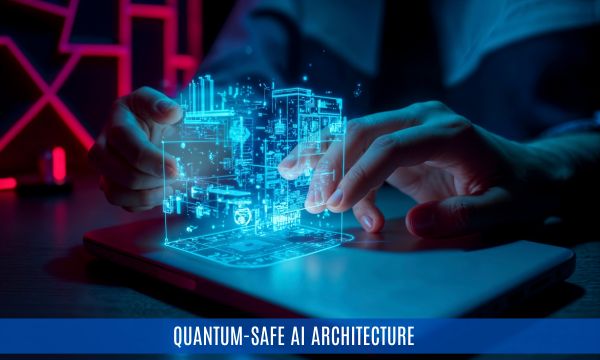
Join Our WhatsApp Channel →Enterprise AI conversations have a quantum problem, but it's not the one most people think they're solving. Walk into any security roadmap meeting today and you'll hear "quantum-safe" used almost interchangeably with "quantum computing readiness," as if the goal is to bolt a quantum processor onto the AI stack. It isn't. Quantum-safe AI architecture is not about replacing AI with quantum computing. It is about making enterprise AI security crypto-agile and future-ready. That distinction matters more than it sounds, and getting it wrong is already costing organizations time, budget, and security posture they can't afford to lose.
The Threat Isn't Hypothetical Anymore
For years, "quantum threat" was a slide in a future-trends deck, comfortably parked a decade out. That comfort is gone. On August 13, 2024, NIST published the first finalized post-quantum cryptography standards after an eight-year, multi-round evaluation involving dozens of algorithm submissions from cryptographers worldwide. FIPS 203 (ML-KEM) now anchors general-purpose encryption and key exchange, FIPS 204 (ML-DSA) anchors digital signatures, and FIPS 205 (SLH-DSA) provides a hash-based fallback in case lattice-based assumptions are ever broken. A fourth standard, FN-DSA, and a fifth algorithm, HQC, are following close behind. The algorithm selection phase is over. What remains is migration, and migration is where most enterprises are dangerously behind.
The urgency isn't only about when a cryptographically relevant quantum computer arrives. It's about "harvest now, decrypt later" — adversaries capturing encrypted traffic and data today, banking on the ability to decrypt it once quantum capability matures. For any enterprise AI system handling long-lived sensitive data — contracts, health records, financial models, proprietary embeddings — that data is being exposed today, even if the decryption key only breaks years from now. Regulatory timelines reflect this seriousness: NSA's CNSA 2.0 mandates ML-KEM-1024 and ML-DSA-87 for national security systems, with new systems required to comply starting in 2025 and legacy systems by 2030–2033. NIST's own transition guidance targets deprecation of RSA and elliptic-curve cryptography for federal use after 2030, with full removal by 2035.
Why "Crypto-Agile" Is the Operative Word
Here's the part the LinkedIn quantum hype cycle tends to skip: nobody actually knows with certainty which algorithms will still be standing in fifteen years. During NIST's own evaluation process, two once-promising candidates — SIKE (isogeny-based) and Rainbow (multivariate) — were cryptanalytically broken before the competition even concluded. Even the current lattice-based standards, while showing no known weaknesses, have had a fraction of the decades of scrutiny that RSA and ECC have endured. That uncertainty is precisely why the architecture matters more than the algorithm. A crypto-agile system is one where cryptographic primitives, key sizes, and signing schemes can be swapped, rotated, or run in hybrid mode without re-architecting the entire platform. Leading national cybersecurity bodies — the UK's NCSC, Germany's BSI, and France's ANSSI — all recommend hybrid deployment as the default transition state: running a classical algorithm and a post-quantum algorithm side by side, so that a flaw in either one alone doesn't compromise the system. For most enterprises, the practical entry point is TLS key exchange combining ML-KEM-768 with X25519, paired with new certificate issuance using ML-DSA-65 — addressing the broadest attack surface first, without forcing a simultaneous full-estate migration.
The Real Challenge: AI Systems Aren't One Thing
This is where enterprise AI complicates an already hard cryptography problem. A modern AI deployment isn't a single model behind an API. It's a chain: identity providers and zero-trust gateways, an AI orchestrator and prompt builder, a RAG pipeline pulling from vector databases and document stores, session and long-term memory layers, agents calling tools through registries and gateways, and a governance layer logging every decision for audit and compliance. Each of those layers touches sensitive data in a different form — raw documents, embeddings, retrieved chunks, prompts, model outputs, audit trails. A quantum-safe strategy that only protects the database and ignores the embeddings store, the agent-to-tool communication, or the audit log has protected one room in a house with twelve doors.
That's why the architecture has to treat cryptographic protection as a fabric that runs underneath every layer, not a feature bolted onto one of them — encryption at rest and in transit, key management and rotation, certificate lifecycle management, TLS/mTLS, and secrets management, all built on a crypto-agile foundation that assumes algorithms will need to change again. Identity and access controls — SSO, MFA, RBAC/ABAC, device trust, session risk scoring — need to verify a request before it ever reaches the AI orchestrator, since a compromised identity layer renders downstream encryption largely irrelevant. And because AI agents increasingly take action on an organization's behalf, tool execution needs policy checks and human approval gates for high-risk actions, with every action logged for audit and compliance evidence.
Prioritization Beats Panic
No enterprise can migrate everything at once, nor should it try. The sensible approach is risk-based: prioritize migration according to data sensitivity, retention period, exposure to harvest-now-decrypt-later risk, and the business impact if that data were exposed years from now. Long-lived data with high sensitivity — intellectual property, regulated personal data, strategic contracts — deserves migration priority over short-lived, low-sensitivity data, even if the latter is technically easier to fix first. This is also where governance and observability earn their keep: continuous monitoring for drift, policy violations, and security events isn't a quantum-specific concern, but it's what makes a crypto-agile architecture verifiably trustworthy rather than theoretically trustworthy.
The Takeaway for Security Leaders
The organizations that get this right won't be the ones who waited for a "quantum-ready AI platform" to buy off the shelf. They'll be the ones who treated cryptographic agility as a design principle from day one — building AI systems where encryption, identity, and policy can evolve as standards evolve, instead of requiring a rebuild every time NIST publishes a new FIPS document. AI makes enterprise systems smarter. Zero trust keeps access controlled. Quantum-safe security, built on crypto-agility rather than a quantum-computing fantasy, is what makes the whole platform durable enough to still be trustworthy a decade from now. That's not a future problem. Given how long sensitive data stays sensitive, it's already a today problem.