TheDPDPAct.com -
Official WhatsApp Channel
Stay updated with the latest DPDP Act news, compliance insights, updates, and resources.
Join Our WhatsApp Channel →India's data protection law is no longer coming. It is here. The DPDP Rules came into force on November 13, 2025, and with the Data Protection Board already operational and penalties reaching up to INR 250 crore per violation, the pressure on Indian businesses to comply has never been greater.
And the market has responded — with a flood of software vendors, each promising that their platform is all your organisation needs to become DPDP compliant.
Before you open your procurement budget, there is one question you need to answer honestly: do you actually know what you are buying?
The Awareness Gap Nobody Is Talking About
The urgency is real and the numbers reflect it. IBM's 2025 Cost of a Data Breach Report found that India recorded an all-time high average breach cost of INR 220 million — up 13% from the previous year. At the same time, a PwC India survey revealed that only 16% of Indian consumers are even aware of their rights under the DPDP Act, and 69% did not know they could withdraw consent over how their data is used.
Low consumer awareness, mounting breach costs, and a looming compliance deadline have created the perfect storm — and vendors have spotted the opportunity.
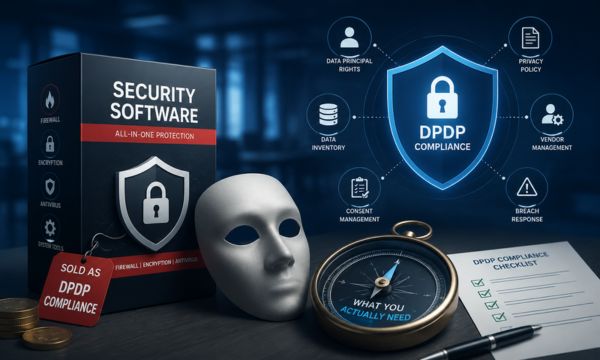
The result is a marketplace where encryption tools, data loss prevention software, and access control systems are being repackaged, relabelled, and sold as DPDP compliance platforms. The branding is new. The product, in most cases, is not.
Security Software Is Not Compliance Software — And the Difference Is Everything
This is the single most critical distinction your business must understand before spending on any DPDP tool.
Security software protects your data from external threats — it keeps attackers out, encrypts files, and monitors for breaches. That matters. But it answers only one question: is your data safe from outsiders?
The DPDP Act asks an entirely different set of questions. Did you have the legal right to collect that data? Did the individual knowingly consent to it? Can they access it, correct it, or demand its deletion? And can you prove all of this to a regulator?
A fully encrypted database with no consent records, no user rights workflow, and no erasure mechanism is completely non-compliant with the DPDP Act — no matter how impenetrable its security. Encryption is not consent management. A firewall is not a compliance program. These are fundamentally different things being sold under the same label.
What the Market Is Actually Selling — Categorised Honestly
Not every vendor is selling mislabelled products. The DPDP software landscape has three distinct categories, and knowing the difference is what separates a smart investment from an expensive mistake.
1. Rebranded Security Tools form the largest and most misleading category. Existing DLP, encryption, IAM, and vulnerability scanning products have been repositioned with DPDP branding. They address cybersecurity — not the legal, consent-based, and rights-based obligations that the Act actually imposes. Treat them as security infrastructure, not compliance solutions.
2. Single-Function Compliance Tools address genuine DPDP obligations but only in isolation. Consent Management Platforms do an effective job of collecting, versioning, and auditing user consent. Data discovery tools help organisations map where personal data lives across their infrastructure — a critical first step. Breach notification systems help trigger regulatory alerts within required timelines. Each serves a real purpose. None of them, standing alone, constitutes compliance.
3. Full-Stack DPDP Platforms are the most capable category available today. Purpose-built platforms cover consent management, Data Principal Rights workflows, Records of Processing Activities, vendor compliance tracking, retention automation, and audit-ready reporting — all in one system. In India, this segment includes platforms like ComplyDP, built ground-up for the DPDP Act, global players like OneTrust and Securiti AI with India-specific modules, and enterprise players like Seqrite approaching compliance from a security-led angle. These come closest to being genuinely useful — but even they have hard limits.
What No Tool Will Ever Do for You
Even the most comprehensive DPDP platform on the market covers only the technical layer of compliance. The Act demands three things simultaneously: the right legal framework, the right technical controls, and the right organisational culture. Software addresses one of those three — and only partially.
What remains firmly in human hands: legal interpretation of the Act's grey areas, drafting privacy notices that genuinely meet regulatory requirements, negotiating vendor contracts and data processing agreements, training employees who handle personal data daily, and coordinating the kind of cross-functional breach response that no dashboard can automate.
For organisations designated as Significant Data Fiduciaries, the obligations go further still — mandatory external audits and Data Protection Impact Assessments must be conducted by qualified professionals. No platform substitutes for that.
Think of a DPDP compliance tool the way you think of accounting software. Tally does not make your business tax compliant — your CA does, using the software as a working tool. A DPDP platform is infrastructure. Without legal counsel, trained teams, and genuine governance processes built on top of it, the software alone leaves your organisation dangerously exposed.
Five Questions to Ask Before You Sign Any Contract
The vendor evaluation process matters as much as the tool itself. Before committing, demand answers to these:
* Can the vendor map each feature directly to a specific section or rule of the DPDP Act 2023 or DPDP Rules 2025?
* Does the platform support multilingual consent notices, which the Rules explicitly require?
* Does it integrate with your existing CRM, HRMS, and cloud systems — or does it create yet another disconnected data silo?
* Is it built for India from the ground up, or is it a GDPR tool with an India module retrofitted later?
* Does the vendor offer implementation and consulting support — or simply hand you a login?
Any vendor who promises complete DPDP compliance without once mentioning legal review, internal policy, or staff training is either uninformed about the law or deliberately overselling their product.
The Bottom Line
India's data protection market was valued at USD 5.34 billion in 2024 and is projected to reach USD 27.77 billion by 2033. The money is moving fast. The tools are multiplying faster. And the enforcement window — May 2027 — is closer than most organisations have planned for.
Businesses that will navigate this successfully are those that treat DPDP compliance as a governance program — one that uses the right software as its operational backbone, pairs it with qualified legal and consulting support, invests in training its people, and embeds privacy into its processes from the ground up.
Those who purchase a rebranded security tool and call it compliance will be the ones explaining themselves to the Data Protection Board when it matters most.
DPDP compliance is not a product you can procure. It is a posture your organisation has to earn — and continuously maintain.