TheDPDPAct.com -
Official WhatsApp Channel
Stay updated with the latest DPDP Act news, compliance insights, updates, and resources.
Join Our WhatsApp Channel →A Cybersecurity Consulting Perspective on Separating Genuine Legal Obligation from Vendor-Driven Urgency
If you've had a reg-tech vendor pitch you on DPDP compliance in the last few months, there's a good chance you've heard some version of this line: "You need to integrate with a Consent Manager to be compliant."
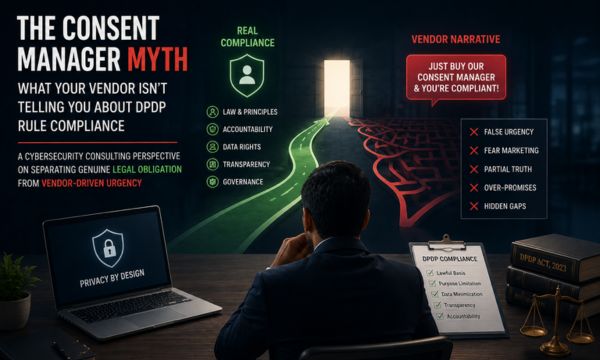
It's one of the most persistent myths in India's privacy and reg-tech market today — and it's incorrect. The Digital Personal Data Protection Rules, 2025 do not require Data Fiduciaries to route consent through a Consent Manager. It is an optional mechanism, not a compliance prerequisite. What the law actually requires is that organizations meet clear standards for notice, consent, withdrawal, logging, and data principal rights — regardless of the specific method or platform used to deliver them.
This distinction matters more than it might appear. Organizations acting on the myth risk signing contracts and building integrations around infrastructure they were never legally required to have, while the requirements that genuinely are mandatory receive less attention than they deserve.
What a Consent Manager Actually Is?
A Consent Manager is a Board-registered intermediary that gives individuals a single, centralized point of control to grant, review, manage, and withdraw consent across multiple Data Fiduciaries. Conceptually, it builds on infrastructure India has already tested at scale: the Account Aggregator framework in financial services, part of the country's broader Data Empowerment and Protection Architecture. This is not an untested idea bolted onto DPDP — it's a proven model being extended into personal data governance more broadly.
The Rules treat this role with appropriate seriousness. Only companies incorporated in India are eligible to register as a Consent Manager, and they must demonstrate sufficient technical, operational, and financial capacity to the Data Protection Board. Once registered, a Consent Manager must retain records of consents, notices, and data-sharing activity for a minimum of seven years, is prohibited from subcontracting its obligations, must avoid conflicts of interest with the Data Fiduciaries it serves, and — critically — cannot read the contents of the personal data passing through it. It also owes a fiduciary duty to the individual, not to the organization paying for the integration.
This is genuine regulatory infrastructure. It is simply not mandatory infrastructure for every organization processing personal data in India.
Where the Myth Comes From
The confusion is understandable, if avoidable. The DPDP Act does introduce the Consent Manager as a formal regulatory construct, and Rule 4 sets out real registration and oversight requirements around it — which can easily read as a broader mandate to anyone skimming the framework rather than the specific obligations within it.
The precision matters here: Rule 4's registration requirements apply to entities that want to operate as a Consent Manager. They do not apply to Data Fiduciaries deciding whether to use one. These are two entirely different populations of organizations, governed by two entirely different sets of obligations — and vendors selling Consent Manager platforms have a natural commercial interest in blurring that line. This is the same dynamic seen across the broader DPDP tooling market, where regulatory complexity creates fertile ground for urgency-driven sales narratives.
What the Rules Actually Require of Data Fiduciaries
Strip away the platform question entirely, and the compliance bar is well-defined. A Data Fiduciary can obtain consent directly — with no Consent Manager involved at all — provided it independently satisfies five core requirements:
* Notice — clear, itemised disclosure at the point of collection, explaining what data is collected and why.
* Consent — specific, informed, and verifiable, tied to a stated purpose rather than a blanket authorization.
* Withdrawal — a mechanism to revoke consent that is genuinely as accessible as the mechanism used to grant it.
* Logging — adequate records of consent given, withdrawn, and notices issued, sufficient to demonstrate compliance if questioned.
* Data principal rights — a functioning process for access, correction, erasure, and grievance redressal.
The law is method-agnostic by design. It cares about verifiable outcomes — transparency, control, accountability — not the specific software architecture an organization chooses to deliver them.
When a Consent Manager Genuinely Makes Sense
None of this makes Consent Managers pointless. For organizations operating at high consent-transaction volume, across multiple platforms, or in sectors already comfortable with the Account Aggregator model — banking, financial services, and insurance in particular — a Consent Manager can meaningfully simplify consent orchestration and improve the individual's experience of managing their own data.
There's also a practical market dynamic worth acknowledging honestly: as Consent Managers become operational, individuals may increasingly expect the convenience of managing consent centrally, creating commercial pressure to integrate even where no legal mandate exists. That's a legitimate business consideration — it simply isn't a compliance one, and the two should not be conflated when making the decision.
The regulatory timeline also gives organizations real room to decide deliberately rather than reactively. Registration obligations for Consent Managers under Rule 4 take effect from November 13, 2026, while the broader consent, notice, and rights obligations for Data Fiduciaries phase in on a schedule culminating around May 2027. This is a multi-year runway, not a rushed deadline.
The Real Risk of Getting This Wrong
The myth is costly in both directions. Organizations that over-invest — locking into a Consent Manager platform under the belief it's legally required — divert budget and attention away from the work that actually determines compliance: building robust notice, logging, and rights-fulfillment processes. Organizations that under-invest, on the other hand, sometimes assume that avoiding a Consent Manager means lighter obligations overall. It doesn't. Choosing to go without one simply means the organization must build and independently demonstrate every one of the five core requirements itself, with no regulated intermediary to lean on.
Get the decision wrong in either direction, and the exposure is the same: a compliance posture built on architecture rather than accountability.
How to Make This Decision Properly
The right starting point is always the same, regardless of which way an organization eventually leans: assess honestly whether the business can independently meet the five core requirements — notice, consent, withdrawal, logging, and rights fulfillment. That assessment is the real compliance baseline, and it has to happen before any platform conversation begins.
From there, Consent Manager adoption becomes a business and user-experience decision, evaluated on its own merits — consent volume, sector expectations, and customer convenience — rather than a regulatory checkbox. And any vendor asserting that Consent Manager integration is "mandatory under DPDP" should be treated as a claim to verify independently, not a fact to act on.
Closing Thought
The Consent Manager is a well-designed, genuinely useful feature of India's emerging privacy architecture. It is not, however, a compliance requirement — and organizations that understand this distinction early will make sharper decisions about where their DPDP investment actually needs to go. The goal isn't to avoid Consent Managers. It's to choose them for the right reason, at the right time, rather than because a sales conversation made it sound unavoidable.