TheDPDPAct.com -
Official WhatsApp Channel
Stay updated with the latest DPDP Act news, compliance insights, updates, and resources.
Join Our WhatsApp Channel →A Cybersecurity Consulting Perspective on the Market's Most Widespread Compliance Misconception
It is one of the most common assumptions we encounter across the market today: that a current ISO 27001 certification automatically means an organization is ready for the Digital Personal Data Protection Act, 2023. It's an understandable assumption — ISO 27001 represents genuine, hard-won security maturity, and it's natural to expect that maturity to carry over into a new compliance framework.
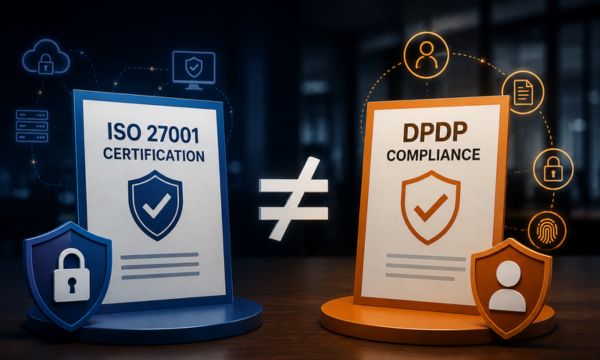
But ISO 27001 and DPDP are answering two fundamentally different questions.
ISO 27001 asks: is this data protected?
DPDP asks: were you legally justified in collecting, using, retaining, and sharing this data in the first place?
An organization can answer the first question perfectly and still fall short on the second — and under the DPDP Rules, 2025, formally notified by the Ministry of Electronics and Information Technology on 14 November 2025, that gap now carries real legal and financial consequences.
Why This Confusion Is So Widespread
This misconception didn't emerge by accident. Across the compliance market, ISO renewal audits are routinely bundled and marketed as "DPDP readiness" — a convenient narrative for vendors, but a costly one for the organizations that rely on it.
There's also a more legitimate version of the confusion. Many Indian companies already comply with GDPR or hold ISO 27701 certification, and leadership reasonably asks: if we're already GDPR-compliant, how much more do we really need to do for DPDP? The honest answer is that these frameworks provide a genuine foundation — but DPDP introduces India-specific statutory requirements that none of them were designed to satisfy, including redesigned consent notices, retention logic, breach processes, and contractual language built specifically around Indian law.
To be clear, this is not an argument against ISO 27001. It is one of the most valuable frameworks an organization can implement, and much of what it builds — access controls, encryption, incident response, risk management — is genuinely useful, DPDP-relevant infrastructure. The issue is scope, not value.
What ISO 27001 Actually Certifies
ISO 27001 certifies that an organization has implemented an Information Security Management System — a structured framework for protecting the confidentiality, integrity, and availability of information assets broadly, not personal data specifically. It is a voluntary, internationally recognized standard, and certification confirms that security controls are documented, risk-assessed, and operating as intended.
What it does not do is ask whether an organization had a lawful basis to collect a piece of personal data, whether an individual meaningfully consented to its use, or whether that individual can exercise any control over it after the fact. Those questions sit entirely outside ISO 27001's design intent — because it was never built to answer them.
What DPDP Actually Requires — And Where ISO Falls Silent
DPDP is not a voluntary certification. It is a statutory legal obligation for any organization that qualifies as a Data Fiduciary — an entity determining the purpose and means of processing personal data — with real penalties attached to non-compliance. Several of its core obligations fall entirely outside ISO 27001's scope:
* Consent architecture. DPDP requires verifiable, itemised, purpose-specific consent — not implied consent buried in a signup form, but clear, granular, revocable authorization tied to a stated purpose.
* Data principal rights. Individuals must be able to access, correct, and request erasure of their data, supported by an actual grievance-redressal mechanism — a rights-fulfillment process ISO audits do not evaluate.
* Purpose limitation and notice. Data collected for one purpose cannot be silently repurposed. Notices must clearly state why data is being collected at the point of collection.
* Retention logic. DPDP requires deleting data once its purpose is fulfilled — a materially different standard from ISO's focus on securing data indefinitely.
* Consent Manager and processor agreements. Every vendor and processor touching personal data must be contractually bound to DPDP-consistent obligations, flowing accountability down the chain.
* 72-hour breach notification. A hard regulatory clock that exists independently of any ISO requirement.
* Cross-border transfer restrictions. DPDP restricts transfers to government-notified jurisdictions — a legal constraint with no equivalent in ISO's technical control set.
None of these are edge cases. They form the operational core of what DPDP compliance actually demands.
The Compliance Illusion — Where This Gap Bites Hardest
Consider an organization that is genuinely, rigorously ISO 27001-certified: strong encryption, tightly governed access controls, mature incident response, clean audit logs. On paper, it looks like a model of security maturity.
Now ask three questions. Can it produce evidence of verifiable, purpose-specific consent for every category of personal data it holds? Can it demonstrate a functioning process for a customer who requests their data be deleted? Do its vendor contracts contain DPDP-mandated processor obligations?
If the answer to any of these is no, that organization is not yet DPDP-compliant — regardless of how current its ISO certificate is. This is a pattern showing up with increasing frequency as the DPDP Rules move from notification toward active enforcement, and it reflects a genuine, industry-wide gap between two frameworks built for different purposes — not a shortfall on the part of any team or individual managing them.
How the Two Frameworks Actually Fit Together
The solution is not to abandon ISO 27001 — it's to correctly position it. ISO 27001 remains the right technical and security backbone: the controls, monitoring, and risk-management discipline an organization needs regardless of jurisdiction. DPDP compliance is a legal and governance layer built on top of that backbone — consent management, rights fulfillment, Data Protection Impact Assessments, and contractual accountability across the vendor ecosystem.
Organizations holding ISO 27701 — the privacy extension to ISO 27001 — are closer to the mark, since it introduces privacy information management concepts. But 27701 was built around global privacy principles and maps most naturally to GDPR, not India's statutory specifics, including Consent Managers and the Data Protection Board's enforcement mechanisms. Even organizations with 27701 in place still benefit from a dedicated DPDP gap assessment.
What Organizations Should Do Next
The path forward is neither dramatic nor optional. It starts with a focused DPDP gap assessment measured explicitly against existing ISO controls, to identify precisely what is already covered and what remains to be built. From there: develop consent notices and mechanisms as a standalone workstream, independent of existing security documentation; map the full data principal rights process end-to-end, from request intake to resolution; and review every vendor and processor contract specifically for DPDP-mandated clauses rather than assuming existing security agreements are sufficient.
Organizations that approach this as a genuine gap assessment — rather than a documentation update — will be well positioned when enforcement scrutiny arrives. Those that continue to equate the two frameworks may find themselves closing this gap under far greater time pressure, once a regulator raises the question first.
Closing Thought
The ISO 27001 certificate on the boardroom table remains something to be genuinely proud of. It represents real, hard-won security maturity. It simply answers a different question than the one Indian law — and increasingly, Indian customers — are now asking. Understanding that distinction early is what separates genuine readiness from a compliance illusion.
For DPDP Readiness Assessment and Implementation, get connected with DPDP Assessment