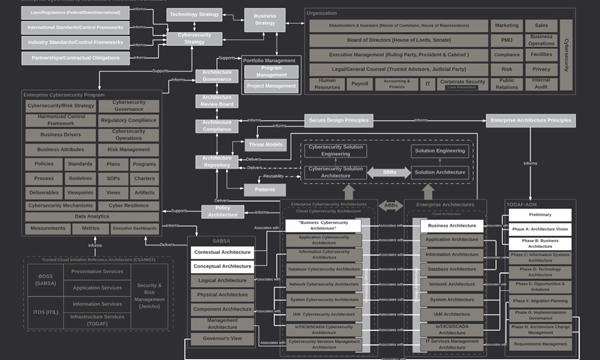
ILLUME's Enterprise Cyber Security Architecture defines the structured, layered controls required to protect organizational assets, reduce risk, and enable business resilience. Effective security is not measured by tool count, but by clarity of design, defined ownership, and integrated control execution.
1. Identity Security (Control Plane)
Identity serves as the primary control plane across modern enterprises. Compromise at this layer enables lateral movement across systems and environments.
Core Capabilities:
Identity and Access Management (IAM)
Multi-Factor Authentication (MFA)
Single Sign-On (SSO)
Privileged Access Management (PAM)
Identity Governance and Administration (IGA)
Conditional and risk-based access controls
A mature identity architecture enforces least privilege, continuous verification, and lifecycle governance.
2. Network and Infrastructure Security
Network security establishes segmentation boundaries and reduces the attack surface while limiting blast radius during incidents.
Core Capabilities:
Network segmentation and zero-trust segmentation
Next-Generation Firewalls (NGFW)
Web Application Firewalls (WAF)
DDoS protection
Secure DNS controls
Bastion and controlled administrative access
Architecture should prioritize containment and assume breach scenarios.
3. Endpoint and Workload Security
Endpoints and workloads remain primary initial access vectors in modern attacks. Visibility at this layer is critical for detection and response.
Core Capabilities:
Endpoint Detection and Response (EDR)
Extended Detection and Response (XDR)
Host hardening and secure configuration baselines
Runtime workload protection
Configuration and integrity monitoring
Effective security programs rely on endpoint telemetry as a core investigative data source.
4. Application and DevSecOps Security
Security must be embedded throughout the software development lifecycle to reduce production risk exposure.
Core Capabilities:
Static Application Security Testing (SAST)
Dynamic Application Security Testing (DAST)
Software Composition Analysis (SCA)
Secrets detection and management
Infrastructure-as-Code (IaC) scanning
API security testing
Organizations must choose between proactive defect prevention or reactive incident response.
5. Data Security
Data protection is a regulatory, reputational, and operational imperative.
Core Capabilities:
Data classification and labeling
Encryption at rest and in transit
Key Management Systems (KMS)
Data Loss Prevention (DLP)
Data masking and tokenization
Database activity monitoring
Regulatory scrutiny centers on data protection outcomes rather than perimeter investments.
6. Cloud and Container Security
Cloud-native environments require continuous configuration governance and workload visibility.
Core Capabilities:
Cloud Security Posture Management (CSPM)
Cloud Infrastructure Entitlement Management (CIEM)
Cloud Workload Protection Platforms (CWPP)
Container image scanning
Kubernetes policy enforcement
Misconfiguration remains one of the leading drivers of cloud breaches, making preventive control automation essential.
7. AI and Emerging Technology Security
Artificial intelligence introduces new attack surfaces and governance challenges that require structured oversight.
Core Capabilities:
Model governance and lifecycle management
Prompt injection and adversarial input protection
Integrity validation and output monitoring
AI API security monitoring
Responsible AI compliance frameworks
AI risk velocity often exceeds traditional governance maturity and must be addressed proactively.
8. Security Operations and Governance
This layer integrates controls, provides executive visibility, and ensures continuous risk management.
Core Capabilities:
Security Information and Event Management (SIEM)
Security Orchestration, Automation, and Response (SOAR)
Threat intelligence integration
Vulnerability management
Governance, Risk, and Compliance (GRC)
Security operations translate architecture into measurable risk reduction and operational resilience.
Executive Perspective
Enterprise security maturity is not defined by the number of deployed tools.
It is defined by:
Clearly defined architectural layers
Assigned ownership and accountability
Integrated telemetry and response workflows
Measurable risk reduction outcomes
When incidents repeat despite significant investment, the root cause is often architectural fragmentation rather than insufficient budget.
A well-defined enterprise cyber security architecture provides clarity, integration, and resilience — enabling security to function as a strategic business enabler rather than a reactive cost center.
Comments
No Comments Found.
Search Here

ILLUME's AI Driven Cyber Attack Mitigation Plan for India
February 22, 2026
ILLUME's Enterprise Cyber Security Architecture
February 22, 2026

Top AI Cyber Security Company Kerala India
February 21, 2026