TheDPDPAct.com -
Official WhatsApp Channel
Stay updated with the latest DPDP Act news, compliance insights, updates, and resources.
Join Our WhatsApp Channel →Most security teams implement a defense and move on. The assumption, usually unspoken, is that a control in place is a control that works. In conventional application security, that assumption is already questionable. In AI API security, it's genuinely dangerous.
The reason is specific to how model extraction works. An attacker targeting your API isn't triggering an error condition or breaking a rule — they're doing something your API was designed to do, just systematically and at scale. Whether your defenses hold up against that isn't something you can verify by reading a configuration file. It requires deliberately simulating the attack and measuring what comes back.
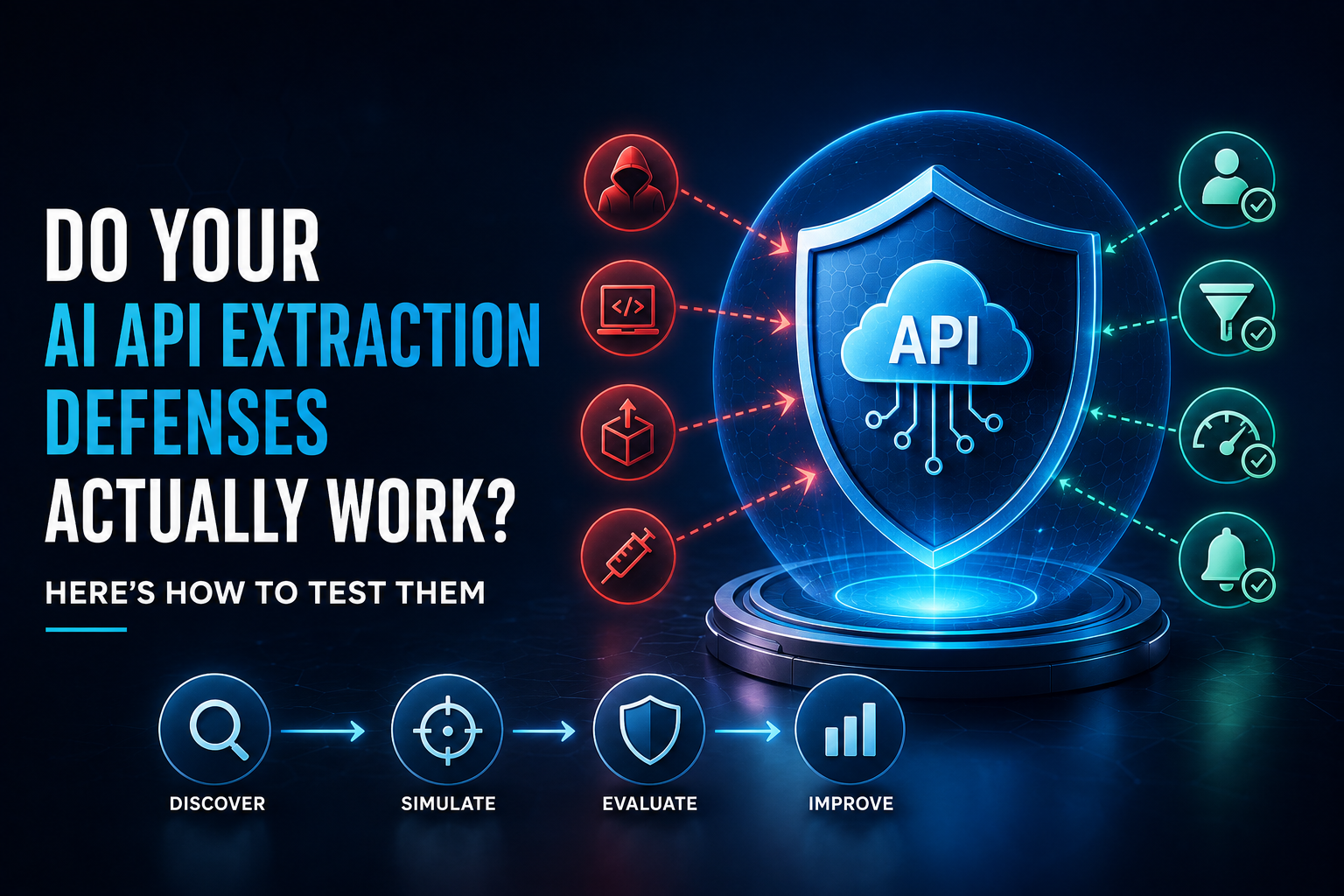
Implementing a defense and testing a defense are two different things. This piece covers the second one.
Why Verification Matters More Than You'd Expect
Here's the uncomfortable case study worth starting with. Researchers documented a real extraction of a proprietary Android malware classifier — a model built over three years from two million labeled samples. The attacker didn't breach any system. They queried a public-facing API over six months, collected predictions on 50,000 Android applications, and trained a surrogate model that achieved 97% functional equivalence to the original.
The organization had protections in place. The extraction succeeded anyway — not because the defenses were absent, but because nobody had tested whether they held up against a patient, distributed, long-running campaign. The six-month window isn't the remarkable part. The remarkable part is that nobody noticed it happening until the damage was already done.
That's the gap this piece is about.
Testing Output Design: Measuring Information Leakage
Output truncation is the first and often most impactful defense against extraction — returning less information per response gives an attacker less to work with per query. But "we return hard labels instead of confidence scores" is a configuration claim, not a security validation.
Testing it properly means measuring what an attacker can actually learn from your API's responses under a realistic extraction scenario.
The OWASP AI Testing Guide's methodology for this is a useful starting point: query the target API with a representative dataset, use the returned labels as training data for a surrogate model, then measure the surrogate's accuracy on a held-out evaluation set. If a simple off-the-shelf classifier trained on your API's responses achieves high accuracy on your task — comparable to what a model trained on the original data would achieve — your output design isn't providing meaningful extraction resistance, regardless of what the configuration says.
The test should be run twice: once against your current output configuration, and once with a richer output format (if your model can produce one) to establish a baseline. The gap between those two numbers tells you how much protection your truncation actually provides. A small gap means the defense is weaker than expected. A large gap confirms the configuration is doing real work.
What to look for: Surrogate model accuracy below 65–70% of your model's own accuracy on the same evaluation set suggests meaningful extraction resistance. Above 85% is a signal that the output design needs revisiting regardless of what the implementation looks like on paper.
Testing Rate Limiting: Simulating a Real Campaign
Most rate limiting configurations were built to stop burst traffic. An extraction campaign doesn't look like burst traffic. It looks like a moderately active integration — a steady stream of authenticated requests, spread across multiple API keys, designed to stay well below any threshold calibrated for denial-of-service scenarios.
Testing rate limiting for extraction resistance requires simulating the thing it's actually supposed to catch: a patient, multi-account, multi-session campaign.
Set up two or three test accounts with separate API keys. Query your API from each at a pace that individually looks unremarkable — well within your per-account limits. Vary the timing. Run the campaign across several days if the engagement allows. Then check: did any of this surface in your monitoring? Did cumulative cross-account volume trigger any review? Did query diversity patterns register anywhere?
If the answer to all three is no, your rate limiting is configured for the wrong threat. The control exists. It's just watching for the wrong thing.
Practical adjustment to test for: Once you've confirmed the gap, retest with cumulative per-account budgets enabled — limits that track total queries over a rolling seven or fourteen day window rather than just per-minute throttles. The difference in what surfaces should be visible.
Testing Behavioral Monitoring: Deliberately Generating the Signal
Behavioral monitoring for extraction-pattern traffic is the control most organizations don't have at all today. Testing whether it works starts with confirming it exists — and then confirming it actually fires when it should.
The test is conceptually simple: generate the statistical fingerprint of an extraction campaign deliberately, from a controlled test account, and verify that your monitoring surfaces it.
What that fingerprint looks like in practice:
* Inputs that methodically vary one parameter at a time across a known range
* Unusually high input diversity from a single account over a short window
* Query sequences concentrated near known decision boundaries
* Minimal repetition compared to what an organic user would generate
Run this pattern from a test account for a defined window — an hour, a day — then check your monitoring. If nothing surfaced, the monitoring either doesn't exist in the form you assumed, or it's not calibrated to catch extraction-pattern behavior specifically.
This is also the test that reveals whether your logging is fit for purpose. Distributional analysis of query sequences requires query-level logging — individual inputs and their timing, not just aggregate request counts. If your logs can't reconstruct the query sequence for a given account over the past week, your monitoring can't run the analysis needed to catch this regardless of what tooling sits on top of it.
Testing Output Perturbation: Measuring Degradation in Practice
If your API implements output perturbation — adding calibrated noise to responses to degrade surrogate training — the verification test is a direct measurement of whether the degradation is actually happening at a meaningful scale.
Run the same surrogate model training exercise described in the output design section, but now against your perturbation-enabled API. Compare the surrogate's accuracy on the evaluation set against what it achieved against the unperturbed baseline. The difference is your actual perturbation effectiveness — not the theoretical effectiveness from the research paper the technique was drawn from, but the real-world effectiveness of your specific implementation with your specific model and your specific users.
Perturbation that works well in a laboratory setting can underperform in production for several reasons: the perturbation is tuned too conservatively to avoid affecting user experience, it doesn't correctly identify out-of-distribution queries as requiring stronger noise, or it interacts unexpectedly with the model's output format. The only way to know which of these applies to your deployment is to measure it.
What to look for: The perturbation-enabled surrogate should achieve meaningfully lower accuracy than the unperturbed baseline. If the gap is less than 10–15 percentage points, the perturbation is providing weaker protection than it should, and the configuration needs revisiting.
Testing Watermark Persistence: Verifying the Signal Survives
Watermarking is an evidentiary control — its value lies in proving ownership after an extraction succeeds, not in preventing the extraction itself. Testing it means confirming the embedded signal actually persists through the distillation process, rather than assuming it does.
The test requires training a surrogate model on your watermarked API's outputs — the same process an attacker would run — and then querying the resulting surrogate with your watermark verification inputs. If the surrogate reproduces the expected trigger-response pairs, the watermark survived. If it doesn't, the watermark provides no evidentiary value against a distilled model, regardless of whether it works against the original.
This test should be run against a surrogate trained on a realistic query volume, not a minimal one. Watermarks that survive training on 10,000 queries don't always survive training on 100,000, and the persistence curve matters for how much confidence the watermark actually provides as legal evidence.
The Quarterly Validation Exercise
All of these tests belong in a regular cadence, not a one-time implementation check. AI APIs change — models are updated, prompts are revised, output formats shift, integrations are added. Each of these changes can silently alter the effectiveness of defenses that were working fine against the previous configuration.
A quarterly extraction defense validation exercise — running the five tests above against the current production configuration — creates a continuous record of actual defense effectiveness rather than an assumed one. It also produces exactly the kind of documented evidence that regulators and insurance underwriters are increasingly looking for when asking whether an organization's AI security practices are genuine rather than nominal.
At ILLUME Intelligence, running this kind of structured validation is a core component of our AI API security assessments — testing each defensive layer against realistic attacker behavior, measuring actual effectiveness, and producing findings specific enough to close the gaps rather than describe them. If you'd like to know where your current configuration actually stands, reach out to Illume to scope a validation exercise for your environment.