TheDPDPAct.com -
Official WhatsApp Channel
Stay updated with the latest DPDP Act news, compliance insights, updates, and resources.
Join Our WhatsApp Channel →Somewhere in your organization, there's probably an AI agent already live right now — quietly embedded in a support workflow, a customer-facing tool, or some internal process someone built over a weekend sprint. It has access nobody has fully mapped. And there's a real chance the security team doesn't know it's there at all.
That's not a scare tactic. It's close to the median enterprise reality today. Agents went from experimental pilot to embedded default faster than almost any technology before them — by Gartner's count, roughly four in five enterprise applications shipped or updated in early 2026 came with at least one AI agent built in, up from about a third just two years earlier.
The real question most organizations are facing isn't whether to deploy agents anymore. It's whether anyone checked first.
The Confidence Nobody Earned
Here's where it gets uncomfortable. Ask executives whether their policies actually protect them from an agent taking an unauthorized action, and the overwhelming majority will say yes, confidently. Ask how many of their agents are actually being monitored, and the number drops to less than half.
That gap isn't a rounding error. It's the whole risk, sitting in plain view. It's also exactly why so many AI agent failures land as a genuine shock to the people supposed to be watching for them — the confidence was never backed by anything concrete to begin with.
Governance surveys tell the same story from a different angle. Only about one in five organizations describe their AI agent governance as mature, even though nearly three-quarters name security and privacy as a top concern. Dig a layer deeper and it gets worse: a majority of organizations admit they can't reliably enforce limits on what their agents are authorized to do, and most say they couldn't shut down a misbehaving agent even if they realized it was misbehaving.
An agent you can't fully constrain, and can't reliably turn off, isn't a governed system. It's a system running on hope.
What Waiting Actually Costs
Skipping adversarial testing before deployment isn't a neutral choice. It's a bet — and the evidence on how that bet tends to play out isn't kind.
Recent research puts the share of organizations reporting a confirmed or suspected AI agent security incident at somewhere near nine in ten. A meaningful share of enterprise breaches now trace back to agent activity specifically. And when an agent gets deployed outside official oversight — the now-familiar "shadow AI" pattern — the resulting breach tends to cost noticeably more than a standard incident, not less.
The financial picture backs this up from another direction entirely. Roughly two-thirds of large companies say they've already lost over a million dollars to AI-related failures of one kind or another. Not always a breach in the traditional sense — sometimes just a costly mistake nobody caught in time. But the root cause tends to rhyme: nobody adversarially tested what the agent could be pushed into doing before it was handed real access.
Why "We'll Fix It Later" Doesn't Work Here
There's a pattern worth naming plainly, because it shows up again and again across independent research on this topic: agents quietly end up with more access than their actual job requires. It's the single most consistently reported failure mode, and it's exactly the kind of thing adversarial testing is built to catch before an agent ever touches production — not after.
The instinct to treat this the way teams treat web application bugs — ship it, patch what breaks — doesn't really translate here. A vulnerable web endpoint sits still until someone stumbles on it. An agent with too much access is actively making decisions and taking actions the moment it goes live, whether or not anyone's watching. There's no dormant period. The exposure starts on day one.
It gets harder still once agents start delegating to each other. A meaningful share of deployed agents can already spin up or task other agents on their own. Testing a single agent's boundaries before launch is a manageable problem. Reconstructing what a whole chain of interacting agents actually did, after something's already gone wrong, with logging that was never built for this — that's a much harder problem, and usually the wrong moment to be solving it for the first time.
What a Red Team Engagement Is Actually Looking For
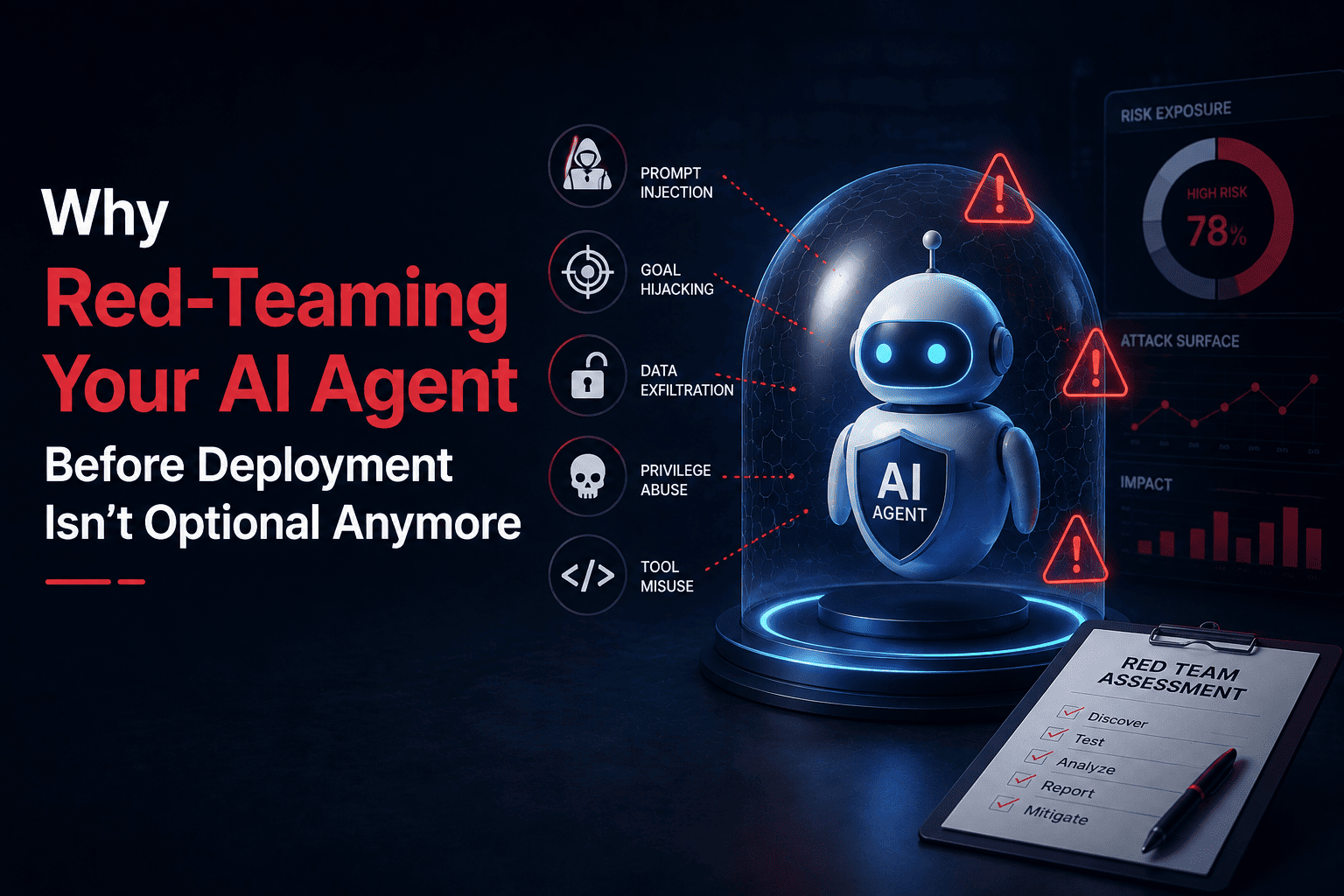
An AI agent red team assessment exists to answer the exact questions these surveys keep circling back to, before they turn into someone's postmortem.
* Can this agent be manipulated — through a crafted prompt, or something hidden in a document it processes — into acting outside what it was built to do?
* Does it hold more access than its job actually requires, and can that access be reached sideways, not just through the obvious front door?
* If it can hand tasks off to other agents, does that chain stay auditable, or does it quietly become a black box the moment two or three agents start talking to each other?
* And if something did go wrong tomorrow, would anyone actually notice — or would it only surface once the damage was already done?
These aren't hypothetical questions dreamed up for a checklist.
They're the same failure patterns showing up over and over in the research — too much access, unauditable chains, oversight that exists on paper and nowhere else.
A red team engagement run before an agent goes live tests for precisely this, deliberately, on your own schedule — instead of an attacker, a regulator, or a very bad week finding it for you.
A Cheaper Bet Than the Alternative
Set against everything above, a red team engagement stops looking like a nice-to-have and starts looking like fairly inexpensive insurance. A properly scoped assessment, run before launch, costs a fraction of what organizations are already losing to AI failures after the fact — and considerably less than the elevated breach costs that come specifically from ungoverned, unmonitored agents operating in the wild.
The organizations actually closing the gap between AI ambition and AI governance aren't the ones moving fastest. They're the ones testing first — treating an agent with real access and real autonomy the way any other high-privilege system deserves to be treated before it goes live: adversarially, deliberately, by someone whose entire job is finding the problem before it finds you.
At ILLUME, that's exactly what our AI agent red team assessments are built to do — testing an agent's boundaries, its access, how it behaves under manipulation, and whether your team would actually notice if something went wrong, before that agent is ever trusted with a real customer conversation or a real system credential. If you're planning to deploy an agent, or already have one running without this kind of testing behind it, get in touch with ILLUME before it becomes the incident report nobody wanted to write.