TheDPDPAct.com -
Official WhatsApp Channel
Stay updated with the latest DPDP Act news, compliance insights, updates, and resources.
Join Our WhatsApp Channel →Attackers no longer wait for a patch to exist before they exploit the gap it would have closed. Recent threat intelligence research puts the mean time-to-exploit at -7 days — not seven days after a fix ships, but seven days before one is even available. In practice, that means vulnerabilities are routinely weaponized while defenders are still working out what to fix.
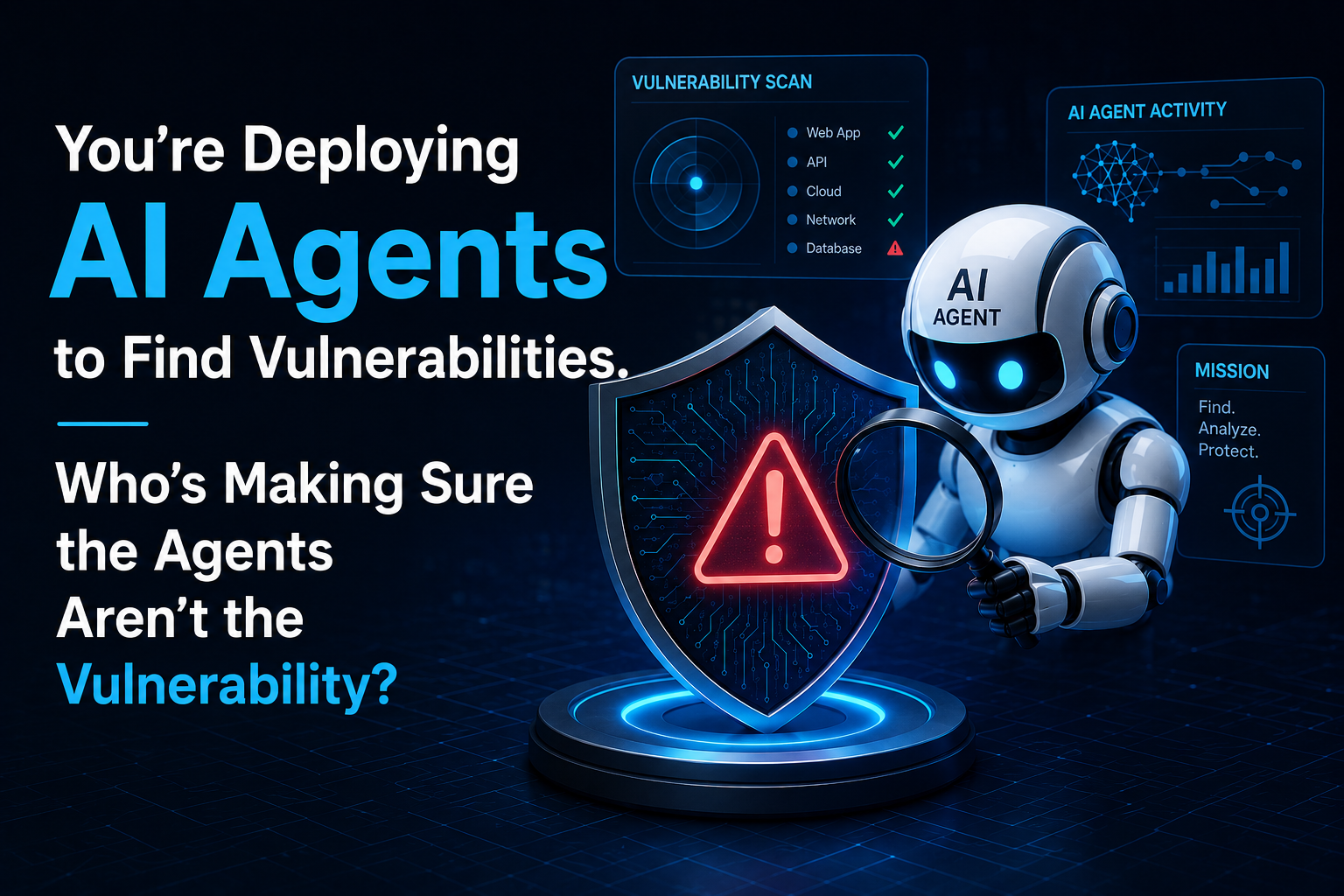
That single statistic explains why so many security teams are racing to integrate large language model (LLM) agents into their codebases, development environments, and CI/CD pipelines — automated vulnerability discovery and remediation, moving at a speed no human team can match on its own.
It also explains why this needs to be done carefully. Deploying privileged AI agents without mature integration processes doesn't close the gap between attack and defense. It opens a new one — inside the very tooling meant to protect you.
The Uncomfortable Symmetry
An AI agent capable of finding a vulnerability in your codebase is, by definition, an agent with meaningful access to that codebase. It can read source code, spin up sandboxes, execute payloads, and in more advanced deployments, generate and commit fixes.
That's exactly the kind of access an attacker would want.
If that agent can be manipulated — through a poisoned dependency, a hidden instruction buried in a code comment, a compromised skill or plugin — the tool built to find your vulnerabilities becomes the mechanism for exploiting one instead. This isn't a hypothetical edge case. It's the central design challenge any organization adopting AI-assisted vulnerability management has to solve for, deliberately, before deployment — not after an incident forces the conversation.
Building the Guardrails Before the Agent Gets Access
A handful of frameworks — NIST's AI Risk Management Framework and the OWASP Top 10 for LLMs among them — provide the baseline for identifying this category of risk. Turning that baseline into something operational requires a more specific structural blueprint. A few principles matter most.
* Treat the codebase itself as untrusted input. This is easy to overlook, because the instinct is to think of the codebase as "yours" — trusted by definition. But threat actors can embed indirect prompt injections inside source code comments or third-party dependencies: hidden instructions telling an agent to ignore a vulnerability it just found, or quietly exfiltrate environment variables while it's in there. Input sanitation has to apply even to internal scanning, not just external-facing prompts.
* Enforce data security before anything reaches the model. Agents shouldn't have access to personally identifiable information, protected health information, or other sensitive data in the first place. Testing environments should run on synthetic data, not production records. In production, a layered defense makes sense: deterministic policy engines acting as hard chokepoints, paired with reasoning-based guard models that filter sensitive data and block malicious prompt injections before they ever reach the agent.
* Isolate every agent workload. Agents should execute inside strictly isolated, unprivileged containers with tightly scoped, dynamically limited permissions. Robust sandboxing is what keeps the blast radius contained if an agent hallucinates a destructive command or gets hijacked mid-task.
* Red-team the agents themselves, before they're trusted with autonomous scanning. Before deploying an AI agent capable of spinning up sandboxes and executing code on its own, the agent needs to go through human-led adversarial testing — validating its resilience against jailbreaks, recursive logic loops, and layered prompt injection attempts. The goal is straightforward: make sure the security tooling doesn't quietly become the attack vector it was built to catch.
* Scope machine identities tightly, and tie them back to a human. Agents need real privileges to generate pull requests and commit code — that's unavoidable. What's avoidable is giving those privileges more reach than the task requires. Short-lived, just-in-time tokens bound to a specific repository and branch, tied back to an accountable human controller, mean that even a compromised agent container can't pivot into adjacent enterprise codebases.
* Treat third-party skills and plugins as supply chain risk, not convenience features. As teams extend AI agents with third-party skills and Model Context Protocol (MCP) servers, each integration is a supply chain component that can be silently poisoned — a previously benign plugin quietly updated with malicious dependencies. The orchestration frameworks running underneath these agents deserve the same scrutiny, since they carry their own risks around session memory poisoning and recursive loop hijacking.
* Watch what the agent actually does, not just what it was told to do. Static controls — vetting and hashing incoming tools before deployment — establish a necessary baseline, but they can't account for behavior after deployment. Toxic flow analysis, monitoring data paths at runtime to ensure agents aren't exfiltrating sensitive context to unvetted external endpoints, requires active, centralized logging that keeps every action, input, and output fully observable.
Why Human Judgment Still Has to Lead
None of this replaces human-led threat modeling — and it's worth being direct about why.
LLMs are genuinely strong at spotting syntax patterns. What they consistently struggle with is unwritten business intent — the reasoning a human engineer applies almost automatically, like asking why a particular microservice has broad database read permissions in the first place, rather than simply flagging that it does.
Connecting agents to internal wikis, design documents, and issue trackers through retrieval-augmented generation helps close some of that gap, but it isn't a fix on its own. Internal documentation is frequently stale, contradictory, or simply wrong by the time anyone reads it. An agent can retrieve an outdated architecture diagram and confidently describe a secure path that no longer exists in production — sounding authoritative while being quietly incorrect. Structured frameworks like PASTA (Process for Attack Simulation and Threat Analysis), applied by experienced human threat modelers during both design and post-build review, remain essential precisely because they reason about business risk and operational context in ways an agent, on its own, currently cannot.
Where AI Agents Genuinely Excel — and Where They Don't
One of the more useful distinctions in this space is between vulnerabilities with a binary oracle and vulnerabilities that need an architectural oracle to validate.
Memory corruption bugs in languages like C and C++ have a binary oracle almost by definition: the payload either crashes the system or it doesn't. That clear, objective feedback loop is exactly the kind of problem AI agents are proving genuinely strong at — which is part of why the industry is seeing a real surge in AI-discovered vulnerabilities across memory-unsafe targets like browsers and operating systems.
Enterprise software, though, is dominated by a different category: authorization bypasses, business logic flaws, indirect server-side request forgeries. These require an architectural oracle — an understanding of business context and trust boundaries that a probabilistic engine doesn't inherently have. When an agent's payload doesn't produce a clean pass/fail outcome, it often can't reliably tell whether it's found a real flaw or simply constructed a bad test — and a malformed payload crashing an unrelated background process can lead an agent to hallucinate a false success entirely.
That distinction should directly shape deployment strategy: reserve autonomous agent audits for systems with clear binary oracles — memory-unsafe codebases, systems parsing untrusted external input, shared internal libraries, foundational authentication services where full source access exists — and keep traditional SAST and DAST tooling doing what it already does well elsewhere.
The Staffing Reality Nobody's Solved Yet
There's a workforce implication here that deserves honesty rather than a marketing gloss. AI agents can generate findings far faster than human engineers can triage them. Point an agent indiscriminately at every available codebase, and a security team ends up drowning in unverified output — the fastest route to alert fatigue and eventual burnout.
The workable pattern is requiring every agent-generated finding to come with a reproducible, deterministic test harness attempting to prove the exploit, executed automatically in an isolated sandbox. If the harness fails, the ticket gets discarded before it ever reaches a human. If it succeeds, a human engineer reviews it — not to rediscover the vulnerability, but to validate whether it's actually reachable and actually matters in context, since a technically real flaw in unreachable dead code isn't a meaningful risk.
That shift is important to name plainly: this doesn't reduce a security team's workload so much as it redirects it, from hunting for vulnerabilities to auditing AI-generated proof of them. It also carries a real blind spot worth guarding against — a team hyper-focused on filtering AI-generated noise can develop a false sense of full coverage, when in reality, a genuinely novel technique or zero-day the model wasn't trained to recognize can pass through completely unflagged.
What This Means for How You Deploy
Bringing this together into a working posture, a handful of commitments matter more than the rest:
* Never let an agent operate outside a sandbox with tightly scoped, short-lived credentials — no exceptions, regardless of how much the workflow slows down.
* Require deterministic proof for every finding before it consumes human review time.
* Keep human threat modeling in the loop for anything involving business logic, authorization, or trust boundaries — not as a formality, but because this is precisely where agents currently fall short.
* Log everything an agent does, not just what it reports finding — remediation workflows need immutable audit trails to satisfy compliance frameworks and to reconstruct what actually happened if something goes wrong.
* Test the agents themselves adversarially, before trusting them with autonomous execution — the same discipline applied to any other privileged system with access to sensitive infrastructure.
The Question Worth Asking Before You Deploy
Organizations adopting AI-assisted vulnerability management are, correctly, trying to close a widening gap between when a flaw is discovered and when it's exploited. That's a real and urgent problem, and AI agents genuinely help close it, when they're deployed with the discipline this requires.
But the question in this piece's title isn't rhetorical. An unsandboxed agent, an over-privileged machine identity, an unvetted third-party skill — each of those is a legitimate path for an attacker to walk straight through the front door of a tool built specifically to keep them out.
Before deploying an AI agent into anything resembling a privileged security workflow, it's worth asking plainly: has this agent been tested the way any other high-privilege system in the environment would be tested — by someone whose job is to try to break it first?