TheDPDPAct.com -
Official WhatsApp Channel
Stay updated with the latest DPDP Act news, compliance insights, updates, and resources.
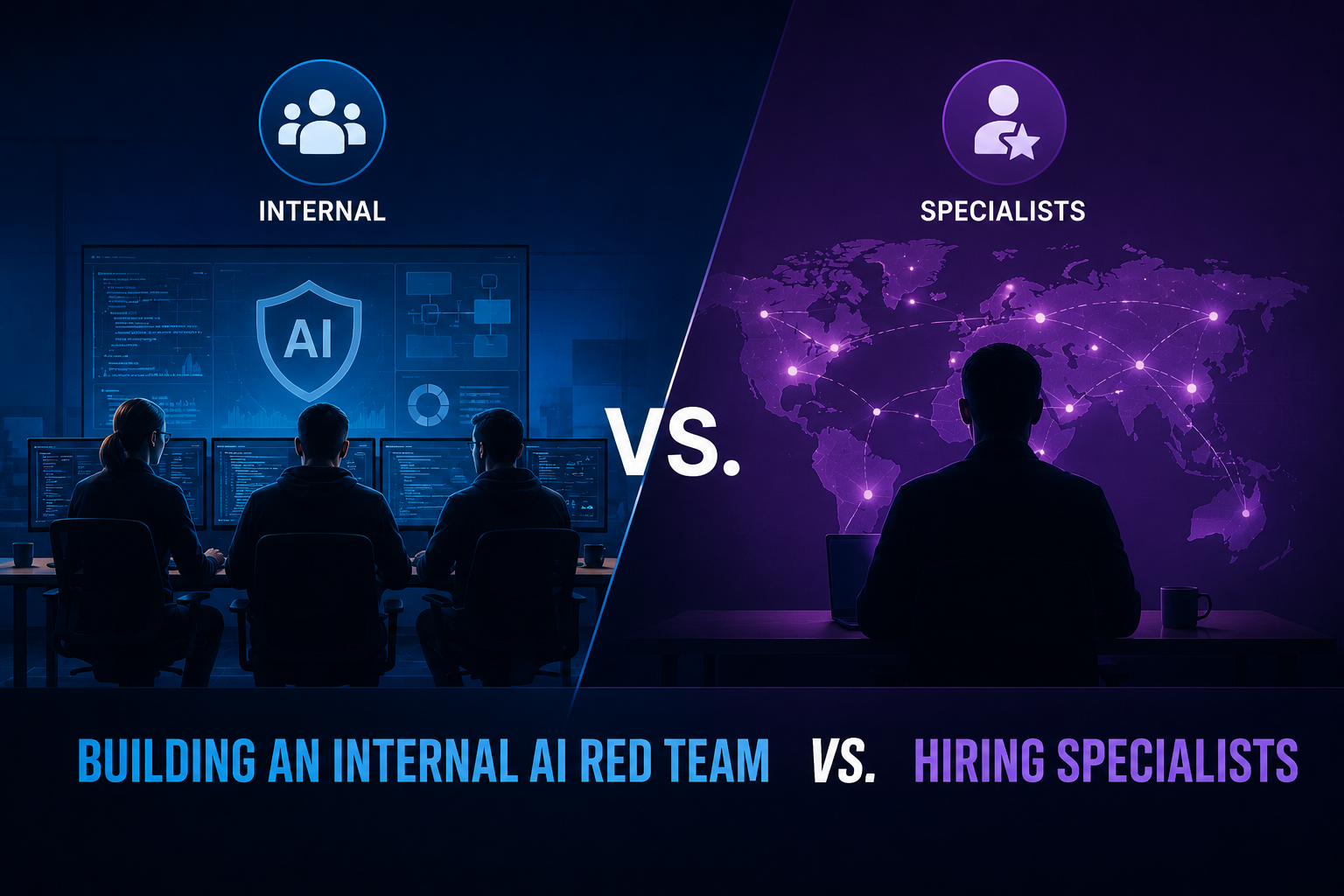
Join Our WhatsApp Channel →At some point in almost every security leader's year, this question surfaces: should we build this capability in-house, or bring in specialists?
For most security functions, the answer has become reasonably settled over time — some capabilities belong in-house, some are better outsourced, and the decision framework is familiar. AI red teaming is not yet in that category. It's a discipline young enough that most organizations are making this call for the first time, without the benefit of institutional experience, in a talent market that makes the in-house option considerably harder than it might appear on paper.
Here is a honest comparison of what building looks like against what hiring specialists looks like — what each actually costs, where each genuinely wins, and how to think through the decision for your specific situation.
Why This Decision Is Harder Than the Standard Build vs. Buy
AI red teaming sits at an unusual intersection: it requires people who can think like attackers, reason about machine learning model behavior, understand prompt injection and extraction mechanics, and apply frameworks like MITRE ATLAS to real production systems — simultaneously. That combination is genuinely scarce.
The US Bureau of Labor Statistics projects a 35% surge in demand for adversarial AI testing roles by 2028. LinkedIn reported AI red teamer as the fastest-growing cybersecurity job title of 2026. The gap between candidates who claim AI security expertise and those who can actually red-team a production AI system is, by most practitioners' accounts, substantial.
Hiring AI security engineers is currently the hardest specialist hire in cybersecurity. Frontier AI labs, regulated enterprises, and AI-native companies all compete for the same small pool — and that competition is fierce in both salary and working environment. For an organization that isn't itself an AI company, attracting and retaining this talent is a meaningful challenge before the capability delivers a single engagement.
What Building In-House Actually Costs
The honest cost picture for an internal AI red team involves several components that often get underestimated in initial planning.
* Talent is the largest and least predictable line item. AI security engineers with genuine adversarial testing capability command salaries that reflect their scarcity — and turnover in a tight market is expensive in both replacement cost and institutional knowledge. Published 2026 build-vs-buy models for comparable specialist security functions converge on staffing accounting for 65–70% of total annual program cost, and the AI security talent market is more competitive than most.
* Tooling and infrastructure adds meaningful overhead. Effective AI red teaming requires access to automated testing frameworks, model evaluation environments, adversarial payload libraries, and the compute to run them at meaningful scale. These aren't one-time purchases — they require ongoing maintenance and updates as both attack techniques and model architectures evolve.
* Time to capability is the cost that appears least in spreadsheets but matters most in practice. Building an internal AI red team from scratch — hiring, onboarding, developing processes, building institutional knowledge about how your specific AI systems behave under adversarial conditions — takes time measured in quarters, not weeks. During that period, AI systems continue to ship, and the exposure continues to exist without the coverage the program is being built to provide.
* Ongoing development is not optional in a field moving as fast as AI security. A capability built to current attacker techniques becomes outdated as techniques evolve. Internal teams require continuous investment in skills development to stay relevant — and in a field where the research landscape shifts meaningfully every six months, that investment is ongoing rather than one-time.
Where Building In-House Genuinely Wins
Despite those costs, there are genuine reasons to build internal AI red teaming capability, and they're worth taking seriously rather than dismissing.
* Depth of system knowledge. An internal team can develop detailed, sustained familiarity with specific AI systems over time — the particular failure modes of a fine-tuned model, the quirks of a specific agentic deployment, the historical record of what prior testing has and hasn't found. That context compounds over time in ways that a series of point-in-time engagements from external specialists doesn't replicate as directly.
* Continuity and integration. An internal capability can be woven into development and deployment processes — running assessments at each significant model update, participating in design reviews before a new agent is built, developing relationships with the engineering teams building the systems being tested. This level of integration is genuinely valuable, and it's easier to achieve with internal capability than through a series of episodic external engagements.
* Regulatory and compliance needs. Some regulatory frameworks, sector-specific requirements, and enterprise security programs call for documented internal adversarial testing capability rather than purely outsourced assessment. For organizations operating under those requirements, the build decision may be partly determined by compliance rather than pure economics.
* Scale at maturity. For organizations with large AI portfolios — many models, many agents, many endpoints requiring ongoing adversarial coverage — an internal capability that scales with the portfolio can eventually become more cost-effective than a series of external engagements at the same coverage level. This argument is strongest for the largest AI-deploying organizations; for most, the portfolio isn't yet at the scale where internal coverage is economically advantaged over external.
Where External Specialists Genuinely Win
For most organizations — particularly those deploying AI for the first time, scaling rapidly, or operating in regulated environments — external specialists offer advantages that internal builds struggle to match in the near term.
* Immediate depth. An external AI red team arrives with established methodology, accumulated adversarial techniques across many engagements, and the ability to apply current attack research directly to a specific system without a ramp-up period. The capability is available from day one of an engagement rather than from the end of a multi-quarter build.
* Objective perspective. Teams who built a system have legitimate blind spots about how it might be abused. External red teamers bring no such attachment — and the most valuable findings in adversarial engagements are frequently the ones the internal team never considered, precisely because it was too close to the system to see the angle.
* Cross-environment pattern recognition. External specialists accumulate knowledge across dozens or hundreds of engagements — recognizing failure patterns that appear across many different systems, applying attack techniques that proved effective elsewhere, and understanding how the threat landscape has shifted based on real-world evidence rather than single-organization observation.
* Predictable cost and coverage. A scoped external engagement has a defined cost, a defined timeline, and a defined deliverable. There's no hiring risk, no turnover risk, and no ongoing overhead between engagements. For organizations where AI red teaming is not yet a continuous program requirement — where a well-executed annual or semi-annual assessment covers the need — external engagement provides the coverage without the fixed cost of building and maintaining an internal team.
The Decision Framework Worth Using
Rather than framing this as a binary choice, most organizations end up in one of a small number of positions, and the honest recommendation differs by position.
* If you're deploying AI for the first time or scaling quickly: External specialists first, almost always. The immediate need for adversarial coverage, combined with the time required to build an internal capability, makes external engagement the right first move. Start building internal knowledge as part of those engagements — sending internal team members to observe, requiring findings to be documented in forms the internal team can learn from — but don't let the build plan delay the coverage that's needed now.
* If you have a growing AI portfolio and are developing regulatory requirements: A hybrid model — external specialists for major engagements and independent validation, an internal practitioner developing ongoing coverage between engagements — starts to make sense. The internal practitioner's job is integration and continuity; the external team's job is depth, independence, and bringing current attack research that an internal practitioner can't develop as quickly alone.
* If you're operating at scale with a large, continuously updating AI portfolio: The case for significant internal investment becomes compelling. At that point, the engagement cadence required for meaningful coverage, and the depth of system-specific knowledge that compounds over time, create genuine advantages for an internal capability — supplemented by external specialists for independent validation and for capabilities that are genuinely difficult to replicate in-house.
What Both Options Have in Common
Whatever the build-vs-buy outcome, one principle holds regardless of where the capability sits: the first in-house AI security hire, or the first external AI red team engagement, makes the most sense once AI features are actually in production — or as a prerequisite immediately before they ship.
Testing AI systems before they have real users and real consequences is the correct order of operations. Building an internal capability before AI systems exist to test is premature. Commissioning an external engagement after AI systems are already in production and already under adversarial attention is late. The timing matters as much as the sourcing decision.
At ILLUME Intelligence, we work with organizations across the spectrum of this decision — from first-time AI security assessments for organizations just beginning to deploy AI, to ongoing partnership models that complement and develop an organization's internal capability over time. If you're working through the build-vs-hire decision for your own program, reach out to Illume to talk through what the right model looks like for your specific environment and AI deployment stage.