TheDPDPAct.com -
Official WhatsApp Channel
Stay updated with the latest DPDP Act news, compliance insights, updates, and resources.
Join Our WhatsApp Channel →Try a quick test this week. Ask whoever looks after your customer-facing AI where the record of its last attack test is. If the answer is a shrug, a vendor brochure, or "somewhere in Slack," that is an audit finding waiting for a date.
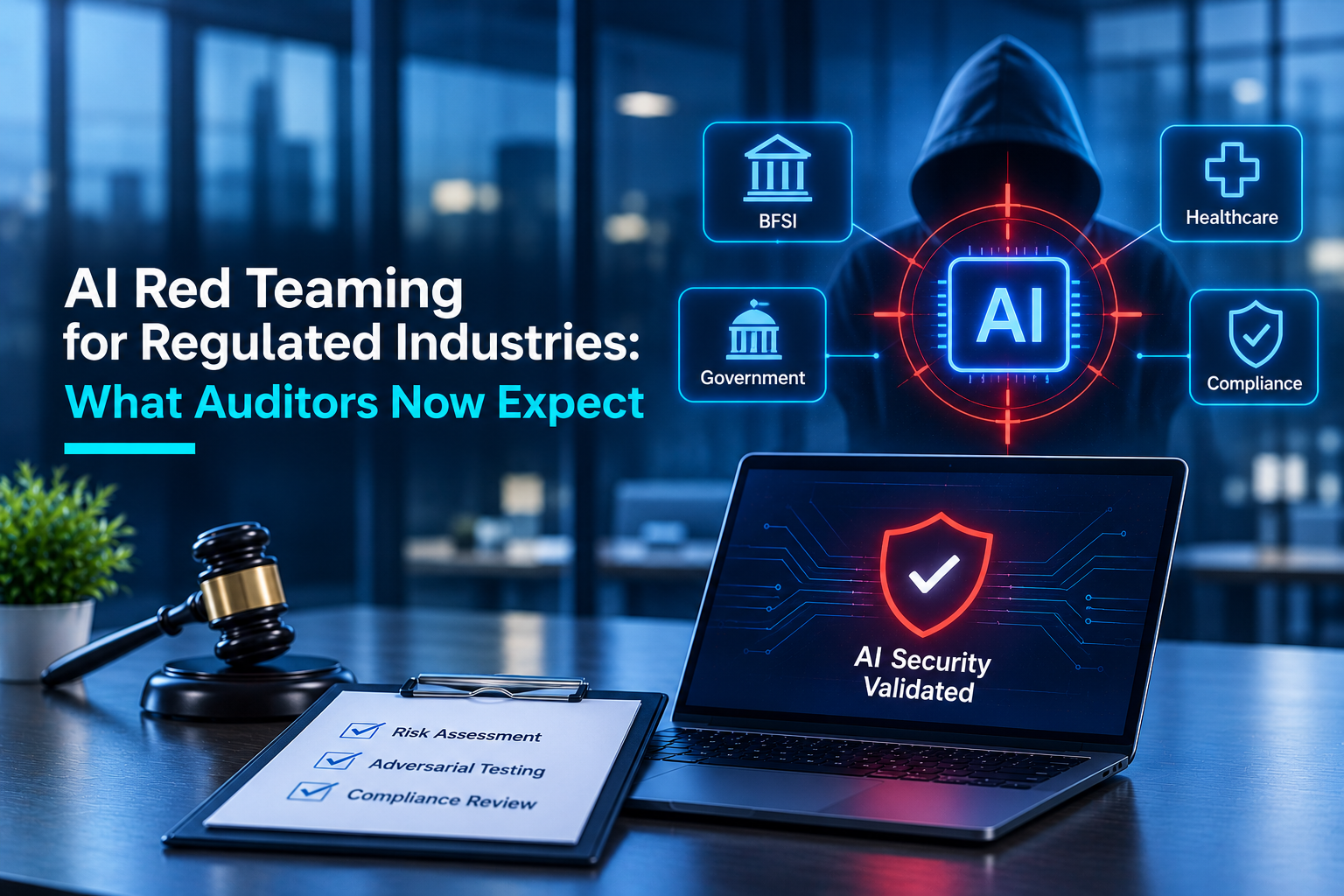
Regulated sectors are moving in the same direction. The question used to be whether you had an AI policy. Increasingly it is whether anyone tried to break the system before customers relied on it, and whether you wrote down what happened. That is what AI red teaming compliance comes down to.
What AI Red Teaming Means in layman language?
Red teaming means people try, on purpose, to make your AI do things it should not. They coax a chatbot into revealing data, talk it past its rules, hide instructions in a document it will read, or push an AI agent to take an action nobody approved. You do it so that the first person to find the weakness works for you.
For audit purposes there is a catch. A test nobody documented is a test that, on paper, never happened.
What the rulebooks say, and what they don't?
None of these frameworks hands you a test script, and several are recommendations or drafts. Here is what we could verify.
| Source | What it says | Status |
|---|---|---|
| RBI FREE-AI (August 2025) | Set up structured red teaming across the AI lifecycle, proportionate to risk and more frequent for high-risk models. Run risk-based audits covering data inputs, models and outputs. | Committee recommendations. We could not confirm from the report itself whether any are binding. |
| SEBI (June 2025 consultation) | Systems should be "robust, tested, and secure against malfunction and misuse," with detailed records of development, testing, deployment and monitoring. | Draft. Legal500 also reports a notified amendment to the Intermediaries Regulations making firms accountable for AI outputs, including third-party tools. Confirm the final text. |
| EU AI Act, Article 55 | Providers of general-purpose models with systemic risk must carry out and document model testing, including adversarial testing. | Applies since 2 August 2025. High-risk dates now sit at 2 December 2027 (Annex III) and 2 August 2028 (Annex I), per Orrick's reading of the published Omnibus. |
| NIST AI RMF, MEASURE 2.7 | AI security and resilience "are evaluated and documented." Red-team exercises appear as a suggested action. | Voluntary guidance. |
The RBI recommendation number, 20, comes from one secondary summary, so treat it as unverified. The pattern across all four is easy to see, though: evaluate the system, then keep the record.
The paper trail an auditor will want
Since no rule lists the exact artefacts, this is our reading of how an audit is likely to proceed. Treat it as a preparation checklist, not a regulatory requirement.
1. An inventory of AI systems with a risk tier. You cannot show proportionate testing without knowing what you have. Customer-facing and decision-making systems rank highest.
2. Scope and rules of engagement. Which systems, data, and tools were in scope, who approved the test, and what was off limits.
3. A named methodology. Tests mapped to a recognised list, such as the OWASP Top 10 for LLM Applications (2025), cover prompt injection, sensitive information disclosure, system prompt leakage, and excessive agency in an order an auditor can follow.
4. Findings with evidence. Reproducible steps, severity ratings, and what an attacker could have achieved.
5. Remediation and retest. Who fixed each finding, when, and proof that the retest passed. An unfixed finding with an owner and a date is acceptable; an unrecorded one is not.
6. Frequency and triggers. FREE-AI links frequency to risk. Retest after model changes, new data sources, new tools, and incidents, not only on a calendar.
7. Independence. A summary of FREE-AI's validation guidance notes that validation should sit with a function organisationally separate from the teams that build and deploy models. The team that built the chatbot should not be the only one that tested it.
8. Management reporting. Evidence that results reached whoever is accountable, such as a risk committee.
Where teams usually slip
* Relying on the vendor. If you use a third-party model or platform, the vendor's certificate covers the vendor's systems. Your prompts, data connections, and agent permissions are yours to test.
* Testing the model, not the application. Most real failures come from how the model is wired into your product: what it retrieves, what tools it can call, and what it may do without approval. The AI behaves in your context, not the lab's.
* One-off testing. A single report from last year says little about a system that has changed since.
* Findings with no owner. A report that ends in a PDF and a shrug is a weak audit record.
It isn't only a finance question
Section 8(5) of the DPDP Act requires reasonable security safeguards for personal data, with penalties of up to INR 250 crore for failure. The main duties are due from about mid-May 2027. If an AI system touches personal data, a documented adversarial test is one way to show you took reasonable steps. That is our interpretation, not a position the Data Protection Board has taken, so get legal advice on how it applies to you.
How ILLUME Intelligence can help
ILLUME Intelligence's AI Red Teaming service attacks your AI systems the way a real adversary would, then hands you documentation an auditor can read, scope, method, evidence-backed findings, severity ratings and a retest. Our AI Penetration Testing (AI VAPT) and LLM Security Testing services cover the application layers around the model, and our vCISO service can run the governance side, including reporting to your risk committee. A scoped test of your highest-risk AI system is a sensible place to begin.
Better to find it yourself
Auditors rarely expect perfection. They expect proof that you went looking and acted on what you found.
List your systems, test the riskiest first, write down every finding and fix, and retest when things change. Then the question about how you tested has an answer you can hand across the table.
Comments
No Comments Found.
Search Here



AI Supply Chain Attacks: Precautions Every Small Business Should Take
November 05, 2026
What Boards Should Ask Before Approving an AI Red Team Budget
November 05, 2026