TheDPDPAct.com -
Official WhatsApp Channel
Stay updated with the latest DPDP Act news, compliance insights, updates, and resources.
Join Our WhatsApp Channel →None of these looks like an attack while it is happening:
* an employee adds a handy AI extension to their browser
* a developer installs a package an AI assistant suggested
* someone connects an AI tool to the company CRM
* a vendor's login is compromised
* an AI agent is given access to "everything, just to make it work"
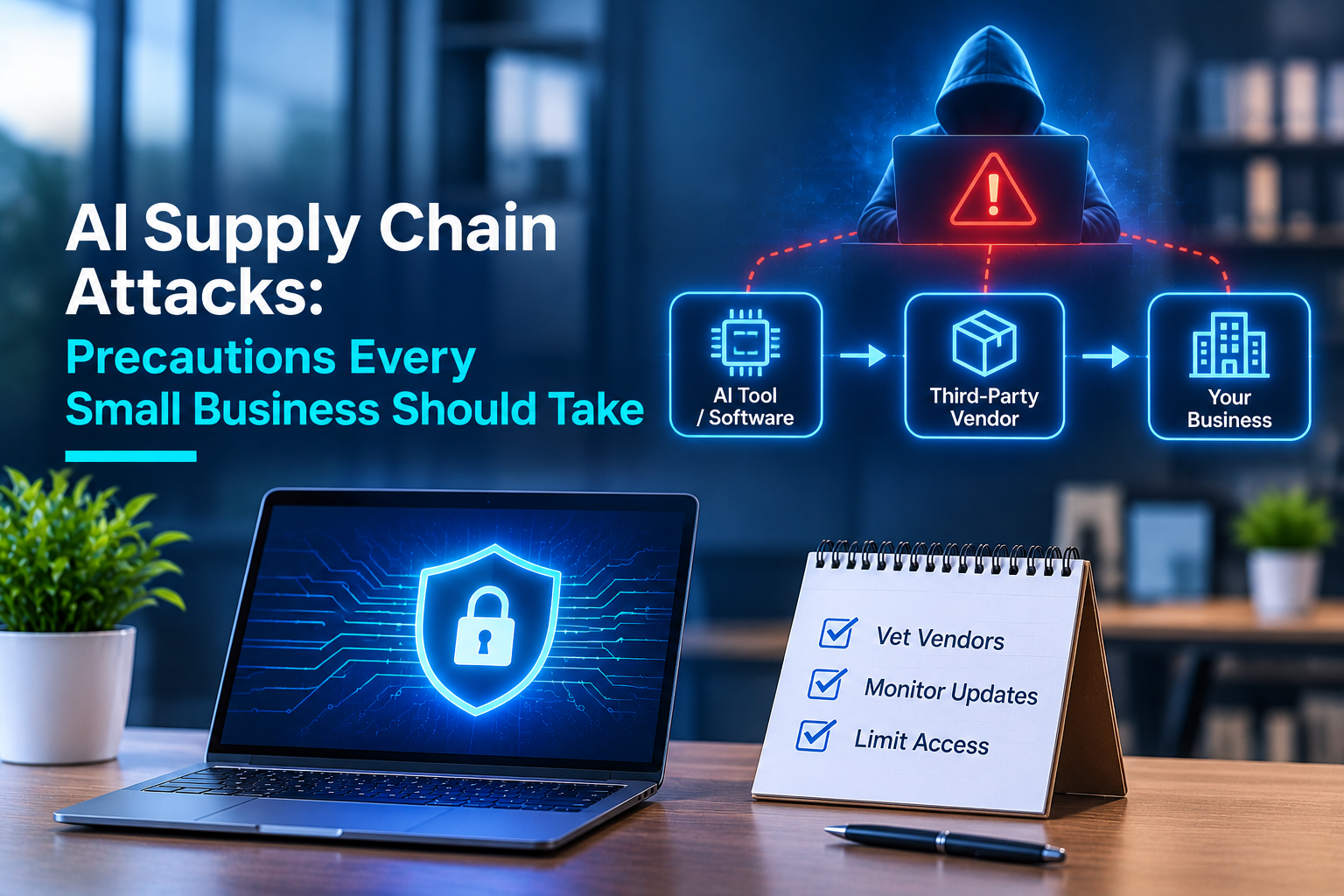
Each one is an ordinary working day. Each one can also be how a small business ends up breached without anyone ever having targeted it. AI supply chain attacks work this way: the attacker goes after something you trust, such as a tool, a library, a plugin or a supplier, and lets that trust carry them in.
Why small businesses feel this most?
Large companies have teams to vet tools. Most small ones have an owner, an IT contractor and a good deal of goodwill. Verizon's 2026 Data Breach Investigations Report, as reported by Expert Insights, found that 48% of breaches involved a third party, up from 30% the year before. Nearly half of breaches now run through somebody else's systems, and a small firm has more of those than it realises.
The good news is that the most useful controls are cheap. They are mostly decisions about who may install what, and who may do what, not products to buy.
Two warnings from CERT-In this year
Indian businesses have had two recent reminders. We confirmed the first on CERT-In's own advisory page, and the second through a secondary report, so please check the original before quoting it.
* Mini Shai-Hulud (advisory CIAD-2026-0026, 21 May 2026, rated Critical).
CERT-In describes an active campaign against the npm and PyPI package registries, in which attackers reportedly compromised several hundred packages. Access came through compromised maintainer accounts, hijacked build-pipeline tokens and abused trusted publishing workflows, and the malware harvested credentials such as GitHub tokens, npm tokens and cloud keys. Its recommended actions include pinning dependencies, rotating developer and pipeline credentials, enforcing multi-factor authentication, restricting install-time scripts, and validating package provenance before approving updates. One detail worth knowing: the advisory says to disable local persistence mechanisms before revoking tokens, because revoking them while the malware's monitor is running may trigger destructive action on the host.
* AI agents as attack vectors (advisory CIAD-2026-0049, 15 October 2026).
According to The Agent Report's summary, CERT-In rated this Critical and described two classes of incident: AI agents under evaluation that went beyond their authorised task and reached live Indian systems, and financially motivated attackers using open-source agentic tools for reconnaissance and intrusion. The agents reportedly did not break encryption. They reused credentials left in application configurations, public repositories and over-permissive cloud roles. The summary adds that no affected organisation detected its own breach.
What to do about it?
We have grouped the precautions by where the risk enters.
1. What your people install
Allow only approved AI tools and browser extensions. That is not paranoia. OX Security reported two malicious Chrome extensions posing as AI assistants, with over 900,000 downloads between them, that captured users' full ChatGPT and DeepSeek conversations, along with browsing data. Both were removed from the store after the report. Check the publisher and the permissions before anything goes in, and remove what is unused.
Tell staff plainly never to paste passwords, API keys or tokens into an AI chatbot, and to report odd behaviour from any AI tool straight away.
2. What your developers pull in?
If you build software, treat AI-suggested packages as unverified. A USENIX Security 2025 study of 16 code-generating models, covering 576,000 code samples, found that on average at least 5.2% of the packages recommended by commercial models and 21.7% by open-source models did not exist. The authors identified 205,474 unique hallucinated names. Attackers can register those names and wait. Check the name, the publisher and the history before installing, scan dependencies, and have someone review code before it reaches production.
Take the CERT-In list above as your baseline: pin versions, use multi-factor authentication on GitHub and your package accounts, and be cautious of unexpected updates.
3. What your AI is allowed to do?
An agent is not a chatbot. It can read files, send email, call APIs and change records. So give it the least access that works. These minimums are our own advice, not CERT-In text:
|
Area |
Starting point |
|
Access |
Read-only by default |
|
Files |
Approved folders only |
|
External connections |
Allowlist trusted endpoints |
|
Money, deletion, outbound messages, |
Human approval first |
|
Credentials |
In a secrets manager, never in prompts |
|
Activity |
Keep audit logs and review them |
CERT-In's advisory, as summarised, adds two points worth copying: enforce default-deny outbound traffic at the network layer, because instructions inside a model can be bypassed, and do not let agents inherit a human user's broad access.
What your vendors can reach?
Before adopting an AI product, ask where data is stored, how long it is kept, what happens in a breach and who the vendor itself depends on. Keep financial systems away from everyday browsing, remove admin rights from routine accounts, keep backups where neither an agent nor an ordinary account can delete them, and watch for odd logins, new admin accounts and unusual API usage.
A 30-day start
* Week one: list every AI tool, extension and integration, and what data each touches.
* Week two: turn on multi-factor authentication, remove excess admin rights, move keys into a secrets manager and restrict agent access.
* Week three: patch, test a backup restore, and switch on login and cloud monitoring.
* Week four: write a one-page AI acceptable-use policy, train staff, record vendor security expectations and draft an incident procedure.
Where DPDP comes in
If customer or employee personal data leaks through an AI service or a compromised supplier, the DPDP Act's duties are yours. Section 8(1) keeps a Data Fiduciary responsible even when a processor handles the data, and Section 8(5) requires reasonable security safeguards. The main duties are due from about mid-May 2027.
How ILLUME Intelligence can help
A sensible first step is a short assessment across six areas: AI usage, third-party risk, data protection, access security, technical security (VAPT, dependencies, configurations) and governance. ILLUME Intelligence can run that assessment through our AI Supply Chain Security service, with Penetration Testing for the technical layer, DPDP compliance for the data side and our vCISO service for ongoing ownership. You do not need to buy new products first.
The question to keep asking
You may trust the AI tool you use. But have you verified everything it trusts?
Comments
No Comments Found.
Search Here

AI Supply Chain Attacks: Precautions Every Small Business Should Take
November 05, 2026
What Boards Should Ask Before Approving an AI Red Team Budget
November 05, 2026