TheDPDPAct.com -
Official WhatsApp Channel
Stay updated with the latest DPDP Act news, compliance insights, updates, and resources.
Join Our WhatsApp Channel →Of the more than INR 65 crore taken from 12 Delhi-NCR NBFCs, police say they seized about INR 18 crore before it could be cashed out or turned into crypto, as reported by Outlook India. That is roughly a quarter. The rest was gone.
The gap between the money that came back and the money that did not was speed: how fast the loss was noticed, and how fast someone could act. That is the thought behind this checklist. Preventing a fraudulent payout matters most, and being able to stop one in minutes matters nearly as much.
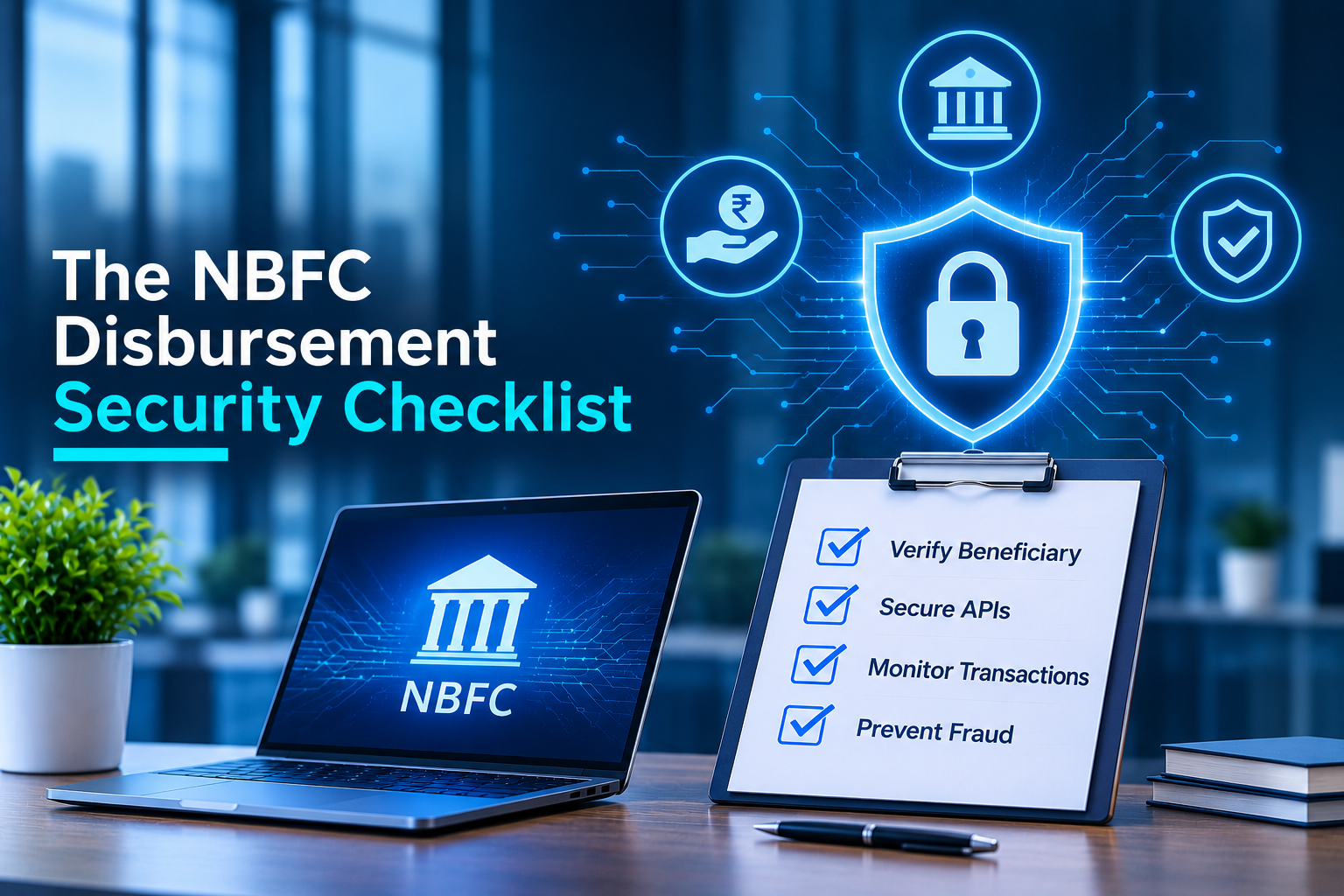
How to use it: tick an item only when you can show the config, the test or the log that proves it. A * means fix it first.
Items marked CERT-In reflect the advice in advisory CIAD-2026-0046 as summarised.
Items marked Police come from Delhi Police's account of the NBFC cases.
Everything else is our recommendation, not a regulatory requirement.
1. Know every way money can leave
A. * List every payout path: apps, APIs, partner-bank links, batch files, admin consoles. Attackers go for the path nobody remembers, so you cannot protect what is not on the list.
B. Switch off old and unused payout APIs. CERT-In lists deprecated and unauthenticated APIs among the ways in. Retire anything you no longer need.
C. Give each path a named owner. Someone should be able to answer "who is responsible for this?" in one breath.
2. Protect the keys that move money
A. * Keep long-lived keys out of source code and config files. CERT-In names hard-coded static tokens and plaintext credentials as common entry routes. Anyone who reads the code or the file can pay out.
B. Store secrets in a vault or HSM and rotate them. CERT-In advises this. After any suspicion, rotate at once, so a stolen key stops working.
C. Turn on multi-factor authentication for every service that can touch payments. CERT-In lists services without it as an entry route.
3. Treat a changed bank account as a red flag
A. * Verify any new or changed beneficiary account before paying out. Police describe the borrower's bank details being replaced with a mule account's. This is the moment the fraud becomes possible.
B. Add a cooling-off period and a second approver for beneficiary changes. A delay of even a few hours gives your team time to notice.
C. Alert when an account changes shortly before a payout. This is our suggestion, and it catches the pattern even if the other checks fail.
4. Make every payout earn its approval
A. * Check on the server that each payout matches an approved, undisbursed loan. CERT-In advises rejecting reference IDs with no matching record. A payout with no loan behind it should stop at the API.
B. Add a second control on fund movement. CERT-In recommends maker-checker or second-level approval. For automated flows, let routine low-risk payouts through and hold exceptions for a person.
C. Set per-transaction and per-day limits and speed limits at the API. CERT-In lists these. Ninety minutes of unlimited transfers is a design decision.
D. Stop treating an allow-listed address as proof of identity. Police say requests from cloud data-centre addresses on NBFC allow-lists passed straight through. Review each entry, remove broad ranges, and check who is asking, not only where they are.
E. Limit where your servers can send traffic. CERT-In lists outbound allow-listing, so a compromised server cannot reach anywhere it likes.
5. Harden the app and the code
A. * Test the lending app and APIs for the weaknesses attackers used. CERT-In lists exposed applications, middleware flaws, unauthenticated APIs and unrestricted file upload. Police noted many NBFCs are small and their code has gaps.
B. Scan your code for hard-coded secrets and review commits. CERT-In mentions forged-commit compromise of repositories, so someone should be checking who changes the code.
C. Use a tester who tries business-logic tricks. Can a payout skip the loan workflow? Scanners rarely find this, and Police have urged NBFCs, especially smaller ones, to get their systems audited.
6. See it fast, and be able to stop it
A. * Get real-time alerts on payout speed, volume and unusual patterns. The South Delhi losses were reportedly discovered while reviewing records that evening. Alerts should fire in minutes.
B. * Have a tested kill switch that pauses all payouts quickly. It is only useful if someone has already practised using it.
C. Reconcile payouts against approved loans and bank statements daily. CERT-In lists reconciliation. It is your safety net when other checks miss something.
D. Keep central logs for at least 180 days, and protect them from deletion. CERT-In advises 180 days, and attackers reportedly deleted or truncated logs.
7. Know what you will do when it happens
A. * Write a payment-fraud playbook: who calls the bank, the police and CERT-In, and in what order. CERT-In expects serious incidents to be reported within six hours.
B. Agree contacts at your partner banks in advance. Freezing or recalling funds works best when the first call is not a search for a phone number.
C. After an incident, recheck the whole payout path. YourStory reports that CERT-In observed the same companies being attacked repeatedly.
Your score
Count your ticked * items.
All of them: you are ready for an independent security test to confirm the rest.
Some missing: fix those this month, starting with section 4 and the kill switch in section 6.
Unsure about several: that is itself the finding. You cannot defend what you cannot see.
How ILLUME Intelligence can help?
ILLUME Intelligence's Penetration Testing and API security testing check your payout flows for the gaps above, including business-logic flaws. Our Static and Dynamic Code Analysis finds hard-coded keys and weak authentication, our SOC watches for abnormal payout patterns, and our Incident Response service helps you act in the first hour. A review of one payout path is a practical first step.
Comments
No Comments Found.
Search Here

The NBFC Disbursement Security Checklist: Can Your Payouts Be Stopped?
November 19, 2026
When Your Own Server Is the Attacker: Securing Disbursement APIs
November 19, 2026

The SaaS Developer's Checklist for Shipping AI Features Safely
November 11, 2026