TheDPDPAct.com -
Official WhatsApp Channel
Stay updated with the latest DPDP Act news, compliance insights, updates, and resources.
Join Our WhatsApp Channel →INR 41.27 crore in 90 minutes.
That works out to about INR 46 lakh every minute, or one transfer roughly every 56 seconds, if the figures reported for a South Delhi NBFC on 16 November hold up. (The loss is alleged and the investigation is open.)
Reports say the money moved to at least 96 bank accounts between 1:30 pm and 3 pm. Nobody noticed until officials reviewed the financial records that evening. By then there was nothing to stop. That pace points to software doing the work, not people clicking through screens, though that is our inference, not a finding.
If you run a lending business, the useful question is not who did it. It is a quieter one: What in our systems would have let a request like that through?
Attackers did not break into the bank
The attackers did not hack a bank. According to Delhi Police, who put losses at more than INR 65 crore across 12 Delhi-NCR NBFCs in three months (as reported by Outlook India), they went through the NBFCs' own front door. Police describe a pattern, and note that it comes from the wider cases, not necessarily the South Delhi one:
* Malware sat in the front end of a lending app for seven to eight days, unnoticed, learning which loans were approved but not yet paid out, and which commands trigger a payout.
* Attackers opened accounts on public cloud services and sent requests from there. Many NBFC firewalls had whitelisted those data-centre addresses, so the requests sailed through.
* The borrower's bank details were swapped for a mule account's, and the payout request went to the NBFC's disbursement API. The bank approved it instantly.
Police have arrested 20 people and seized about INR 18 crore, and say they found traces of AI in some cases. In South Delhi, the method is not yet known, and the report says investigators have not tied it to AI tools.
What CERT-In adds?
CERT-In's advisory CIAD-2026-0046 (October 2026) describes the same shape.
Attackers steal the credentials a firm uses to move money, then call the fund-transfer interfaces directly from the firm's own trusted servers. That skips loan creation, KYC, sanctions screening, beneficiary verification, balance checks and per-transaction limits. Entry routes reportedly include exposed applications, old unauthenticated APIs, long-lived static tokens in source code, plaintext credentials in config files, and services without multi-factor authentication. After entry, attackers deleted logs.
As reported CERT-In calling the actor CRAFTY FALCON, "AI-assisted," and operating "at machine speed."
The real problem: the API trusted the wrong things
Most disbursement APIs ask two questions: is the caller on our list, and does it hold the right key?
This pattern passes both. Here is what it did, and what a safer API checks instead.
| What the API trusted | Why that failed | What it should check instead |
|---|---|---|
| The caller's IP address | Attackers borrowed addresses already on the list | Whether this payout matches an approved, undisbursed loan |
| A long-lived key | Stolen keys work from anywhere, for as long as they live | Short-lived, scoped credentials held in a vault |
| The app's own request | Malware inside the app sends valid-looking requests | Whether the beneficiary was changed recently, and who approved that |
| Each request alone | 96 small transfers each look reasonable | Speed and pattern across requests |
OWASP's API Security Top 10 has a name for this: unrestricted access to sensitive business flows.
A vendor summary of it makes the point that every request looks legitimate, so the harm shows only at business level, and that the business conversation has to come first. Paying out a loan is exactly that kind of flow.
Five changes that break this pattern
1. Make every payout prove it is real.
CERT-In's advice, per Ampcus, is to validate every payout on the server against approved records and reject reference IDs with no matching record. A payout request with no loan behind it should die at the API.
2. Treat a beneficiary change as an alarm.
Swapping the bank account is the moment the fraud becomes possible. Verify the new account, add a cooling-off period, and require a second approver. CERT-In's list includes beneficiary validation.
3. Put a second control on the money.
Ampcus reports a recommendation for maker-checker or second-level approval on all fund movement. For automated payouts that means routine, low-risk ones can flow, while exceptions wait for a person or a second system.
4. Cap the damage at the API.
Per-transaction and per-day limits, plus speed limits on disbursement paths, are on CERT-In's list. Ninety minutes of unlimited transfers is a design choice.
5. Stop trusting location and static keys.
Move secrets into a vault or HSM with rotation, as CERT-In advises. We would also look at signed requests and mutual TLS so a stolen address is not enough. That last point is our suggestion, not something the Ampcus summary attributes to CERT-In.
Underneath all five sit three basics: real-time monitoring, daily reconciliation, and logs kept for at least 180 days, which the same summary lists. Add a tested way to switch payouts off in minutes.
How to find out where you stand?
Ask whoever tests your systems four plain questions.
* Can a payout be triggered without going through the loan workflow?
* Can a beneficiary be changed without verification?
* Does a request from an allow-listed server get a free pass?
* And would anyone notice 96 transfers in 90 minutes before the end of the day?
Most of these are business-logic flaws, which scanners rarely find and a skilled human tester will.
Police have urged smaller NBFCs especially to get their systems audited.
How ILLUME Intelligence can help?
ILLUME Intelligence's Penetration Testing and API security testing probe your disbursement flows the way an attacker would, including the business-logic gaps above. Our Static and Dynamic Code Analysis finds hard-coded keys and weak authentication before attackers do, and our SOC and Incident Response services watch for abnormal payout patterns and act quickly when something goes wrong. A focused review of one payout API is a practical first step.
Comments
No Comments Found.
Search Here

The NBFC Disbursement Security Checklist: Can Your Payouts Be Stopped?
November 19, 2026
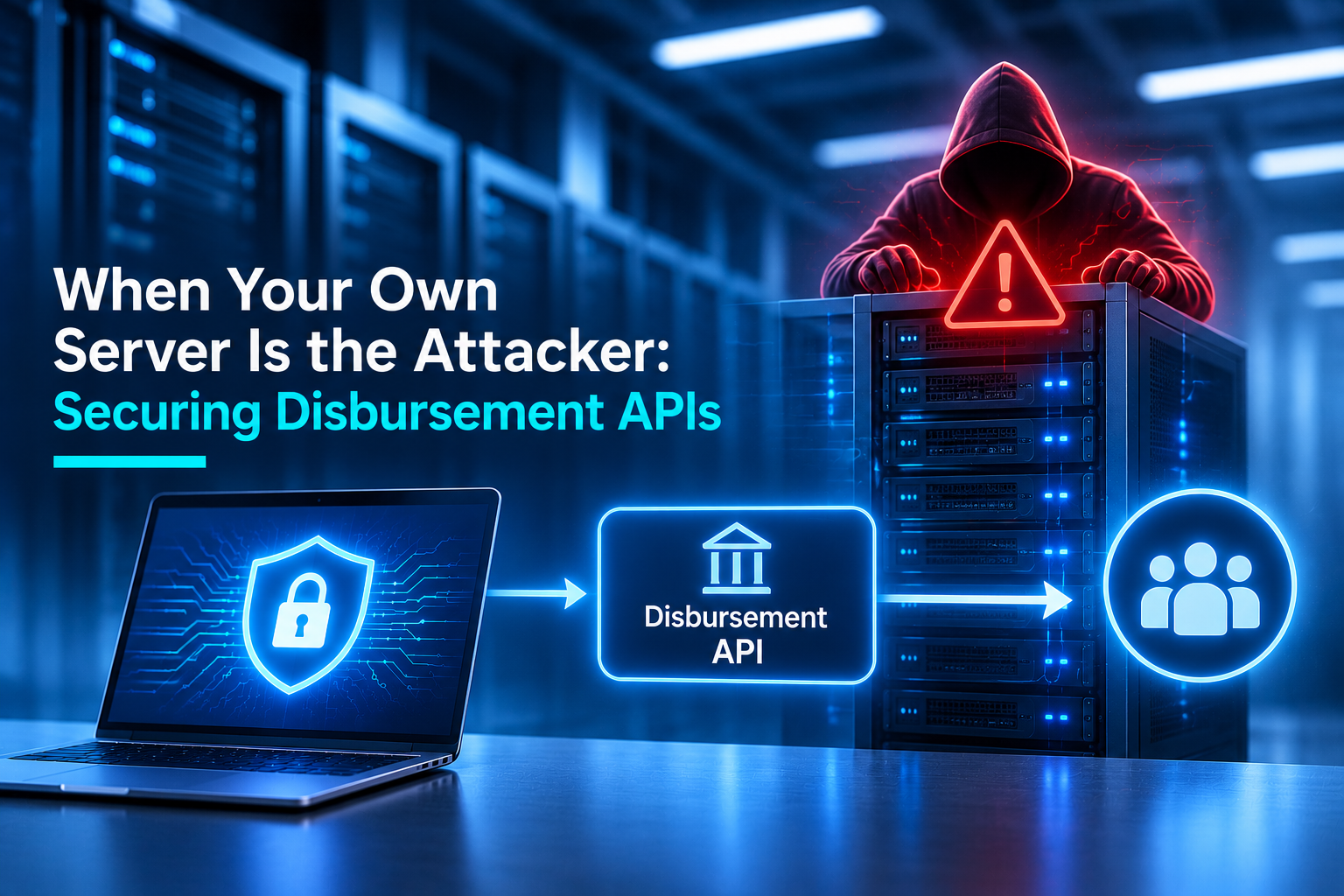
When Your Own Server Is the Attacker: Securing Disbursement APIs
November 19, 2026

The SaaS Developer's Checklist for Shipping AI Features Safely
November 11, 2026