TheDPDPAct.com -
Official WhatsApp Channel
Stay updated with the latest DPDP Act news, compliance insights, updates, and resources.
Join Our WhatsApp Channel →In 2022, the median time between an attacker getting into a network and handing that access to a second group was more than eight hours. By 2025 it was 22 seconds.
That figure comes from Mandiant's M-Trends 2026 report, and Mandiant does not blame AI for it. In fact, it says 2025 was not the year breaches became the direct result of AI. But the number shows something every security team now has to plan around: once attackers are in, they move faster than people can read an alert. AI-assisted attacks push the same way. The question is what to do about it.
What AI changes, and what it does not?
Three recent findings give a fair picture.
* It can do much of the work. Anthropic reported a state-sponsored campaign in which an AI model carried out an estimated 80–90% of the work, with humans stepping in at perhaps four to six decision points. At its peak, the AI made thousands of requests, often several per second. It also made mistakes, including hallucinated credentials, which Anthropic says remains an obstacle to fully autonomous attacks. Of roughly thirty targets, only a small number were breached.
* It can find flaws. In May 2026, Google's Threat Intelligence Group reported what it believes is the first zero-day exploit developed with AI: a script to bypass two-factor authentication in a popular open-source admin tool. The flaw was a hardcoded trust assumption, a logic error of the kind AI models are good at spotting.
* The basics still decide outcomes. Mandiant found exploits were the most common way in for the sixth year running, at 32% of intrusions, and estimates the mean time to exploit at about minus seven days, meaning exploitation routinely begins before a patch exists.
So AI does not invent new weaknesses. It lowers the cost of finding old ones and shrinks the time you have to react.
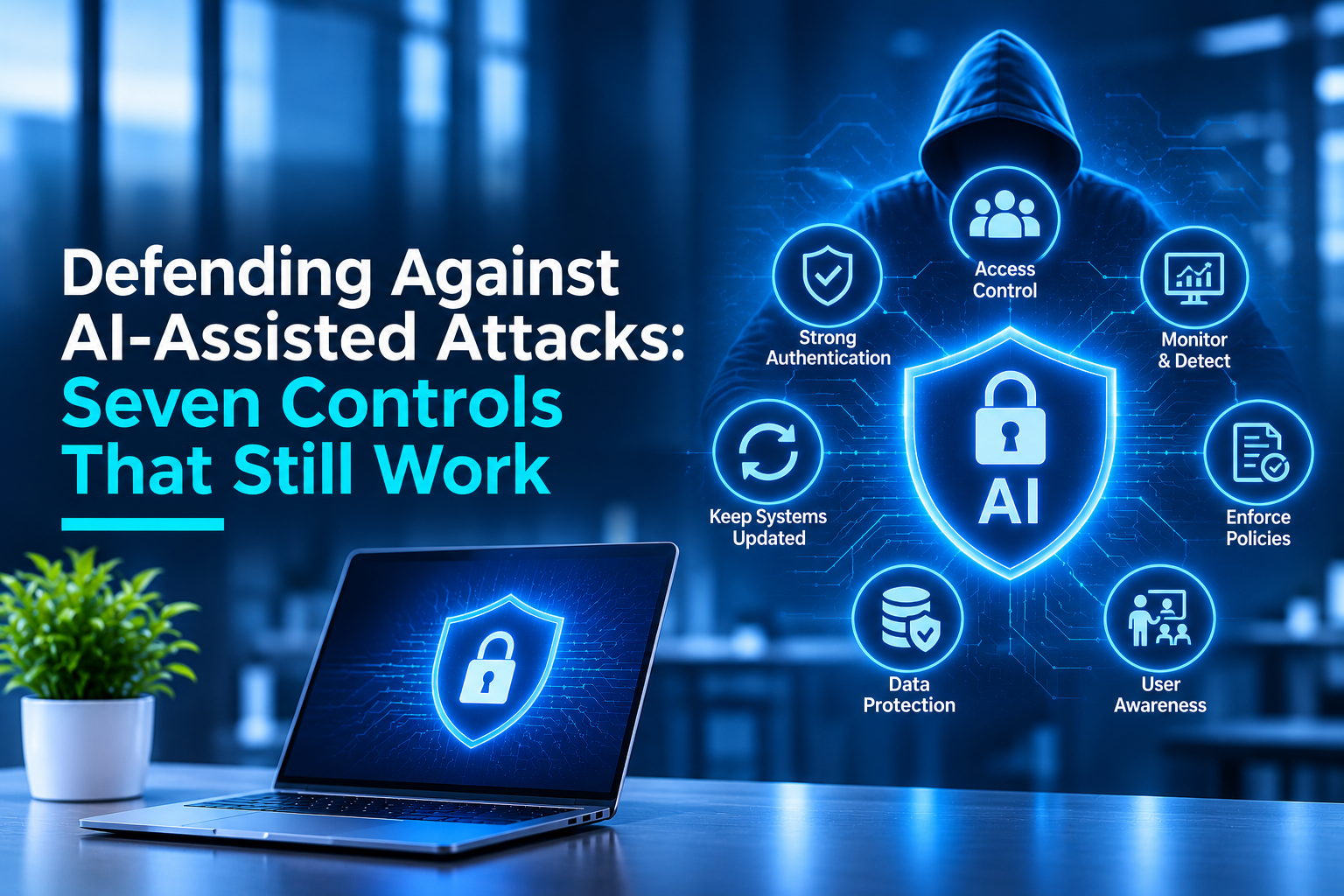
Our answer is a simple rule: you cannot out-type a machine, so make its job harder and your response automatic. Seven controls follow.
1. Shrink what is exposed, and patch by risk
Why it matters: exploits are the top way in, and the gap between disclosure and attack is closing. Start with a current list of everything facing the internet, including forgotten test systems. Retire what you do not need, patch the actively exploited flaws first, and use virtual patching, such as web application firewall rules, where a patch cannot go in right away.
2. Make stolen identity hard to use
Why it matters: Mandiant found prior compromise was the top entry route in ransomware cases, at 30%, so stolen access is reused. Use phishing-resistant multi-factor authentication for administrators, give powerful accounts short-lived access instead of standing rights, and keep keys and tokens out of source code. The AI-developed zero-day above was a bypass of 2FA, a reminder that logic around your login matters as much as the login itself.
3. Put limits on everything that matters
Why it matters: a tool that makes several requests a second will test every door you leave unlimited. Set rate limits and caps on logins, password resets, exports, API calls and any action that moves money or data. Add lockouts, and treat sudden bursts or many near-identical requests as a signal. A limit costs a legitimate user nothing, and costs an automated attacker a lot.
4. Add a second key to high-impact actions
Why it matters: a single approval step is the easiest thing to automate around. Require a second person, or a separate system, for payments, privilege changes, bulk deletions and changes to payment details or contact information. Make the check happen outside the channel the request came from, for example a call-back to a known number.
5. Contain the blast radius
Why it matters: with access passed on in seconds, assume someone will get in. Separate networks so that one compromised system cannot reach everything. Keep backups where ordinary accounts and admin tools cannot delete them. Give each application and service only the permissions it needs, because what an attacker inherits is what they can do.
6. Detect behaviour, and cover the quiet hours
Why it matters: automation runs at 3 a.m. on a holiday as happily as at noon on a Tuesday. Mandiant reports that organisations spotted intrusions themselves in 52% of 2025 investigations, up from 43%, and global median dwell time was 14 days. Better monitoring helps, but look for patterns, not only known signatures: bursts of activity, many slight variants of the same request, tiny test actions before a large one, and logins at odd hours. Make sure someone, or something, is watching nights and weekends, with lower alert thresholds then.
7. Rehearse a machine-speed response
Why it matters: a plan that starts with "convene the committee" finishes after the damage. Pre-approve a few automatic actions: disable an account, revoke a token, pause payouts, isolate a server. Write them down, test them, and name who can trigger them. Know your reporting clock too: CERT-In expects serious incidents to be reported within six hours. Then test the whole thing against a fast, automated attacker, because a rehearsal shows you what a policy cannot.
Use AI on your side, carefully
Anthropic's own advice to defenders is to experiment with AI in security operations, threat detection, vulnerability assessment and incident response. We agree, with one caveat: use AI to speed up your analysts, not to replace the controls above. A clever detector does not help if the payout API has no limits.
Where to start?
You do not need all seven at once. In the next 30 days, do three things: list and trim your internet-facing systems, put rate limits and second approvals on your highest-value actions, and run one rehearsal of a fast incident. Those three cover exposure, speed and response.
How ILLUME Intelligence can help?
ILLUME Intelligence's Penetration Testing and Red Team Testing services show you how a fast attacker would get in and what they could reach. Our SOC provides round-the-clock monitoring, our Incident Response service helps you rehearse and act, and our vCISO service can run the programme. A short exposure and response review is a practical first step.
Comments
No Comments Found.
Search Here

Defending Against AI-Assisted Attacks: Seven Controls That Still Work
November 22, 2026
The NBFC Disbursement Security Checklist: Can Your Payouts Be Stopped?
November 19, 2026
When Your Own Server Is the Attacker: Securing Disbursement APIs
November 19, 2026