TheDPDPAct.com -
Official WhatsApp Channel
Stay updated with the latest DPDP Act news, compliance insights, updates, and resources.
Join Our WhatsApp Channel →There's a version of this conversation that happens before something goes wrong, and a version that happens after. The before version is a budget discussion. The after version is a very different kind of meeting — one that includes legal counsel, a communications team, and a figure in the breach report that nobody in that room wanted to be responsible for explaining.
Most organizations only have one of those conversations. The question worth sitting with is which one.
The Numbers Behind the Decision
IBM's 2026 Cost of a Data Breach Report — based on 602 organizations that experienced real breaches between March 2025 and February 2026, with over 3,500 security and business leaders interviewed — puts the global average data breach cost at $4.99 million, a record, up 12% on the year before.
For AI-enabled breaches specifically, the number is higher: $6 million on average — roughly $1 million above the global figure. One in four malicious breaches are now AI-enabled, up 56% year-over-year. These are no longer edge cases. They are a quarter of the threat landscape, and they cost more than the average breach precisely because they move faster, adapt to defenses in real time, and exploit the specific blind spots of AI systems that most organizations have never deliberately tested for.
For organizations operating in the United States, the numbers are sharper still: the average US breach reached $11.5 million in 2026 — nearly double the global average — with regulatory fines and lost business driving the gap.
And for AI model inversion specifically — attacks that extract sensitive training data back out of a model — IBM's report puts the average cost at $6.07 million per incident. Prompt injection attacks follow close behind as one of the costliest categories. The most expensive failures in the current breach landscape aren't the ones coming through the front door. They're the ones exploiting the layer organizations forgot to lock.
The Asymmetry Worth Understanding
Here's the detail that reframes this conversation entirely. Attackers can now launch AI-enabled operations for a few thousand dollars. A deepfake impersonation campaign, an AI-generated spearphishing sequence, a systematic prompt injection attempt against a deployed LLM — these have become relatively inexpensive to run at scale. The cost of mounting the attack has collapsed. The cost of experiencing one has not.
IBM's own analysis found that organizations using AI and automation in their security operations reduced breach costs by an average of nearly $2 million compared to those that didn't. That's not a marginal efficiency gain — it's a meaningful shift in financial exposure, from a single operational decision. Yet a quarter of organizations have still not integrated AI-assisted tools into their security operations at all.
The economics of this moment are unusual in the history of cybersecurity. The attacker's cost curve is falling. The defender's breach cost curve is rising. Every year that gap widens, the case for proactive testing — including adversarial AI red teaming — becomes more straightforward to make in financial terms, not less.
What Gets More Expensive When You Wait
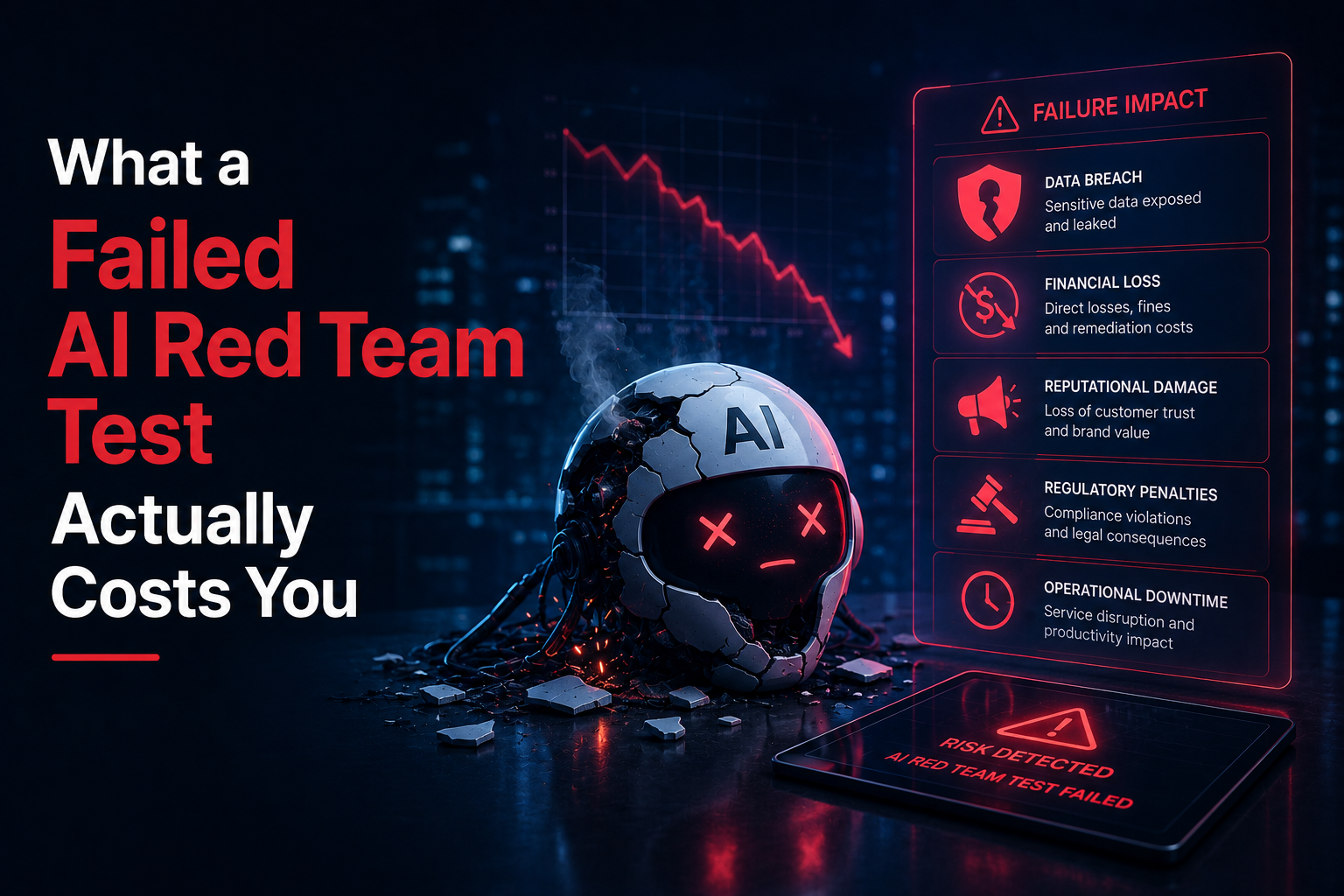
Beyond the breach cost itself, there are three downstream costs that rarely appear in the headline figure but reliably show up in the aftermath.
* Remediation under pressure is always more expensive than remediation by design. When a vulnerability is found by a red team before deployment, fixing it is a development task. When the same vulnerability is found by an attacker, fixing it becomes an incident response effort — with the model potentially already offline, customer data potentially already exposed, and engineering teams pulled off roadmap work to triage something that didn't need to become a crisis. IBM's data consistently shows that organizations taking longer to identify and contain breaches pay significantly more in total costs than those who contain quickly. The gap between a pre-deployment finding and a post-breach finding isn't just about timing — it's about what kind of organizational emergency surrounds the fix.
* Regulatory exposure compounds the base cost. For organizations operating in markets with active enforcement — the EU AI Act came into full enforcement on August 2, 2026, carrying penalties up to €35 million or 7% of global annual turnover — an AI system incident carries compliance risk layered on top of the direct breach cost. India's DPDP Act carries penalties up to INR 250 crore for inadequate security safeguards. Neither of these regimes requires a security team to have deployed a perfect system. They do require one to have deployed a demonstrably thoughtful one. An AI red team engagement, with its findings documented and remediated before launch, is evidence of exactly that standard of care — evidence that becomes very valuable once a regulator starts asking questions.
* Reputational cost is the line nobody can put a precise figure on, but everyone in the room understands. IBM notes that lost business — customer attrition, reputational damage, diminished trust — drives a meaningful share of total breach costs and tends to persist long after the technical incident is closed. For AI systems specifically, the reputational stakes are higher than for a conventional application breach, because AI failures carry a particular kind of public visibility — the news story writes itself.
What Shadow AI Is Doing to This Equation
IBM's 2026 report surfaced one trend that deserves specific attention: workers using unapproved AI tools figured in 43% of security incidents — more than double the share from the year before. The average cost of those shadow AI-related breaches was also higher than the standard figure.
More than two-thirds of breached organizations said they lacked governance processes to limit or detect unapproved AI use. This isn't just a policy gap — it's a structural visibility problem. Organizations can't red-team what they don't know exists, and they can't govern what they can't see. The proliferation of AI tools across an organization without formal oversight creates exactly the kind of blind spot adversarial testing is designed to find, and exactly the kind of exposure the breach data shows is becoming more common and more costly every year.
The Comparison That Actually Matters
The cost of an AI red team engagement is a fraction of the figures above. It is bounded, scoped, and known in advance. The cost of the incident it prevents is open-ended, contingent on things outside an organization's control once an attacker is already inside the system, and on average running into the millions before regulatory and reputational exposure are even added.
Framed that way, the ROI question almost inverts itself. The more accurate question isn't whether an organization can justify the cost of a red team engagement. It's whether it can justify the financial, regulatory, and reputational exposure of deploying an untested AI system against a threat landscape where one in four malicious breaches is now AI-enabled, the average cost of an AI-specific incident is $6 million, and the gap between attacker cost and defender cost is widening every year.
At ILLUME Intelligence, we help organizations answer that question on their own terms — before the incident that makes the answer obvious. A properly scoped AI red team engagement finds the exploitable weaknesses in an AI system before an attacker does, produces a remediation roadmap that closes them, and generates the documented evidence of due diligence that increasingly matters under both contractual and regulatory scrutiny. Reach out to ILLUME to scope an engagement — and have the budget conversation before you're in the other kind of meeting instead.