TheDPDPAct.com -
Official WhatsApp Channel
Stay updated with the latest DPDP Act news, compliance insights, updates, and resources.
Join Our WhatsApp Channel →
The clock on India's data protection law just started running for real. On November 13, 2025, the Ministry of Electronics and Information Technology notified the Digital Personal Data Protection Rules, 2025, formally operationalizing the DPDP Act — and with it, an 18-month countdown to full enforcement that lands on May 13, 2027. That deadline is about to trigger a rush of businesses shopping for compliance help, and predictably, a rush of vendors positioning themselves to sell it. Some will genuinely know what they're doing. Many won't. Here's how to tell the difference before you sign a contract, not after an audit exposes the gap.
Why This Decision Carries Real Financial Weight
This isn't a routine vendor selection. The Data Protection Board of India can impose penalties for serious violations, with the ceiling reaching INR 250 crore for failing to implement reasonable security safeguards that leads to a breach. Separate penalty tiers apply to other failures — up to INR 200 crore for not notifying the Board and affected individuals of a breach, and up to INR 150 crore for a Significant Data Fiduciary failing to meet its enhanced obligations like DPO appointment and audits. Multiple violations from a single incident can stack, meaning combined exposure can run into the hundreds of crores. Choosing a compliance partner who genuinely understands this framework — rather than one repackaging a generic privacy template — is a materially different bet.
The Checklist: What to Actually Evaluate
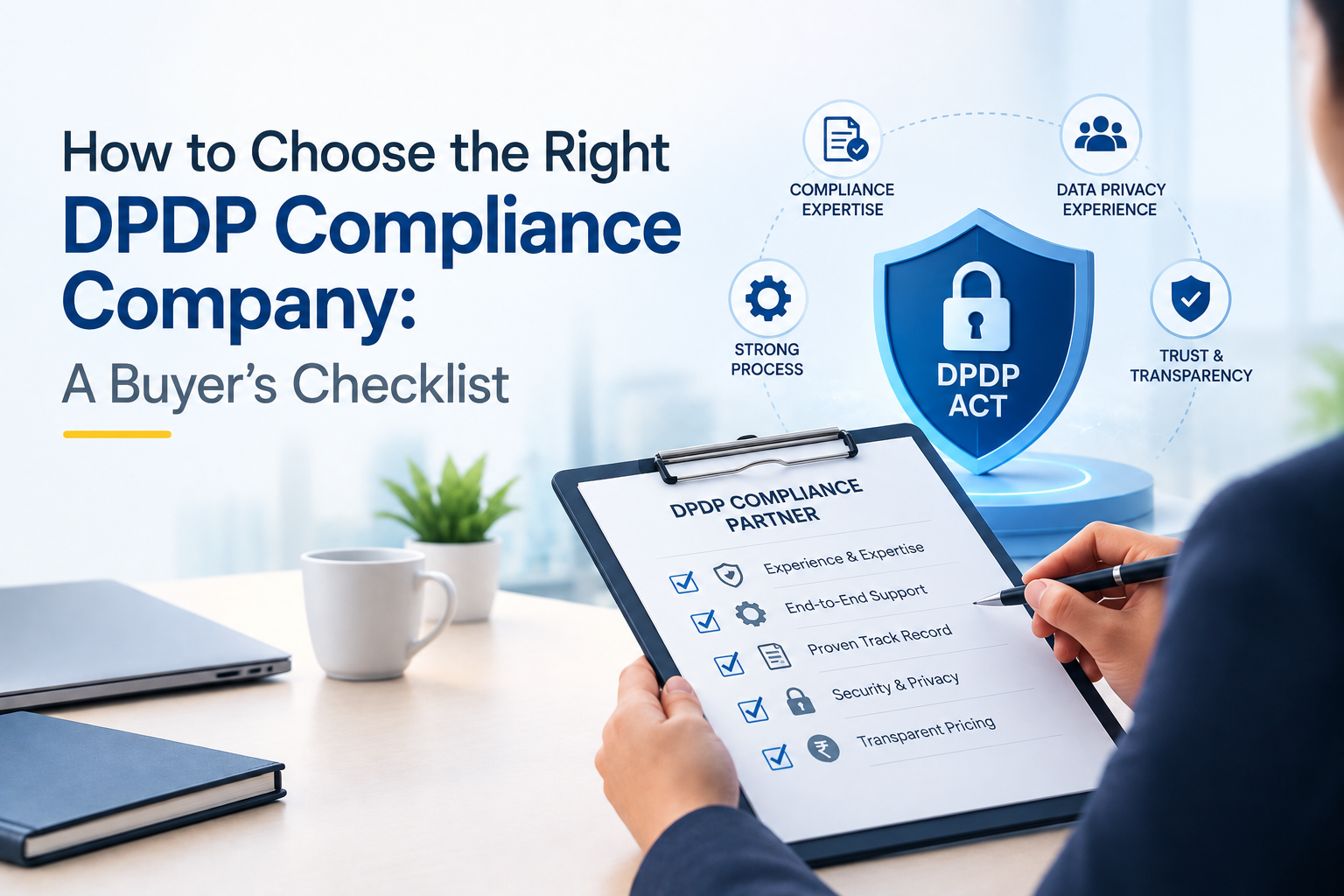
1. Do They Combine Legal Understanding With Technical Depth?
DPDP compliance isn't purely a legal exercise. It requires understanding how your systems actually handle, store, and secure personal data — not just what your policy says about it. A compliance partner without real cybersecurity capability (vulnerability assessment, infrastructure review, secure architecture guidance) can only verify what's written, not what's actually happening inside your systems. Ask directly: does the team include people who can technically audit your data environment, or only draft documents about it?
2. Can They Explain the Rules, Not Just the Act?
The DPDP Act, 2023 set out the principles. The DPDP Rules, 2025 are what actually operationalize them — covering consent notice formats, breach reporting timelines, children's data handling, and the specific criteria and obligations tied to Significant Data Fiduciary status. A credible compliance company should be able to walk you through the Rules in detail, not just the headline Act. If a vendor's pitch stops at "the Act says," push further — the Rules are where the real operational obligations live.
3. Do They Understand Whether You're Likely to Be Classified an SDF?
Significant Data Fiduciaries face materially heavier obligations — appointing an India-based Data Protection Officer, conducting independent data audits and Data Protection Impact Assessments, and maintaining governance structures capable of sustaining annual audit cycles. As of now, the government hasn't yet formally notified which entities qualify, but organizations handling large volumes or higher-risk categories of data should prepare well ahead of a formal designation. A good compliance partner should proactively assess your likely exposure here, not wait for a government notification to start the conversation.
4. Do They Have Verifiable Certifications and Credentials?
Look for teams led by recognized credentials — ISO 27001 Lead Auditor status, CISSP certification, or equivalent security and audit qualifications. These aren't vanity badges; they indicate the team has been trained and tested against internationally recognized standards for information security management, which directly overlaps with what DPDP compliance actually requires operationally.
5. Is Their Process Structured, or Improvised?
A serious compliance partner should be able to describe a clear, repeatable methodology — typically something like discovery, gap assessment, policy and control design, implementation, audit validation, and ongoing monitoring. If a vendor can't clearly explain their process before you've signed anything, that's a preview of how the engagement itself will go.
6. Do They Offer Ongoing Support, or Just a One-Time Deliverable?
DPDP compliance isn't a certificate you earn once. The Rules are being implemented in phases, obligations evolve, and your own data practices will change as your business grows. A compliance partner offering only a one-time report is setting you up to fall out of compliance the moment anything shifts. Look for engagement models that include ongoing monitoring and advisory, not just a project with a defined end date.
7. Can They Point to Sector-Specific Experience?
A fintech platform handling financial identity data, a healthcare provider managing patient records, and an e-commerce company processing behavioral data all face the same Act — but very different practical risk profiles. Ask for examples of work in your specific sector, not generic case studies.
Red Flags Worth Walking Away From
* Guaranteed outcomes with no assessment first. No credible partner promises a specific compliance outcome before understanding your actual data environment.
* Pure template delivery. If the "engagement" is essentially a document handover with minimal discovery work, you're buying a policy, not compliance.
* No mention of the Rules, only the Act. As covered above, the Rules are where operational detail lives — a vendor unfamiliar with them is behind the actual regulatory reality.
* No technical security capability. Compliance claims that aren't backed by technical validation are unverified claims, not evidence.
* Vague pricing with no defined scope. Reputable providers can clearly explain what's included in a fixed assessment versus a full implementation engagement.
Questions to Ask Before You Sign
* What does your discovery and gap assessment process actually involve?
* How do you determine whether we're likely to be classified a Significant Data Fiduciary?
* What certifications does your team hold, and can we see them?
* What happens after the initial engagement — is there ongoing support?
* Can you walk us through a specific provision of the DPDP Rules, 2025, not just the Act?
* Do you have experience with organizations in our sector?
The Bottom Line
With the DPDP Rules now formally in force and the May 2027 enforcement deadline no longer a distant milestone, more vendors will enter this space claiming expertise they haven't yet built. The organizations that come through this transition well will be the ones who chose a compliance partner based on genuine technical and regulatory depth — not just polished marketing. Use this checklist as your filter, and don't be afraid to ask hard questions before you commit. The cost of choosing wrong here isn't just wasted budget — it's the false confidence of thinking you're compliant when you're not.