TheDPDPAct.com -
Official WhatsApp Channel
Stay updated with the latest DPDP Act news, compliance insights, updates, and resources.
Join Our WhatsApp Channel →Somewhere in most cloud environments today, a permission exists that is broader than it needs to be.
It rarely happens through negligence. More often, it is granted under time pressure to unblock a deployment, and never revisited once the urgency passes. That single, quiet oversight remains one of the most common ways cloud environments are actually breached.
According to the Thales 2025 Global Cloud Security Study, 44% of organizations have already suffered a cloud data breach, with 14% reporting one in just the past year. More significantly, 55% of security leaders now say the cloud is harder to secure than on-premises infrastructure ever was — a notable admission from the people whose responsibility it is to have this under control.
The Cloud Didn't Get More Dangerous. It Got More Complex.
Cloud environments are rarely insecure by design. They become insecure through drift — the accumulation of countless individually reasonable decisions that no one circles back to review.
The Cloud Security Alliance has ranked misconfiguration as the leading threat to cloud computing for several years running, with identity and access management close behind. That ranking has held steady because the underlying problem has not been resolved. If anything, the trend is accelerating.
CrowdStrike's 2025 Threat Hunting Report found that cloud intrusions in just the first half of 2025 already exceeded the full total for 2024 — by 136%. Not a gradual increase, but a near-tripling of incidents in half the time.
When Verizon's 2025 Data Breach Investigations Report examined what actually drives these incidents, the answer was rarely a sophisticated exploit. 60% of breaches involved a human element — misconfigured systems, misdirected access, or stolen credentials. These remain the dominant patterns, not the exceptions.
One further finding deserves particular attention: Verizon reported that half of all permission misconfiguration findings take close to eight months to fully remediate. For an exposure sitting inside an environment holding customer data, eight months is an extraordinarily long window to remain unaddressed.
Establishing Where Responsibility Actually Sits
This is a point many organizations underestimate. Cloud providers secure the underlying infrastructure. They do not secure how an organization configures what runs on top of it.
Gartner has been unambiguous on this point, projecting that through 2026, at least 95% of cloud security failures will be attributable to the customer — not the provider. This is the shared responsibility model stated plainly: the provider secures the building. What happens inside each tenant's own space remains the tenant's responsibility, in full.
A cloud security assessment exists precisely to answer the question that shared responsibility model leaves open by design: has anyone actually verified what is happening inside that space — recently, rigorously, and on purpose?
What a Thorough Assessment Actually Covers
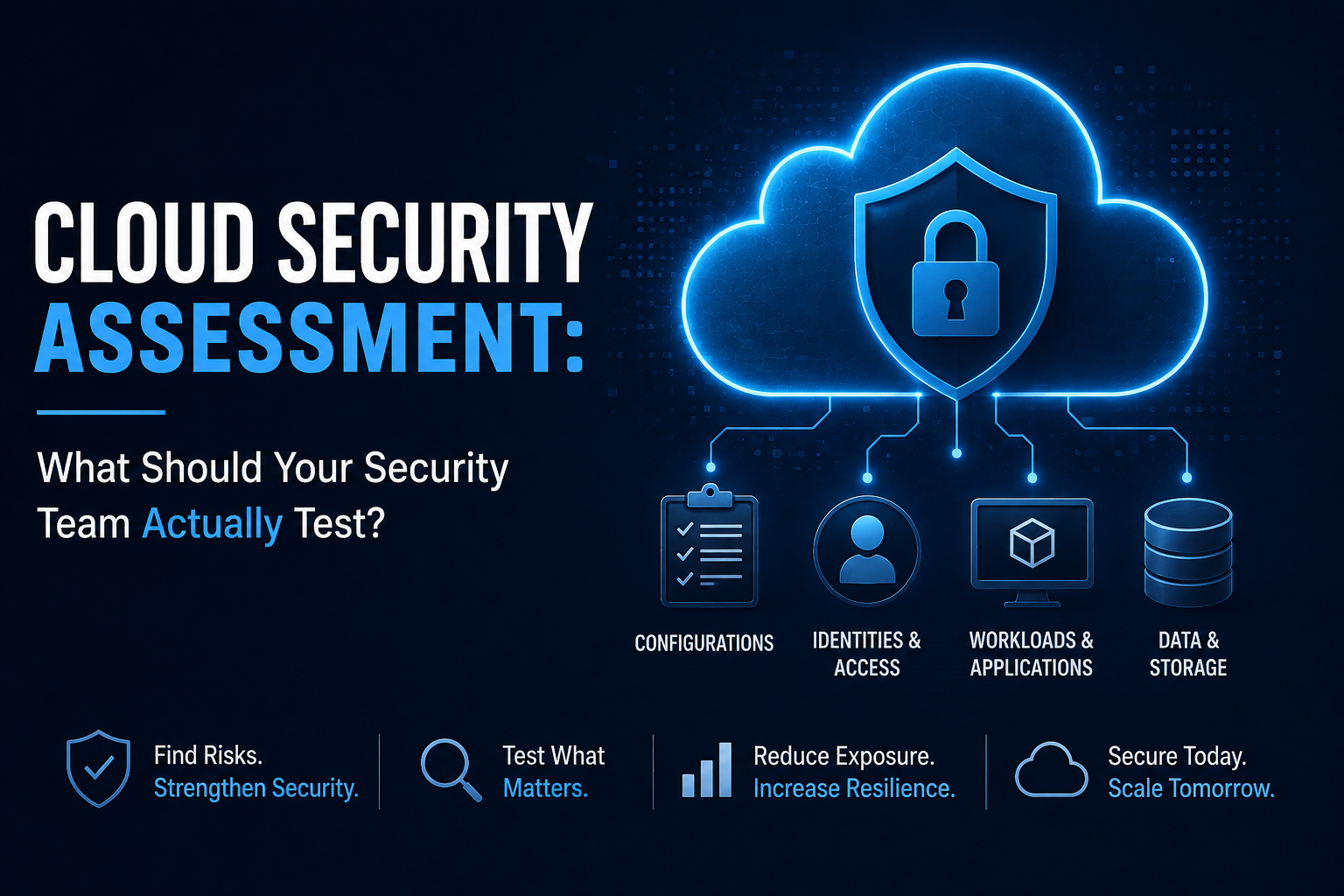
A credible cloud security assessment is never a single scan. It is a structured examination across several distinct layers, because real-world attacks rarely stay confined to just one.
* Identity and access management should be treated as the true perimeter of any cloud environment — more so than the network edge or the firewall. A single overprivileged identity can expose storage, workloads, databases, and backups simultaneously. Testing here involves reviewing role assignments, identifying unused or excessive permissions, and confirming that access genuinely aligns with operational need.
* Storage and data exposure remain among the most common and most preventable failure modes in cloud environments. Public buckets and unsecured databases are the digital equivalent of an unlocked filing cabinet in an unrestricted room. A proper assessment reviews every storage resource for exposure, not only the ones already under routine observation.
* API security deserves particular scrutiny, given that APIs now carry the overwhelming majority of traffic moving through modern applications. A growing share of security leaders already name API vulnerabilities among their top cloud risks. Testing should evaluate authentication, authorization boundaries, and whether an API returns more information than it should to any given requester.
* Container and Kubernetes environments have consistently struggled to keep pace with the speed of adoption. Misconfiguration remains a leading cause of Kubernetes-related incidents, and newly deployed clusters can face active scanning within minutes of going live. Where containers form part of the infrastructure, they warrant dedicated review rather than incidental coverage.
* CI/CD pipeline security matters because the pipeline that builds and ships code is itself a meaningful asset — vulnerable to poisoned dependencies, exposed secrets in build logs, and insufficiently restricted deployment credentials. A compromise at this layer rarely affects a single system; it tends to affect everything the pipeline subsequently touches.
* SaaS permissions extend an organization's attack surface well beyond its own infrastructure. Every connected third-party tool carries access that deserves periodic review, yet this step is frequently omitted from broader assessments.
* Logging and monitoring underpin every other control on this list. None of the preceding safeguards holds real value if their failure would go unnoticed. An assessment should test not only whether controls exist, but whether the organization would detect their compromise or bypass.
Testing Validates What Tools Alone Cannot
It is worth stating plainly that cloud security posture management tools — CSPM, CWPP, CIEM, and comparable platforms — provide genuine value. They surface configuration drift, flag clear exposures, and give security teams continuous visibility into their environment.
What these tools do not reliably establish is exploitability. A platform may correctly flag a permission as overly broad, but it cannot always determine whether that permission, combined with several smaller weaknesses elsewhere, provides an attacker a genuine path from a public-facing API to a production database.
Closing that gap is the purpose of a properly scoped cloud penetration test — validating whether individual weaknesses across identity, network configuration, storage, APIs, SaaS permissions, and CI/CD pipelines can be chained into a meaningful compromise. Misconfiguration statistics translate into value only once acted upon: identifying the exposure, remediating it, and confirming through retesting that the fix holds.
The Question Every Assessment Is Ultimately Answering
Cloud adoption has outpaced cloud security maturity across most industries — a gap that forms the honest premise of this entire discussion, rather than an exception to it. Budgets continue to grow. Tool adoption continues to grow. Genuine operational maturity is advancing at a considerably slower pace.
A cloud security assessment is not undertaken to prove an environment is flawless; very few are. Its purpose is to establish, deliberately and on the organization's own timeline, precisely where the gaps lie — the overprivileged role left unreviewed, the storage bucket left unchecked, the API disclosing more than intended — before an adversary identifies the same gap on a timeline entirely outside the organization's control.
The eight-month remediation window documented by Verizon did not emerge from indifference. It emerged from insufficient scrutiny, applied insufficiently often, to catch the issue sooner.
At ILLUME, this is precisely the gap our cloud security assessments are built to close. Our engagements move beyond the alerts a CSPM dashboard already surfaces, testing whether the identity, storage, API, container, and pipeline weaknesses in a given environment can actually be chained into a meaningful compromise — the same way a real attacker would attempt it. Every engagement concludes with a prioritized remediation roadmap and a retest to confirm the fixes hold, not just a list of findings left for someone else to act on.
If it has been more than a few months since your cloud environment was tested this way, that alone is worth a conversation. Reach out to ILLUME to scope a cloud security assessment built around your specific environment, data sensitivity, and risk profile.