TheDPDPAct.com -
Official WhatsApp Channel
Stay updated with the latest DPDP Act news, compliance insights, updates, and resources.
Join Our WhatsApp Channel →A single non-compliant data practice — a consent form that doesn't meet the new standard, a vendor contract that never mentions data processing obligations — can now cost an Indian business up to INR 250 crore under the Digital Personal Data Protection Act, 2023. Yet ask ten business owners what "DPDP compliance services" actually involve, and you'll likely get ten different, mostly incomplete answers. Some think it means a one-time legal review. Others assume it's just a privacy policy update. Neither comes close. This guide breaks down exactly what a real DPDP compliance engagement covers, why the pieces have to work together, and how to tell a serious compliance partner from a checkbox exercise.
Why "DPDP Compliance" Means More Than a Policy Document
The Digital Personal Data Protection Act, 2023 (DPDP Act) governs how organizations collect, process, store, and protect the personal data of individuals in India. Unlike compliance frameworks built around a single audit or certificate, DPDP compliance is fundamentally about demonstrable, ongoing accountability — meaning your organization needs to prove, not just claim, that personal data is handled lawfully at every stage of its lifecycle.
That distinction matters because it changes what "compliance services" actually need to deliver. A policy document alone doesn't hold up under regulatory scrutiny if your systems, vendor contracts, and internal processes don't reflect what that policy claims.
The Core Components of DPDP Compliance Services
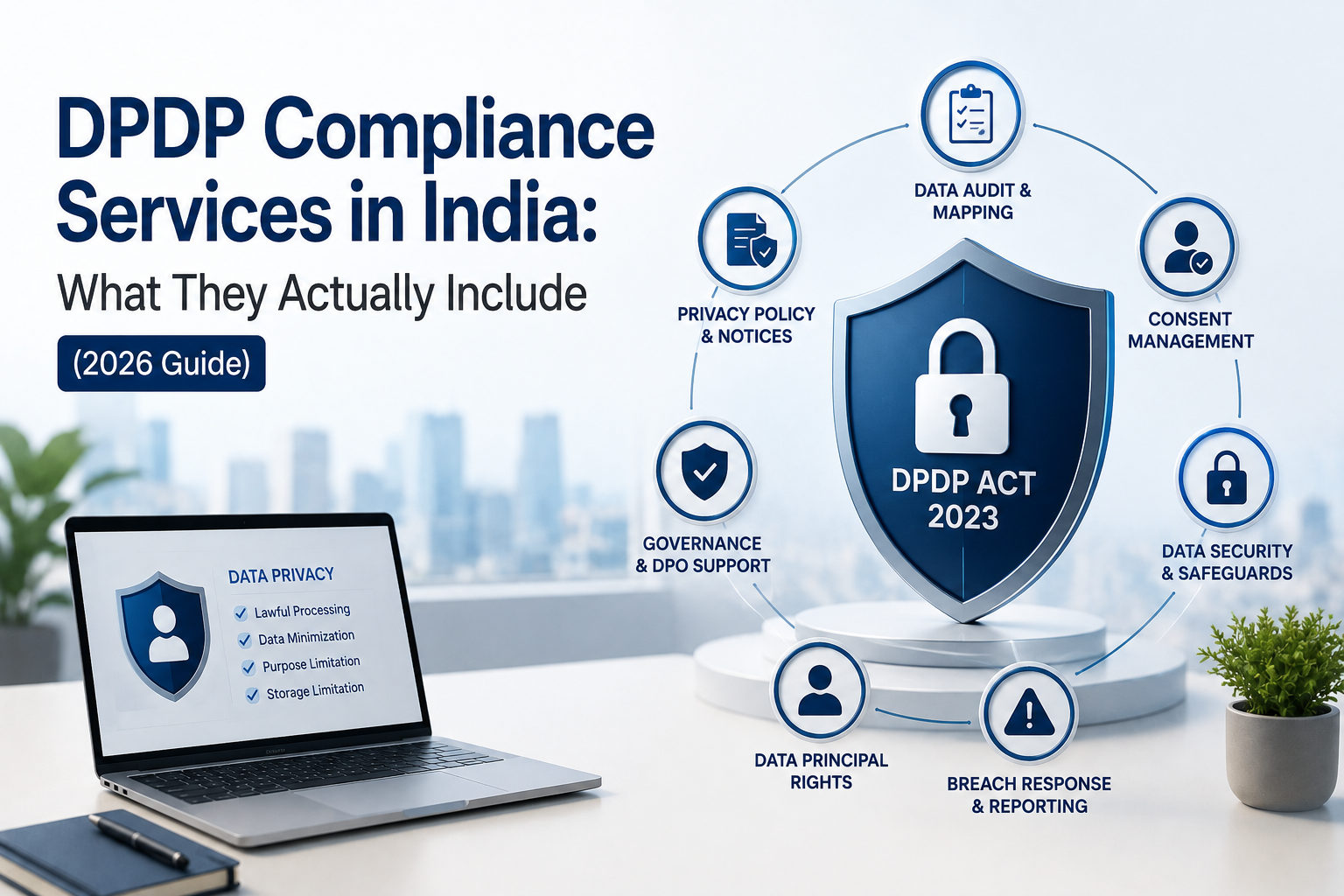
1. Data Discovery & Mapping
Before anything else, a compliance partner needs to answer a deceptively hard question: where does your personal data actually live? This involves identifying every system, database, and third-party vendor that touches personal data, then mapping how that data flows — from collection, through processing, to eventual deletion. Most organizations underestimate how scattered this picture really is until it's mapped out formally.
2. Gap Assessment Against DPDP Requirements
Once data flows are mapped, the next step is comparing current practices against what the Act actually requires — consent standards, data minimization, purpose limitation, and specific obligations depending on whether your organization qualifies as a Significant Data Fiduciary. This produces a concrete gap analysis, not a vague sense of "mostly compliant."
3. Consent & Policy Framework Design
DPDP raises the bar on what counts as valid consent — it needs to be specific, informed, and unambiguous, not buried in dense legal language nobody reads. Compliance services at this stage involve designing consent management mechanisms, notice formats, and privacy policies that actually meet this standard, not repurposing old privacy language with a new name.
4. Data Protection Risk Assessment
Beyond legal gaps, a proper DPDP engagement assesses the operational and security risk tied to how data is stored and processed — because a policy that looks compliant on paper but sits on top of a weakly secured database still represents real exposure. This is where compliance work benefits enormously from teams with actual cybersecurity depth, not just legal training.
5. Governance & Accountability Structures
The Act expects organizations to have clear internal accountability — who owns data protection decisions, how breaches get escalated, how data subject requests get handled. Building this structure is a core, often underestimated part of compliance services, since regulators care about process as much as paperwork.
6. Audit Readiness & Documentation
Finally, real compliance services prepare you for scrutiny — whether that's a regulatory inquiry, an enterprise customer's security questionnaire, or an internal board review. This means structured documentation, evidence trails, and a compliance posture that can be demonstrated on demand, not reconstructed under pressure.
What Separates Genuine DPDP Compliance Services From a Checklist
A surprising amount of what's marketed as "DPDP compliance" in India right now is essentially a repackaged privacy policy template with the Act's name attached. Genuine compliance services are distinguished by a few things:
* They start with discovery, not documents. You can't design accurate policies without first understanding your actual data flows.
* They involve technical validation, not just legal review. Claims about how data is protected should be checked against how systems are actually configured.
* They build for ongoing monitoring, not a one-time deliverable. DPDP compliance isn't a static state — it needs to hold up as your business, data practices, and the regulatory guidance around the Act continue to evolve.
* They're tailored to your sector. A fintech platform handling financial identity data faces different practical obligations than an e-commerce company handling browsing behavior data, even under the same law.
Who Actually Needs to Prioritize This
While the Act technically applies broadly to any organization processing personal data of individuals in India, certain categories face materially higher exposure and should treat DPDP compliance as an immediate priority rather than a future item:
* Organizations processing sensitive categories of data (health records, financial data, biometric information)
* Platforms conducting large-scale user data processing (SaaS, fintech, e-commerce)
* Businesses that may qualify as Significant Data Fiduciaries based on data volume or sensitivity
* Organizations expanding into or already operating in India with global data operations
A Realistic Compliance Timeline
Organizations often assume DPDP compliance is either a quick fix or a multi-year overhaul — the reality typically sits in between. A structured engagement, moving through discovery, gap assessment, policy design, implementation, and audit readiness, generally takes several weeks to a few months, depending heavily on how complex and scattered your existing data environment is. Organizations with cleaner data architecture and fewer third-party integrations tend to move through this considerably faster than those with years of accumulated data sprawl.
The Bottom Line
DPDP compliance services, done properly, aren't a single deliverable — they're a structured process spanning data discovery, gap assessment, policy design, risk assessment, governance, and ongoing audit readiness. Organizations that treat this as a one-time legal exercise tend to discover the gaps the hard way — during an audit, a breach, or a lost enterprise deal that hinged on a security questionnaire they couldn't answer confidently. The organizations that treat it as an ongoing operational discipline, backed by real technical validation, are the ones that turn compliance into a genuine trust signal rather than a lingering liability.