TheDPDPAct.com -
Official WhatsApp Channel
Stay updated with the latest DPDP Act news, compliance insights, updates, and resources.
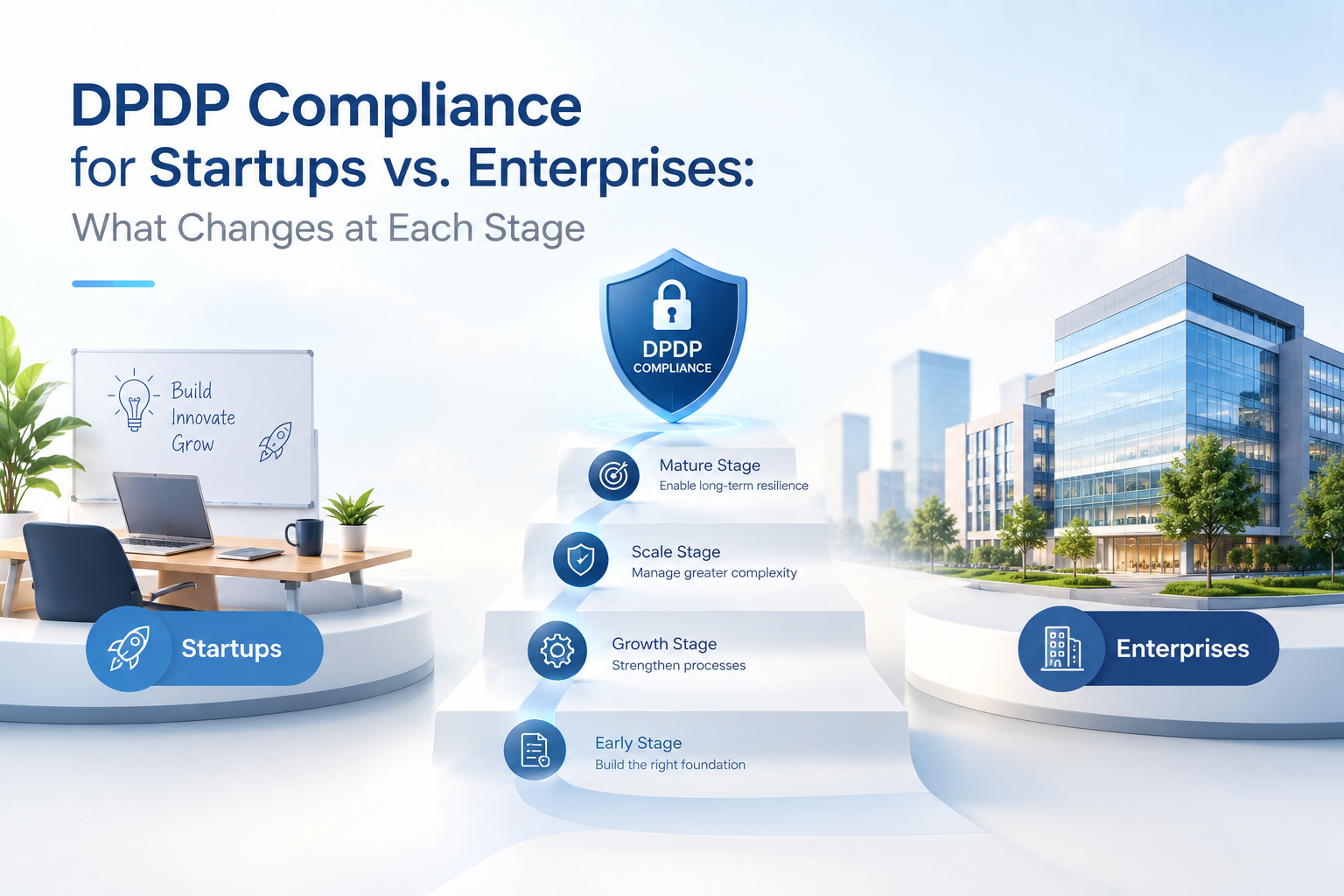
Join Our WhatsApp Channel →One of the most common misunderstandings about India's Digital Personal Data Protection Act is that it scales with the size of the organization it applies to. It doesn't — not in the way most people assume.
The core obligations under the DPDPA apply to every Data Fiduciary processing digital personal data of individuals in India, regardless of size, revenue, or headcount. A bootstrapped startup with 5,000 users has the same requirement to give proper notice, obtain valid consent, honor data principal rights, and implement reasonable security safeguards as a listed enterprise processing millions of records. There is no small-business threshold in the Act. There is no revenue floor below which the obligations don't apply.
What does change at scale is the additional layer of requirements that come with Significant Data Fiduciary designation — a higher-obligation tier the government can impose on organizations based on the volume and sensitivity of data they process, their systemic risk to users, and the potential national security implications of their operations. Below that threshold, the core obligations are the same. Above it, the compliance burden becomes meaningfully heavier.
Understanding where your organization sits — and where it's heading — is the starting point for building a compliance program that's correctly sized for where you actually are.
The Foundation: What Every Organisation Needs, Regardless of Stage
Every Data Fiduciary, from a seed-stage startup to a national enterprise, needs to demonstrate the same foundational obligations by 13 May 2027.
* Notice and consent that actually satisfies Section 6.
This means consent that is specific — given separately for each distinct processing purpose — informed, and unambiguous. Bundling all processing into one checkbox at registration doesn't satisfy the Act. Each purpose needs its own consent, each consent must be withdrawable as easily as it was given, and the withdrawal needs to propagate to every system that holds data covered by it. For a startup with a simple product and a clean data architecture, this is a tractable engineering problem. For an enterprise with legacy systems, acquired data sets, and dozens of processing purposes accumulated over years, it becomes a significant remediation project.
* A functioning data principal rights workflow.
Data principals can request access to their data, correction of inaccuracies, erasure, and grievance redress. These aren't aspirational commitments — they're operational workflows that need to work end-to-end, within reasonable timescales, for whoever submits a request. A startup with a well-structured database and a small team can often build this in days. An enterprise with fragmented data across multiple systems, vendors, and geographies may need months.
* Reasonable security safeguards under Section 8(5).
The penalty for failing to maintain these is up to INR 250 crore — the highest in the Act's penalty schedule — and the obligation requires demonstration, not assertion. What counts as reasonable scales somewhat with the data being held and the risks involved, but no organization escapes it by virtue of being small.
* Breach notification within 72 hours.
Both to the Data Protection Board and to affected Data Principals, in a prescribed format, with a description of what happened and what's being done. This requires a tested incident response workflow before an incident happens, not a plan assembled under pressure afterward.
The practical implication: a startup that assumes DPDP compliance is someone else's problem — or a future problem — until it reaches a certain scale is taking a regulatory risk the Act doesn't support. The penalty structure is not proportionate to organization size. The fines are the same regardless of whether the organization failing to implement reasonable security safeguards serves five thousand users or fifty million.
What Changes for Startups: The Compliance Advantage Nobody Talks About
The organizational reality of being a startup — a small team, a relatively simple product, a still-forming data architecture — creates genuine compliance advantages that larger organizations simply don't have.
1. Less legacy to remediate.
Enterprises often begin DPDP compliance with years of historical data collected under no formal consent framework, processing purposes that have evolved informally over time, and data systems that weren't designed with notice-and-consent architecture in mind. A startup beginning compliance from a clean slate can build the right architecture from the start, rather than retrofitting obligations onto systems designed before they existed.
2. Simpler consent architecture.
The more processing purposes an organization has, the more complex the consent management requirement becomes. A startup with one or two clearly defined use cases for user data has a significantly simpler consent problem to solve than an enterprise with marketing, analytics, personalization, third-party sharing, and research processing all running in parallel.
3. Faster decision-making.
Compliance decisions that require cross-functional alignment across legal, engineering, product, and operations — decisions that can take months in a large enterprise — can happen in days or weeks at a startup. This is a genuine time-to-compliance advantage.
The cost picture reflects this. A startup with under 10,000 users can achieve substantive DPDP compliance for a fraction of what enterprise compliance programs cost — vendors and consultants who quote large-enterprise figures for startup engagements are frequently over-scoping. Getting the basics right — proper consent architecture, a functional data principal rights workflow, reasonable security safeguards, and a tested breach response — is achievable quickly and cost-effectively if the organization starts with an accurate picture of what it actually needs.
What Changes for Enterprises: The Significant Data Fiduciary Tier
The compliance gap between a startup and a large enterprise opens most significantly around the Significant Data Fiduciary designation. The government has not yet published the precise numerical thresholds for SDF classification, but the criteria under Section 10 of the Act include the volume and sensitivity of personal data processed, the potential risk to data principals' rights, the potential national security and public order implications, and the systemic importance of the organization's digital platform.
Organizations in financial services, health, telecommunications, large consumer platforms, and data-intensive B2C businesses are the most widely anticipated candidates for SDF designation. For organizations in these categories, it's worth planning for SDF obligations proactively rather than waiting for formal notification.
SDF status adds meaningful obligations on top of the baseline:
1. A Data Protection Officer based in India.
The DPO must be a senior-enough role to represent the organization with the Data Protection Board — this isn't a junior compliance appointment.
2. Data Protection Impact Assessments.
DPIAs must be conducted for high-risk processing activities and for significant changes to existing processing. These aren't checkbox exercises — they require structured analysis of data flows, risk identification, and documented mitigation, conducted before the processing begins.
3. Mandatory independent data audits.
Under Section 10, SDFs are subject to independent data audits that verify compliance with the Act's requirements. Unlike internal compliance reviews, these are conducted by external auditors accountable to a regulatory standard rather than to the organization being audited.
4. Algorithmic accountability.
SDFs that use automated decision-making processes — recommendation systems, credit scoring models, content personalization — face additional obligations around transparency and fairness in those processes.
For a large enterprise already investing in data governance, these obligations are additive rather than transformational. For an organization that hasn't built a mature data governance function, they represent a significant program of work.
The India-EU Operating Reality: DPDPA and GDPR Side by Side
For organizations operating across both India and EU markets — and there are many, particularly in SaaS, fintech, and healthcare — the comparison between the two frameworks is practically important, not just theoretically interesting.
The most significant structural difference is the lawful basis framework. GDPR allows organizations to process personal data under a range of lawful bases — legitimate interest, contractual necessity, legal obligation, vital interests, and consent. The DPDPA's primary basis is consent, with a narrower alternative category of "certain legitimate uses" that covers specific situations like employment, medical emergencies, and legal proceedings. Legitimate interest as a standalone processing ground doesn't exist under the DPDPA.
This has a direct operational implication: an organization that processes data under legitimate interest for its EU operations will need either consent or a different applicable exemption for processing the same data for Indian data principals. GDPR compliance doesn't automatically translate to DPDPA compliance, and organizations assuming otherwise are leaving a genuine gap in their framework.
Cross-border data transfers are handled differently too. GDPR has an established adequacy framework with specific mechanisms for lawful transfers to countries without equivalent protection. The DPDPA allows cross-border data transfers by default, except to countries specifically restricted by the Central Government. The list of restricted countries has not yet been published, but organizations should monitor it — and build transfer governance that can accommodate restrictions when they arrive — rather than assuming the current default permissiveness will persist.
The children's data treatment is structurally similar in intent but different in the specific threshold: GDPR sets the age threshold at 16 in most member states (with some variations). The DPDPA treats anyone under 18 as a child, with a correspondingly broader scope of children's data obligations.
Building a Compliance Program That Scales With You
The most common mistake organizations make at either stage is building a compliance program sized for where they are rather than where they're heading. A startup that builds a barely-minimum compliance program today will find it more expensive to upgrade when it scales than it would have been to build a scalable foundation initially. An enterprise that treats DPDPA compliance as a separate India-only initiative rather than integrating it into a broader global data governance framework creates duplication and inconsistency that becomes harder to manage over time.
The right approach at both stages is the same in principle, even if it differs significantly in scale: understand what data you actually hold and why, build consent and rights workflows that can genuinely support the obligations you have today and scale to the ones you'll have tomorrow, implement security safeguards at a level that reflects the data you're holding, and test all of it before a regulator or an incident does it for you.
At ILLUME Intelligence, we provide DPDP compliance services across both stages — working with early-stage organizations to build a compliant foundation from the start, and with established enterprises to close the gaps between current practices and the requirements that become enforceable in May 2027. Whether you're assessing your current posture, designing a compliance architecture, or preparing for the security safeguard demonstration that Section 8(5) requires, reach out to ILLUME to scope what the right program looks like for your stage and data profile.