TheDPDPAct.com -
Official WhatsApp Channel
Stay updated with the latest DPDP Act news, compliance insights, updates, and resources.
Join Our WhatsApp Channel →Most conversations about India's Digital Personal Data Protection Act focus on what it requires. Far fewer focus on how long it actually takes to get there — which is the more pressing question for any organization that hasn't started yet.
The short, uncomfortable answer: longer than most compliance calendars currently assume.
The DPDP Rules, 2025 were notified on 13 November 2025, starting an 18-month phased clock. Full substantive compliance — including consent and notice obligations, security safeguards, data principal rights, breach notification workflows, and Significant Data Fiduciary duties — becomes enforceable on 13 May 2027, with no grace period expected. The Data Protection Board is already operational. Complaints can be filed today. The only thing that changes in May 2027 is that the Board's full penalty powers become live, and organizations unable to demonstrate compliance at that point face penalties running up to INR 250 crore per violation — per violation, not per incident, not annually.
That deadline is eight months away from the time this is being written. For most organizations, eight months is not the runway it sounds like.
Why the Timeline Feels Longer Once You're Inside It
The DPDP compliance journey has a deceptive shape. From the outside, it looks like a documentation exercise — update the privacy policy, add a consent banner, appoint a Data Protection Officer, and the work is largely done. From the inside, once an organization actually starts, it looks very different.
* Data discovery and mapping comes first, and it takes longer than expected.
Before an organization can give valid notice under Section 5 about what personal data it collects and why, it needs to know what personal data it actually collects and why. For most Indian enterprises — particularly those that have grown quickly, migrated systems, acquired other companies, or onboarded SaaS tools informally — the answer is genuinely unclear until someone maps it deliberately. Data flows across divisions, vendors, legacy systems, and third-party processors are rarely fully documented in advance. Organizations consistently report this phase taking four to eight weeks when done properly, and longer for complex environments.
* Consent architecture is a technical project, not a form update.
Section 6's requirement for specific, informed, unambiguous consent — given separately for each purpose, withdrawable as easily as it was given — requires a mechanism for managing that consent over time. A checkbox at registration doesn't satisfy this. Organizations need a consent management infrastructure that can record what was consented to, when, in what version of the notice, and can propagate a withdrawal to every system and processor that holds data covered by that consent. Retrofitting this into existing products is a multi-sprint engineering effort for most teams.
* Security safeguards need to be demonstrable, not just present.
Section 8(5) requires reasonable security safeguards — but the word reasonable is not a low bar in a regulatory context, and "we have security controls in place" is not the same as "we can demonstrate reasonable security safeguards under regulatory scrutiny." Penetration testing, access control documentation, encryption evidence, a tested breach detection and response workflow that can actually meet the 72-hour notification timeline — these need to exist and be evidenced, not asserted. Organizations that haven't formally tested their breach response against realistic incident scenarios frequently discover, during readiness assessments, that their response plan has never been exercised end-to-end.
* Historical data creates a problem most organizations haven't solved.
The Act doesn't only apply to data collected after the Rules were notified. Organizations are expected to ensure that personal data collected before the DPDP framework is supported by valid notice and consent mechanisms consistent with the Act's requirements. For large consumer platforms and enterprises with years of accumulated customer records, this is a meaningful remediation challenge — not a policy update.
The Phased Rollout, Mapped to What It Actually Means
The compliance timeline has three distinct phases, each with its own practical implication.
Phase 1 — November 2025 (complete).
The Data Protection Board was constituted and became operational. This matters more than it sounds: it means the regulatory body exists, complaints can be received, and the framework for enforcement is live. Organizations are not in a pre-enforcement vacuum. They are in a supervised transition period, which is a different thing.
Phase 2 — November 2026 (eight months away).
The Consent Manager registration framework opens. For organizations that plan to rely on a registered Consent Manager to facilitate consent collection — rather than building their own consent management infrastructure — this milestone matters because it defines when that option becomes usable. Organizations evaluating whether to build or rely on a third-party Consent Manager need to make that architectural decision well before November, because both paths require implementation time before May 2027.
Phase 3 — May 2027 (the hard deadline).
Full substantive compliance. Notice and consent obligations, security safeguards, data principal rights (access, correction, erasure, grievance redress), breach notification, and Significant Data Fiduciary duties are all expected to be operationally in place. The Board's penalty powers are fully activated. There is no indication of an extended grace period from the government, and multiple independent compliance analysts have flagged the absence of any such indication explicitly.
One statistic from independent analysis of the current compliance landscape is worth sitting with: approximately 83% of in-scope organizations are estimated to be not yet on track for May 2027. If that figure is anywhere near accurate, it describes a significant compliance crunch approaching across Indian industry — which is precisely the kind of environment that tends to attract regulatory attention, not reduce it.
Where GDPR Experience Doesn't Transfer
Some Indian organizations operating globally have existing GDPR compliance programs and assume these provide meaningful DPDP coverage. They provide a foundation, but the DPDPA differs in several ways that require specific work regardless of existing GDPR readiness.
The most significant difference is the lawful basis framework. GDPR allows multiple grounds for processing — contract, legitimate interest, legal obligation, vital interests — alongside consent. The DPDPA uses consent as the primary lawful basis for processing, with a narrower set of "certain legitimate uses" as the alternative. Legitimate interest, as a standalone processing ground, does not exist under the DPDPA. Organizations that process data under legitimate interest for their GDPR obligations will need to identify an alternative basis — typically consent — under the DPDPA, or restructure the processing.
The children's data regime is also structured differently. The DPDPA treats anyone under 18 as a child (not as under GDPR in many member states), requires verifiable parental consent for all processing of children's data, and prohibits tracking, behavioural monitoring, and targeted advertising directed at children outright — regardless of parental consent. These prohibitions require proactive changes to how data is handled, not just consent mechanics.
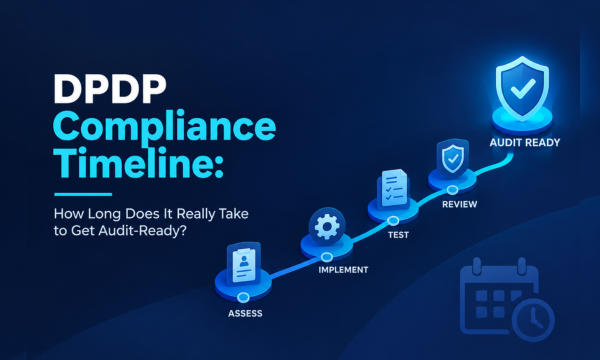
A Realistic Timeline for Getting Audit-Ready
Working backward from May 2027, a realistic compliance timeline for a mid-size Indian enterprise looks something like this:
Months 1–2: Discovery and gap assessment.
Map data flows across all systems and vendors, identify what personal data is collected, where it lives, under what basis, and for how long. Run a formal gap assessment against the Act's requirements. This phase produces the information every subsequent phase depends on.
Months 2–4: Architecture and design.
Design the consent management framework, the data principal rights fulfillment workflow, the breach detection and response protocol, the vendor and processor management approach. For Significant Data Fiduciary candidates, scope the Data Protection Impact Assessment and the independent audit requirement.
Months 4–7: Implementation.
Build the consent infrastructure, update notice and consent touchpoints across products and services, implement the security safeguards required for demonstrable compliance, establish the grievance redress mechanism, train staff on the new obligations.
Month 7–8: Testing and readiness validation.
Run the breach response workflow end-to-end under realistic conditions. Commission a DPDP readiness audit from an independent qualified auditor. Remediate findings with enough time remaining for those remediations to be closed — not merely identified — before May 2027.
The reason this math matters: a compliance program that starts in January 2027 and expects to be audit-ready by May 2027 is not running a compliance program. It's running an emergency. And the evidence from similar regulatory deadlines in India and elsewhere is consistent: organizations that arrive at enforcement with remediation still in progress, rather than compliance already demonstrated, face the sharpest regulatory scrutiny.
The Reasonable Security Safeguards Obligation Is Worth Specific Attention
Among all of the DPDPA's compliance requirements, Section 8(5)'s reasonable security safeguards obligation is the one most likely to catch organizations unprepared — not because it's the hardest to understand, but because it requires technical evidence rather than documentation.
A privacy policy satisfies a notice requirement. A consent log satisfies a consent requirement. Reasonable security safeguards require penetration testing evidence, access control reviews, encryption implementation, and a tested incident response workflow — the kind of substantive security work that takes time to execute properly and can't be manufactured at the last minute.
For organizations that haven't run formal penetration testing or security assessments recently, this obligation is the one that creates the longest lead time in the compliance program. It's also the one that carries the highest penalty for failure — up to INR 250 crore — which makes it the most consequential gap to discover late.
At ILLUME Intelligence, the reasonable security safeguards obligation under Section 8(5) is precisely where our DPDP-readiness assessments and penetration testing engagements connect directly to the Act's requirements. We help organizations establish the technical security evidence their DPDP compliance program needs — not just the policy layer, but the demonstrable safeguards that would withstand regulatory scrutiny. If May 2027 is on your compliance calendar and the security evidence layer isn't yet in place, reach out to us to scope what's needed and how long it will actually take.