TheDPDPAct.com -
Official WhatsApp Channel
Stay updated with the latest DPDP Act news, compliance insights, updates, and resources.
Join Our WhatsApp Channel →
Here's the uncomfortable math most boardrooms haven't run yet: a qualified Data Protection Officer in India now commands between INR 25 and INR 60 lakh annually at large companies, and that's before you account for how hard that role actually is to fill. India is currently short more than one million cybersecurity professionals, with an estimated 25-30% shortfall specifically in mid-to-senior cybersecurity specialists — the exact experience level DPDP compliance actually demands. So when a business asks "should we hire in-house or bring in DPDP consultants," it's rarely a simple cost comparison. It's a build-vs-buy decision playing out against a genuinely tight talent market, on a fixed regulatory deadline. Here's how to actually think it through.
Why This Question Is More Urgent Than It Used To Be
The DPDP Rules, 2025 were notified in November 2025, and SDF-specific obligations — including mandatory Data Protection Officer appointment for Significant Data Fiduciaries — become enforceable from May 13, 2027. That's a fixed date, not a flexible planning horizon. Organizations weighing in-house hiring against outsourced consultants need to factor in not just cost, but whether they can realistically build the required capability before that clock runs out.
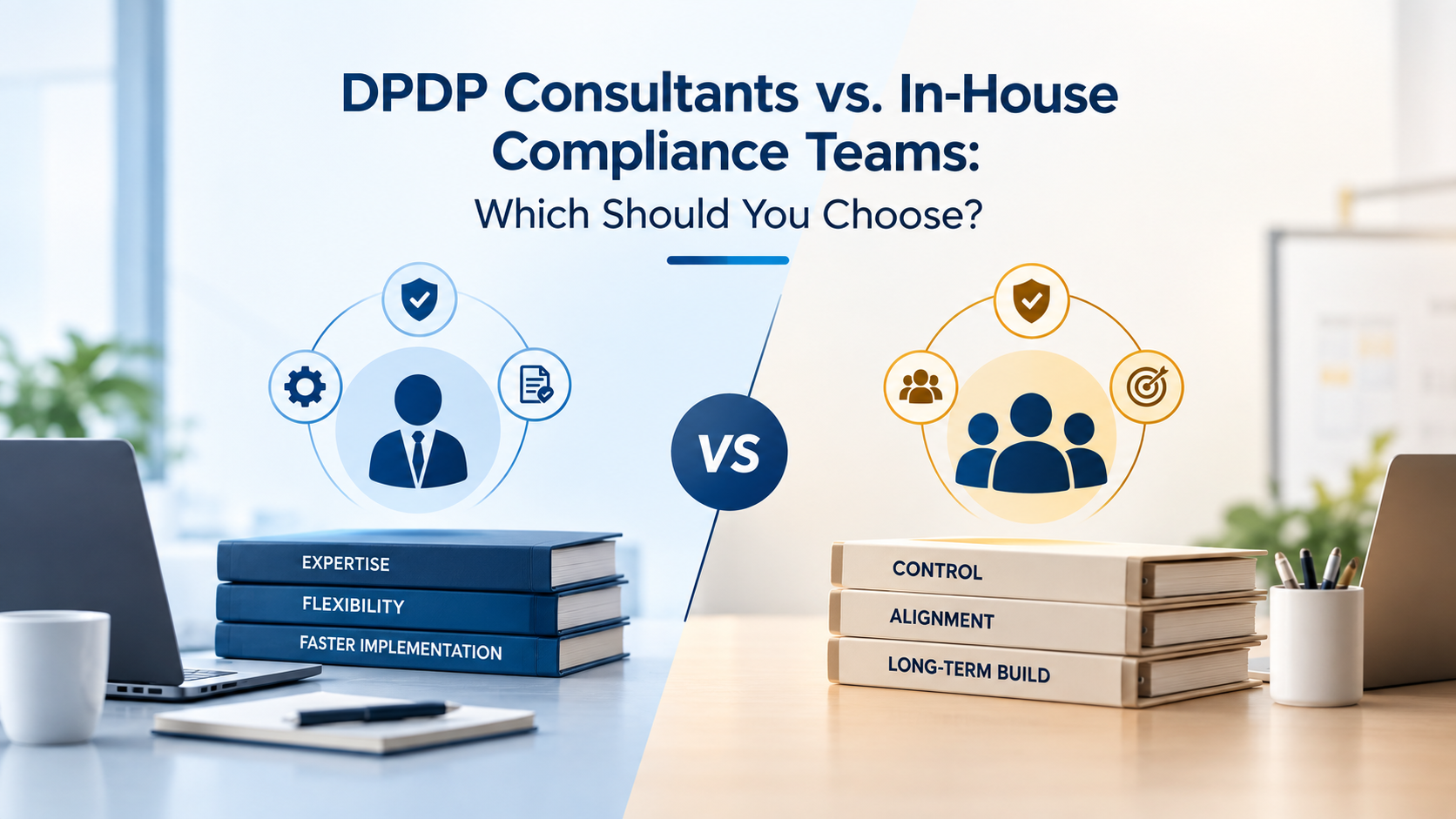
The Case for In-House Compliance Teams
* Deep institutional knowledge. An in-house team lives inside your business every day — they understand your systems, your product roadmap, and your internal politics in a way an outside consultant has to work to learn.
* Direct, immediate access. Questions get answered in real time, without the scheduling friction of an external engagement.
* Long-term ownership. A dedicated internal team can build compliance into company culture over years, not just deliver a project.
Where it struggles:
* The talent is genuinely scarce. Beyond the raw vacancy numbers, industry research shows the privacy skills gap is driven less by a lack of interest and more by a shortage of experienced senior candidates — organizations overwhelmingly want direct role experience, which is exactly what's hardest to find in a still-maturing field. Hiring for DPDP-specific expertise in India right now means competing for a very small pool.
* It's a narrow, single-threaded skill set. One in-house hire, however capable, can't easily replicate the combined legal, technical, and audit expertise a multi-disciplinary consulting team brings by default.
* Cost adds up beyond salary. Beyond the INR 25-60 lakh compensation range for experienced DPOs, you're absorbing recruitment costs, onboarding time, benefits, and the ongoing cost of keeping that person current as the Rules and enforcement guidance evolve.
* Single point of failure. If your one internal expert leaves, your compliance program's institutional knowledge often leaves with them.
The Case for DPDP Consultants
* Immediate, multi-disciplinary expertise. A consulting engagement gives you access to legal, technical security, and audit expertise simultaneously — without needing to hire three different specialists.
* Faster time to readiness. Because consultants have typically run this exact process across multiple clients, they can move through discovery, gap assessment, and implementation faster than a team building the process for the first time.
* Cost efficiency for defined scope. For most mid-sized organizations, an external engagement costs meaningfully less than a full-time senior hire, particularly when the work is front-loaded (initial assessment and implementation) rather than needed at full intensity year-round.
Where it requires care:
* Consistency depends on the partner. Not every consulting firm brings the same technical depth — this is exactly why vetting matters (see our guide on choosing a DPDP compliance company).
* Less day-to-day proximity. External teams need structured communication to stay aligned with your internal priorities and product changes.
* Continuity requires the right engagement model. A one-time project engagement leaves gaps once it ends — ongoing advisory retainers solve this, but not every consultant offers them.
The Hybrid Model: What Most Growing Organizations Actually Choose
In practice, the sharpest divide isn't in-house versus outsourced — it's whether an organization builds a hybrid model. A common, effective structure looks like this:
* External consultants lead the heavy lifting — data discovery, gap assessment, policy design, and technical security validation — where specialized, cross-disciplinary expertise matters most.
* An internal point of contact (not necessarily a full DPO at first) manages day-to-day coordination, data subject requests, and internal awareness.
* A vCISO or DPO-as-a-Service model provides ongoing senior oversight without the cost or hiring difficulty of a full-time executive-level hire.
This hybrid approach is particularly common among organizations that don't yet know whether they'll be designated a Significant Data Fiduciary — since SDF status brings mandatory DPO and independent audit requirements the government hasn't finished formally assigning yet, most businesses are better served staying flexible rather than over-hiring against an uncertain classification.
A Simple Framework for Deciding
Ask these questions before choosing a path:
1. How large and complex is our data environment?
Larger, more complex environments benefit more from dedicated internal ownership over time.
2. Are we likely to be classified a Significant Data Fiduciary?
If so, a formal DPO becomes mandatory regardless of your broader strategy.
3. Can we realistically hire and retain the right talent before May 2027?
Given the current talent shortage, this is a genuine constraint, not a formality.
4/ Do we need this expertise year-round, or in concentrated phases?
Discovery and implementation phases are intensive; ongoing monitoring is lighter — a mismatch here wastes either budget or capability.
5. What's our actual budget reality?
Compare total cost of a senior in-house hire (salary, benefits, onboarding, retention risk) against a structured consulting engagement with an ongoing advisory component.
The Bottom Line
There's no universally correct answer here — but there is a wrong way to decide, which is choosing based on instinct rather than an honest look at your data complexity, your realistic hiring timeline against a fixed regulatory deadline, and your actual budget. Given how tight the specialized talent market currently is, most growing organizations find that a hybrid approach — external expertise driving the heavy technical and legal lift, with lighter internal ownership day to day — gets them to genuine compliance faster and more reliably than either extreme alone.