TheDPDPAct.com -
Official WhatsApp Channel
Stay updated with the latest DPDP Act news, compliance insights, updates, and resources.
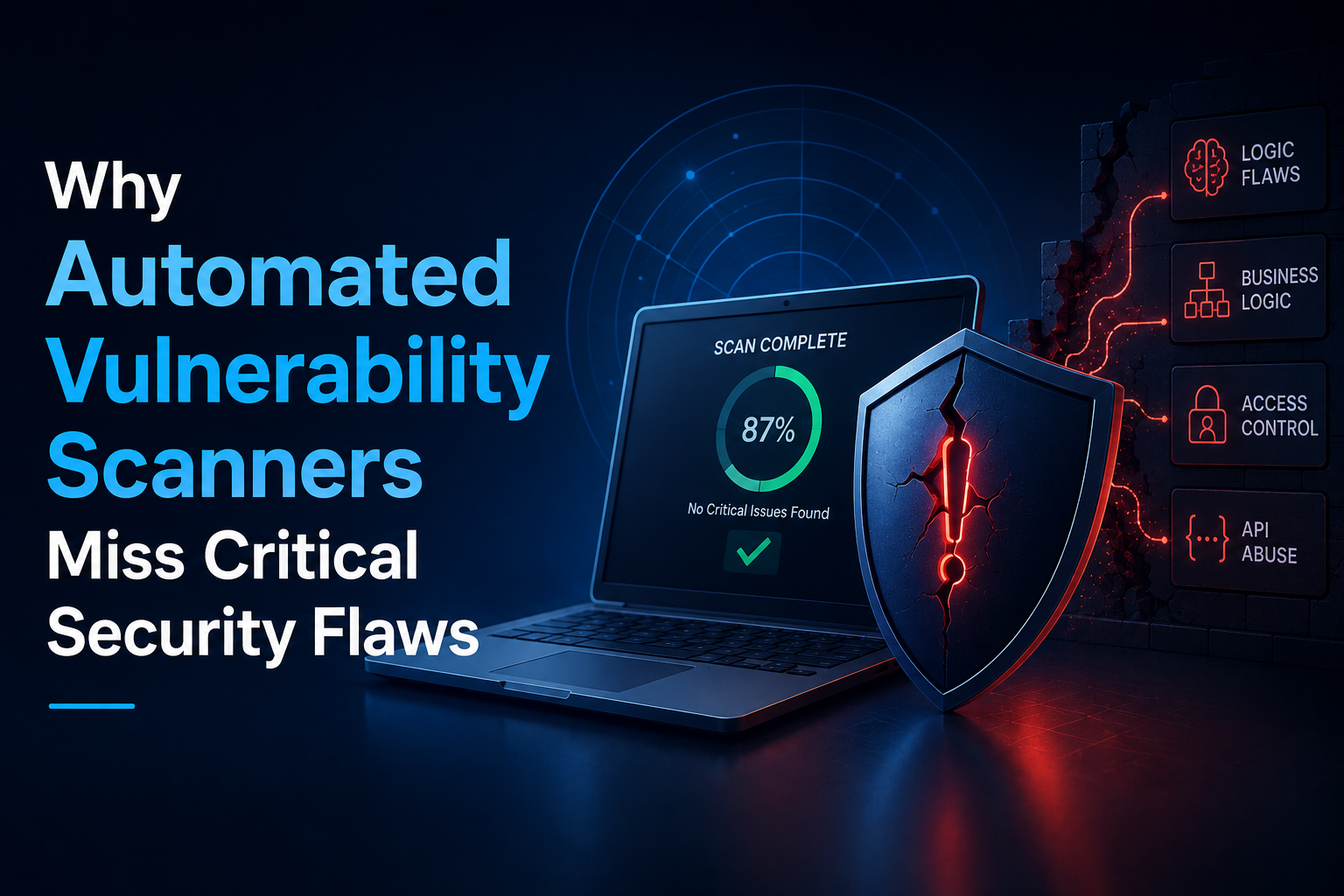
Join Our WhatsApp Channel →A scanner ran against your application last night. It found forty-three issues, ranked them by severity, and delivered a tidy report by morning. Nothing on that report will stop an attacker who understands how your checkout flow actually works.
This is the quiet trap in modern vulnerability management: a clean scan result gets mistaken for a clean bill of health. The two are not the same thing, and the gap between them is where some of the costliest breaches originate.
What Scanners Are Genuinely Good At
It's worth saying plainly, because the rest of this piece is critical of scanners: they are not a wasted investment. Automated tools compare an application or environment against enormous databases of known vulnerabilities, misconfigurations, and compliance failures, and they do this fast, repeatedly, and at a scale no human team could sustain manually.
They are particularly effective against well-understood, pattern-matchable flaws — the kind of issue that looks the same across thousands of applications and can be reliably detected by comparing behavior against a known signature. Unpatched software, default credentials, exposed configuration files, familiar injection patterns. This is genuinely valuable work, and it earns scanners a permanent place in any serious security program.
The trouble starts when an organization mistakes that coverage for complete coverage.
The Blind Spot: Business Logic
Here's a scenario that illustrates the gap precisely. An e-commerce platform offers a promotional discount — 25% off orders over a certain value. A customer adds enough items to qualify, applies the coupon, then removes items from the cart afterward, walking away with a discount the business never intended to give.
Nothing about that sequence trips a scanner. No malformed input. No injection payload. No broken authentication. The application performed exactly as it was coded to. The flaw isn't in the code — it's in the logic, the unstated assumptions about how a legitimate user would behave, that nobody thought to test against a user determined to behave differently.
This category — business logic vulnerabilities — is precisely where automated tools are, by design, structurally blind. Scanners detect deviations from expected technical behavior. They have no mechanism for evaluating whether the intended behavior itself can be abused. A scanner can confirm that a form field is properly sanitized. It cannot ask whether the workflow built around that form makes commercial sense to someone determined to break it.
The same blind spot shows up in access control. Consider an application that exposes a resource — an order, an account, a support ticket — through a predictable identifier, without properly checking whether the person requesting it actually has permission to see it. Catching that requires understanding what a specific user should and shouldn't be able to reach. A scanner sees a valid request returning a valid response and moves on. It has no concept of "this user shouldn't have been allowed to see this."
Industry testing data reflects the scale of what this blind spot actually costs. One recent penetration testing trends report found manual testing surfacing dramatically more vulnerabilities than automated tools alone in exactly this territory — APIs, cloud configurations, and chained exploits that span multiple systems. These aren't edge cases scanners occasionally miss. They're a structural category scanners were never built to see.
The Noise Problem Compounds the Coverage Problem
Coverage gaps aren't the only issue. Scanners also generate real noise, and that noise carries an operational cost most organizations underestimate.
Every false positive a scanner produces consumes a security or engineering team's time chasing something that was never actually exploitable — the familiar phenomenon of alert fatigue, where the sheer volume of unverified findings makes it progressively harder to tell which ones genuinely matter. Teams that have been burned by this enough times start treating scanner output with a degree of skepticism, which is a reasonable adaptation and also, quietly, its own risk: it becomes easier to wave away a real finding buried among the noise.
The result, across the industry, is a persistent remediation backlog — vulnerabilities identified but never actually closed, sitting in a queue for months at a time. Some of that backlog is a prioritization problem. A meaningful share of it is a trust problem.
The Industry Already Learned This the Hard Way
This isn't a hypothetical concern about a shift that hasn't happened yet. Organizations spent the past year genuinely testing whether fully automated security testing — including newer AI-driven approaches — could be trusted on its own. The findings were sobering enough to visibly shift industry confidence: a large majority of companies using automated testing systems reported those systems missing significant vulnerabilities outright, not just generating noise around real ones.
That experience shows up directly in how security leaders now talk about automation. Enthusiasm for relying on fully autonomous testing dropped sharply over the following year, as CISOs and practitioners moved from cautious optimism to a more grounded understanding of where automation's real limits sit. That's not a story about a technology failing. It's a story about an industry finding its limits through direct experience rather than assumption — which is exactly the kind of lesson worth learning before it costs you a breach, not after.
What This Means for How Vulnerability Management Should Actually Work
None of this argues for abandoning automated scanning. The right conclusion is more precise than that: scanning and manual testing solve different problems, and treating either one as sufficient on its own leaves a predictable, well-documented gap open.
Automated scanning earns its place doing what it does well — continuous, broad-coverage detection of known technical vulnerabilities, at a pace that keeps up with rapid deployment cycles and helps satisfy baseline compliance requirements.
Manual, human-led testing earns its place doing what automation structurally cannot: understanding business context well enough to recognize when an application is being abused in ways it was never designed to be abused, chaining smaller weaknesses across systems into a genuine attack path, and validating that a finding is truly exploitable before it consumes a single hour of remediation time.
Regulatory expectations increasingly reflect this same distinction. Frameworks like ISO/IEC 27001:2022 require organizations to identify technical vulnerabilities and take appropriate action — not simply to run a tool once a quarter and call the requirement met.
Where This Leaves Your Security Program
The uncomfortable question worth asking is a simple one: how much of your current vulnerability management confidence rests on scan results that have never actually been tested against a human who understands how your application's logic can be manipulated?
That gap — between what a scanner reports and what an attacker can actually do — is precisely where ILLUME's penetration testing and vulnerability assessment engagements are designed to operate. Our approach combines the breadth of automated coverage with the depth of manual, human-led testing: validating exploitability, chaining weaknesses across your applications, APIs, and cloud environments, and surfacing the business logic and access control flaws that automated tools are structurally unable to catch.
If your last vulnerability assessment was a scan and nothing more, it's worth finding out what a properly scoped, human-led engagement would surface instead. Reach out to ILLUME to talk through what that would look like for your environment.