TheDPDPAct.com -
Official WhatsApp Channel
Stay updated with the latest DPDP Act news, compliance insights, updates, and resources.
Join Our WhatsApp Channel →India’s digital transformation is accelerating at an unprecedented pace. From government digital initiatives and fintech innovation to cloud-driven enterprises and smart infrastructure, organizations across the country are increasingly dependent on interconnected digital ecosystems. While this transformation fuels economic growth and operational efficiency, it also expands the surface area for cyber threats.
Cyberattacks today are no longer isolated events carried out manually by small groups of hackers. They are highly organized, automated, and increasingly powered by artificial intelligence. As attackers leverage AI to launch faster and more sophisticated attacks, traditional cybersecurity approaches are struggling to keep pace.
In this evolving landscape, an AI-Driven Cyber Attack Mitigation Plan for India is becoming essential for organizations seeking to build resilience against modern cyber threats. Businesses must adopt intelligent defense mechanisms that can predict, detect, and respond to attacks in real time.
The Changing Cyber Threat Landscape in India
India has become one of the fastest-growing digital economies in the world. With millions of businesses adopting cloud computing, AI-driven applications, digital payments, and IoT technologies, the country's digital infrastructure has expanded significantly.
However, this growth has also attracted cybercriminals. According to various cybersecurity reports, Indian organizations face millions of cyberattack attempts every year, targeting sectors such as banking, healthcare, manufacturing, government services, and technology companies.
Several factors contribute to this rising risk:
-
* Rapid cloud adoption without mature security frameworks
-
* Increasing remote workforce and distributed networks
-
* Growth of digital payments and financial platforms
-
* Integration of AI systems and data-driven technologies
-
* Expanding third-party vendor ecosystems
Cybercriminals are also evolving their methods. AI-powered phishing campaigns, automated vulnerability scanning, ransomware attacks, and deepfake-based fraud are becoming more common. These threats operate at machine speed, making manual detection and response ineffective.
To counter such sophisticated threats, cybersecurity strategies must evolve from reactive defense models to predictive and intelligent security frameworks.
Why AI Is Becoming Essential for Cyber Defense
Artificial intelligence has emerged as one of the most powerful tools in modern cybersecurity. Unlike traditional security systems that rely on predefined rules and signatures, AI-driven systems learn from patterns and behaviors within a network.
This capability allows security systems to detect anomalies that may indicate potential attacks—even if the attack method has never been seen before.
Key advantages of AI in cybersecurity include:
1. Real-Time Threat Detection
AI systems continuously analyze large volumes of network data, user behavior, and system activity. By identifying unusual patterns, they can detect threats much earlier than traditional monitoring systems.
2. Predictive Risk Analysis
Machine learning models can evaluate historical attack data and identify potential vulnerabilities before attackers exploit them.
3. Automated Response Mechanisms
AI-driven security systems can trigger immediate responses to suspicious activity, such as isolating compromised devices or blocking malicious traffic.
4. Reduced False Positives
Security teams often struggle with alert fatigue caused by thousands of false alarms. AI systems help filter and prioritize alerts, allowing analysts to focus on genuine threats.
These capabilities significantly enhance an organization’s ability to defend against sophisticated cyberattacks.
Building an AI-Driven Cyber Attack Mitigation Plan
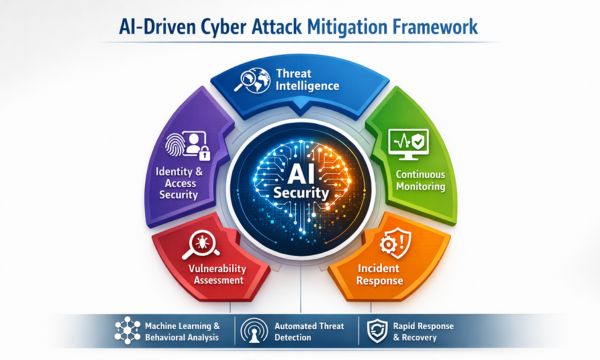
A comprehensive mitigation plan must combine technology, strategy, and governance. An effective AI-Driven Cyber Attack Mitigation Plan for India typically involves several critical components.
1. Threat Intelligence and Risk Assessment
The first step is understanding the organization’s threat landscape. AI-enabled threat intelligence platforms analyze global attack patterns, emerging vulnerabilities, and sector-specific risks.
This intelligence helps organizations anticipate potential threats and design appropriate defense mechanisms.
2. Continuous Security Monitoring
Real-time monitoring is essential for detecting cyber threats before they escalate. AI-driven security monitoring tools analyze network traffic, system logs, and user behavior across the enterprise environment.
Security Operations Centers (SOCs) use these insights to identify suspicious activities and initiate immediate response actions.
3. Vulnerability Assessment and Penetration Testing
Regular security testing helps identify weaknesses in applications, networks, and infrastructure. AI tools can accelerate vulnerability discovery by analyzing systems at scale and prioritizing risks based on potential impact.
Penetration testing further validates the effectiveness of security controls by simulating real-world attack scenarios.
4. Identity and Access Security
Many cyberattacks begin with compromised user credentials. AI systems can monitor login patterns and detect unusual access attempts, helping prevent unauthorized access to sensitive systems.
Advanced authentication mechanisms such as behavioral biometrics and adaptive authentication further strengthen identity security.
5. Incident Response and Recovery
Even with strong preventive measures, incidents may still occur. A robust mitigation plan includes structured incident response procedures that enable organizations to quickly contain and recover from attacks.
AI-assisted incident response platforms help security teams analyze attack patterns, identify root causes, and prevent future occurrences.
Strengthening India’s Cyber Resilience
Cybersecurity is not just an organizational concern—it is a national priority. As India expands its digital infrastructure and adopts emerging technologies such as artificial intelligence, blockchain, and smart cities, the need for robust cybersecurity frameworks becomes even more critical.
Government initiatives, regulatory frameworks, and industry collaboration all play an important role in strengthening cyber resilience across the country.
Organizations must move beyond traditional security measures and adopt intelligent, proactive cybersecurity strategies that can adapt to evolving threats.
The Role of Cybersecurity Consulting in AI-Driven Security
Implementing an AI-driven cybersecurity strategy requires expertise in risk assessment, security architecture, compliance frameworks, and advanced security technologies. Many organizations lack the internal resources needed to design and implement such comprehensive systems.
Cybersecurity consulting firms help bridge this gap by providing specialized expertise and structured security programs.
Companies like Illume Intelligence work with enterprises to evaluate their current security posture and develop tailored cyber attack mitigation strategies. By combining cybersecurity consulting, vulnerability assessments, penetration testing, and compliance support, organizations can build stronger defenses against modern threats.
The focus is not only on preventing attacks but also on enabling organizations to operate securely while pursuing digital innovation.
Preparing for the Future of Cybersecurity
The convergence of artificial intelligence and cybersecurity will continue to reshape how organizations defend their digital environments. As attackers adopt more sophisticated tools, defenders must rely on equally intelligent technologies.
An AI-Driven Cyber Attack Mitigation Plan for India represents a forward-looking approach to cybersecurity—one that combines predictive analytics, automated defense mechanisms, and strategic governance frameworks.
For businesses operating in India’s rapidly evolving digital ecosystem, investing in intelligent cybersecurity is no longer optional. It is essential for protecting critical infrastructure, safeguarding sensitive data, and maintaining trust in an increasingly connected world.
By adopting AI-driven security strategies and partnering with experienced cybersecurity professionals, organizations can build resilient digital environments capable of withstanding the cyber threats of today and tomorrow.