TheDPDPAct.com -
Official WhatsApp Channel
Stay updated with the latest DPDP Act news, compliance insights, updates, and resources.
Join Our WhatsApp Channel →India's average data breach now costs INR 25.5 crore, up 15.9% in a year, according to IBM's 2026 Cost of a Data Breach Report. That headline number is the least useful one in the report. A bank, a hospital, a software firm, and a factory can each suffer the same incident and lose money in entirely different ways: through regulators, through downtime, through stolen intellectual property, or through customers who quietly leave. If you are buying security for a specific sector, the average hides what you most need to know. This post looks at what the sector numbers say, where they stop, and what they imply for each kind of business.
The Numbers: What Is Known, and What Is Not
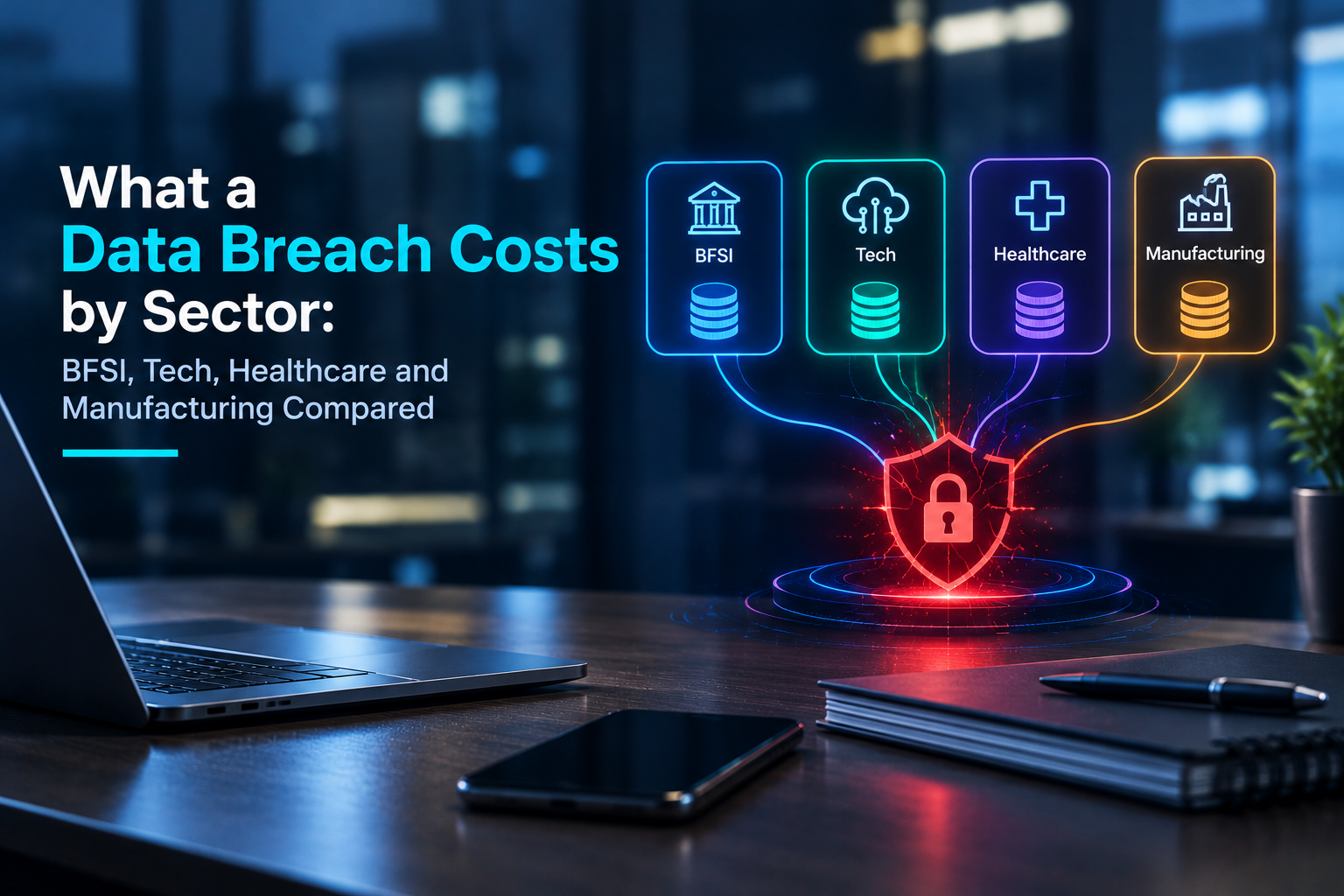
IBM's India release gives sector figures for three industries. Financial services is the costliest at INR 40.9 crore per breach, about 60% above the national average. Technology follows at INR 35.7 crore, and communications at INR 34.5 crore.
IBM's India release does not publish figures for healthcare or manufacturing. For those, the nearest sourced data is global. The table keeps the two sets apart, because they use different currencies and different samples and should not be compared line by line.
|
Sector |
India (INR crore) |
Global (US$ million) |
|
Financial services |
40.9 |
6.29 |
|
Technology |
35.7 |
5.50 |
|
Communications |
34.5 |
not reported in sources reviewed |
|
Healthcare |
not published |
6.64 |
|
Industrial / manufacturing |
not published |
5.50 |
|
All industries |
25.5 |
4.99 |
Global figures are as reported in coverage of the IBM 2026 report. They show healthcare as the costliest sector for the thirteenth consecutive year, though down from USD 7.42 million the year before. Treat all of these as averages across breached organisations. Any single incident can land far above or below them.
Financial Services and Fintech: The Cost of Trust
Financial firms top the Indian table, and the reasons are structural. They hold data that is immediately monetisable, they sit under the heaviest regulatory scrutiny, and their customers can move money, and trust, elsewhere. A breach can start several reporting clocks at once: CERT-In's six-hour window applies now, sector regulators add their own, and the DPDP Act's breach-notification duties follow when the main provisions take effect around May 2027.
Fintechs add a specific exposure: they are built from APIs, cloud services, and partner integrations. IBM's India data lists supply chain compromise as the initial vector in 15% of breaches, behind phishing at 19% and drive-by compromise at 16%. For a platform whose product is its connections, that matters.
What to weigh: the worst loss here is confidentiality and trust. Controls that test whether data can actually be reached, such as penetration testing and red teaming, bear directly on this.
Technology: Where the Asset Is the Code and the Credentials
At INR 35.7 crore, technology companies pay more than the national average because what they hold is leverage: source code, customer environments, and access to other companies' systems. IBM's India findings point to two cost-raising factors worth noting. Shadow AI, meaning staff using unsanctioned AI tools, added about INR 1.79 crore to average cost, and non-compliance with regulations and cloud migration were also among the top increasers.
What to weigh: the worst loss is integrity and access. A compromised build pipeline or a stolen token can reach customers, not just you.
Healthcare: When Downtime Is a Clinical Risk
Healthcare leads the global table for a reason money alone does not capture. When systems go down, care continues without them. In November 2022, ransomware hit AIIMS Delhi's e-Hospital systems, which handle admissions, labs, billing, and reports. Services ran in manual mode for days, with the medical superintendent reporting roughly 12,000 patients a day. Media reports of a INR 200 crore ransom demand were disputed by Delhi Police, who said none had been reported to them. The financial cost was never published, but the operational one was visible to every patient.
What to weigh: the worst loss is availability and patient safety, with sensitive health data layered on top. Resilience planning, tested recovery, and incident response matter as much as prevention.
Manufacturing: The Bill Is Written in Idle Production Lines
Industrial organisations average $5.50 million per breach globally in IBM's report, but averages understate the tail. In September 2025, a cyber attack forced Jaguar Land Rover to shut down critical systems and halt production at UK plants for weeks, with phased restarts from early October. The Cyber Monitoring Centre estimated the cost to the UK economy at £1.9 billion, with a modelled range of £1.6 billion to £2.1 billion, and said more than 5,000 UK organisations were affected. Much of that came from suppliers and dealers downstream.
What to weigh: the worst loss is production time. In factories, the question is whether you can keep running, or restart quickly, when IT or operational technology is hit.
What Moves the Number, in Any Sector
IBM's India findings offer a useful common thread. Organisations with extensive AI and automation in security averaged INR 21.3 crore per breach, against INR 31.6 crore for those with none. Among cost-reducing factors, offensive security testing, meaning red teaming and penetration testing, was the largest, saving about INR 2.47 crore. Proactive threat hunting and AI governance technology followed. Shadow AI, regulatory non-compliance, and cloud migration pushed costs up.
These are correlations from survey data, not guarantees. Organisations that test their defences may also be better run overall. Still, the direction is consistent: finding weaknesses before an attacker does is associated with lower bills.
A Simple Way to Use This
Ask which loss would hurt your business most, then check whether your security spending matches it.
* Confidentiality loss (BFSI, fintech): data protection, access control, breach-notification readiness, third-party risk.
* Integrity and access loss (technology): pipeline and identity security, supply chain review, AI governance.
* Availability loss (healthcare, manufacturing): segmentation, recovery testing, incident response rehearsal, continuity planning.
Most organisations face more than one. This framing is our own, not IBM's, but it helps turn a sector average into a budget conversation.
Where ILLUME Intelligence Can Help
ILLUME Intelligence's Penetration Testing and Red Team Testing services show how far an attacker could get in your environment, and our Incident Response Management service helps you contain and investigate an incident when one happens. Our compliance and Virtual CISO services help align controls with CERT-In, DPDP, and sector obligations. A short exposure review, built around the loss your sector fears most, is a sensible place to begin.
The Bottom Line
Averages tell you a breach is expensive. Sector detail tells you how. For a bank it is trust and regulation, for a software firm it is access and code, for a hospital it is availability, and for a plant it is idle machines. Spend against the loss that would hurt you most, and test your defences before someone else does.