TheDPDPAct.com -
Official WhatsApp Channel
Stay updated with the latest DPDP Act news, compliance insights, updates, and resources.
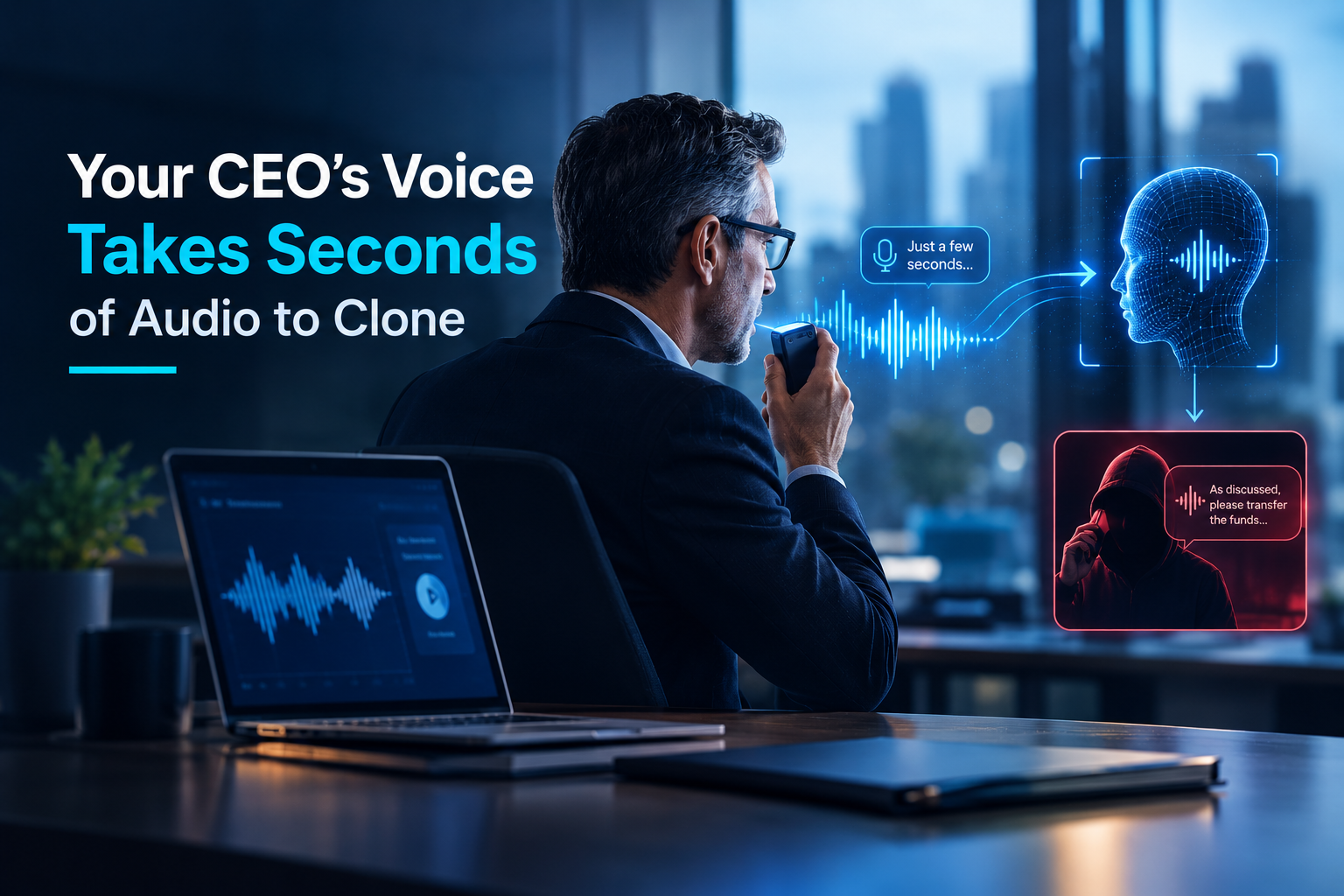
Join Our WhatsApp Channel →It is 6:40 p.m. on the last working day of the quarter. Your finance head's phone rings, and it is the CEO: hurried, slightly irritated, asking for an urgent transfer to close a confidential deal. The voice is right. So is the cadence. Nothing about the call feels wrong, which is exactly the problem. In 2023, security firm McAfee tested a cloning tool and reported that just three seconds of audio produced an 85% voice match. Every earnings call, conference panel, and LinkedIn video your leadership has published is raw material. The question for finance teams is no longer whether a voice sounds real. It is whether your payment process still works when it does.
The Cost of a Convincing Voice Has Collapsed
Consumer Reports assessed six AI voice-cloning companies in 2025 and found that only two, Descript and Resemble AI, had meaningful safeguards against misuse. The other four relied on users ticking a box to confirm they had the right to clone a voice. The same coverage notes that only a few seconds of audio are needed.
India sits in the middle of this. McAfee's survey of Indian adults found that 47% had experienced an AI voice scam or knew someone who had, against a global average of 25%. Of those who were victims, 83% lost money, and about 48% lost INR 50,000 or more. And 69% said they were not confident they could tell a cloned voice from the real one. These are vendor-run survey figures from 2023, so treat them as indicators, not census data. They still point the same way as every other source: the voice is no longer proof of identity.
This Is Not Theory: Three Cases
Arup, Hong Kong (2024). A finance employee first suspected a phishing email asking for a confidential transaction. He set his doubts aside after a video call with what looked like the company's CFO and several colleagues. Police later said all of them were deepfake recreations. The employee sent HKD 200 million, about USD 25.6 million, across 15 transactions. Arup confirmed that "fake voices and images" were used.
WPP (2024). Attackers built a WhatsApp account with the chief executive's photo, then set up a Microsoft Teams meeting using a voice clone and footage taken from YouTube. They aimed to get a senior executive to fund a "new business." It failed because employees were alert. The CEO's warning to staff is worth repeating: "Just because the account has my photo doesn't mean it's me."
Ferrari (2024). An executive received WhatsApp messages and a call from an unfamiliar number, apparently from the CEO. The voice imitated the CEO's accent, but the executive noticed slight inconsistencies in tone. He asked for the title of a book the CEO had recently recommended. The caller could not answer and hung up.
Notice what saved Ferrari. It was not a detection tool, and it was partly luck that the executive was sharp. It was a question that only the real person could answer. That is a process, and it can be designed in advance.
Why "Listen Carefully" Is Not a Control
Many awareness programmes still teach staff to spot odd pauses or robotic tone. That advice ages quickly, because the tools keep improving, and it puts the burden on the person under the most pressure.
Voice fraud attacks judgment, not technology. The caller has authority, claims urgency, and invokes confidentiality so the victim will not check with anyone. A control that relies on one employee overruling the CEO's apparent voice is weak. The stronger design assumes the voice may be fake and makes it impossible to move money on a voice alone.
Controls That Do Not Depend on Recognizing a Voice
1. Call back on a number you already hold. Hang up and ring the executive on the number in your own directory, never the number that called you or one supplied in the request. This single step defeats most voice-only attacks.
2. Make approval a workflow, not a conversation. Payment instructions are valid only when entered and approved in the finance system. A phone call, a WhatsApp message, or a video meeting is never an authorization channel, however senior the caller.
3. Require two approvers. Split initiation and approval between different people, and set a lower threshold for dual approval than you think you need. One compromised person should not be able to move money.
4. Treat changes as higher risk than amounts. New beneficiaries, changed bank details, and first-time payees deserve a delay and a separate verification, whatever the sum.
5. Build in a cooling-off period for urgent, large, or confidential requests. Fraud depends on speed. A rule that urgent exceptions need a second executive's confirmation gives staff permission to slow down without being seen as obstructive.
6. Add a challenge that is not public. The Ferrari question worked because the answer was not online. A pre-agreed code phrase, or a question about something never posted publicly, adds friction. Use it as a backstop to the callback, not a substitute for it.
7. Do not trust video either. Arup shows that a video call with familiar faces is not verification. Apply the same out-of-band checks to meetings.
8. Have the CEO set the rule. When leaders state publicly inside the company that they will never ask for an urgent transfer by phone or messaging app, staff gain the confidence to refuse.
9. Know the recovery path. Speed matters after a transfer. Brief finance staff on who to call at the bank to request a recall, and that fraud can be reported through India's National Cybercrime Helpline (1930) and the cybercrime portal. Depending on the incident, CERT-In's six-hour reporting window may also apply.
Test the Process, Not Just the People
Writing these rules is the easy half. The harder question is whether they hold when someone with a plausible story, a believable voice, and a deadline leans on them. Policies fail in predictable places: the assistant who "just needs one quick approval," the regional finance team that has never met the CEO, the payment desk working late. A social engineering assessment shows how your people and procedures respond to realistic pretexts, including phone and messaging-based impersonation, and where the approval chain can be talked around. A cyber attack simulation goes further, placing impersonation inside a broader attack scenario so you can see how detection, escalation, and response work together under pressure, not in isolation.
ILLUME Intelligence offers both through our Social Engineering Assessment and Cyber Attack Simulation services. The aim is not to embarrass anyone but to find the weak step before an attacker does.
The Bottom Line
A cloned voice is cheap, convincing, and getting better. The defence is not sharper ears but a payment process in which no voice, however familiar, can move money alone. Verify through a channel the caller does not control, require two sets of hands, slow down the unusual, and then test the whole thing under realistic pressure. If your approval chain would hold when the CEO calls and everything sounds right, it will hold against the people pretending to be them.
Comments
No Comments Found.
Search Here

Software Supply Chain Attacks: The Dependency You Never Reviewed
October 19, 2026
Your CEO's Voice Takes Seconds of Audio to Clone
October 19, 2026

Harvest Now, Decrypt Later: Why Your Crypto Inventory Can't Wait
October 18, 2026