TheDPDPAct.com -
Official WhatsApp Channel
Stay updated with the latest DPDP Act news, compliance insights, updates, and resources.
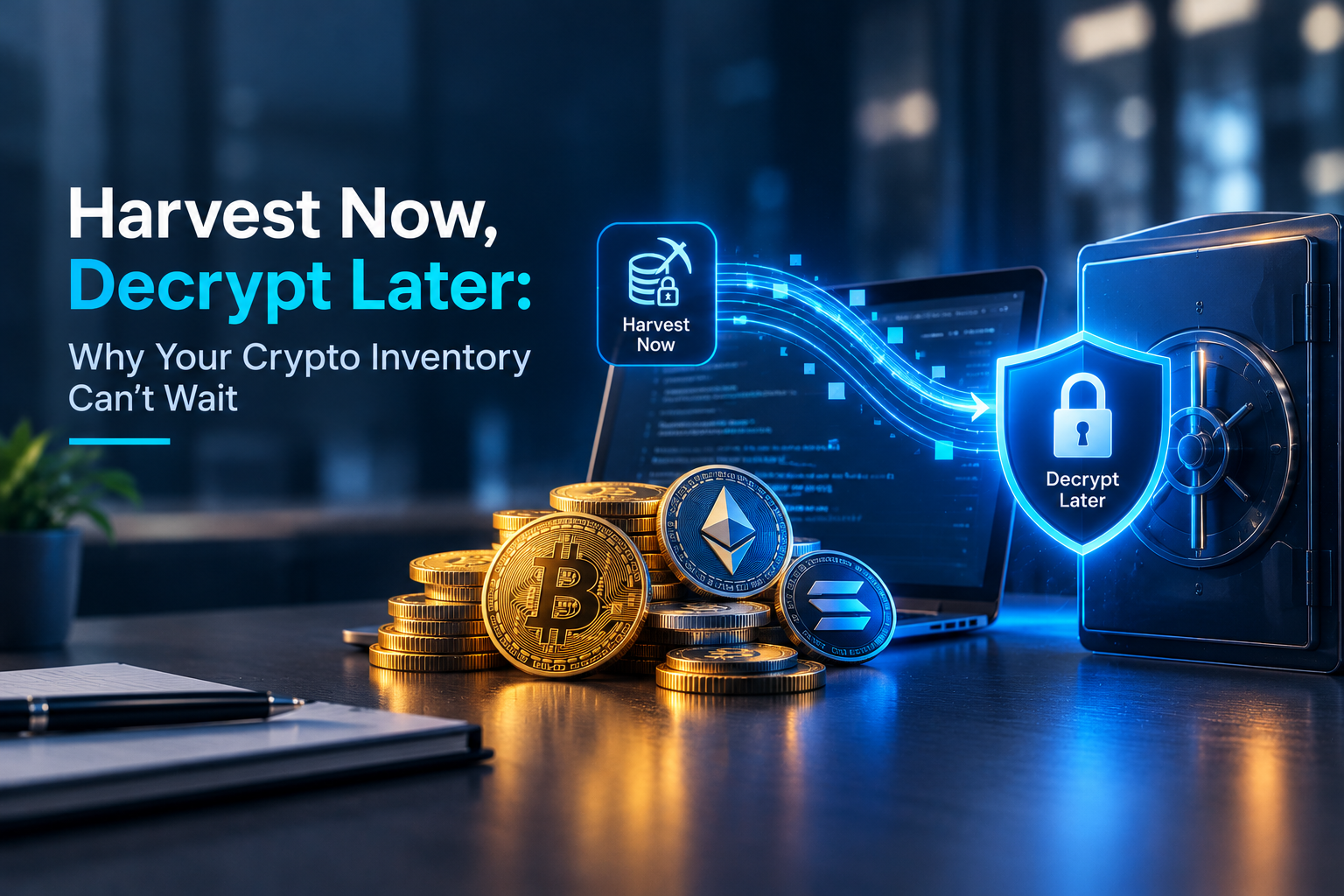
Join Our WhatsApp Channel →Encrypted data that is stolen today does not need to be read today. An adversary can copy it now, store it cheaply, and decrypt it later, once a sufficiently capable quantum computer can break the public-key cryptography that currently protects it. This tactic is known as "harvest now, decrypt later," and it changes the timing of the risk: for information that must remain confidential for a decade or more, such as financial records, health data, and intellectual property, exposure begins at the moment of capture, not on the day quantum computing matures. The standards for replacing vulnerable cryptography already exist. What most organizations lack is a clear answer to a simpler question: where, exactly, is our cryptography?
The Planning Rule That Makes This Urgent
Security planners often use a simple inequality. Add the number of years your data must stay secret to the number of years a cryptographic migration will take. If the total exceeds the years until a capable quantum computer exists, you are already behind.
Nobody can state the arrival date with certainty. But the two terms you control, how long your data needs protection and how long migration takes, are both long for most large organizations, and waiting for certainty is itself a decision to accept the risk.
The Standards Are Ready; The Inventory Is Not
In August 2024, NIST finalized its first three post-quantum cryptography standards: FIPS 203 (ML-KEM, for key establishment), FIPS 204 (ML-DSA), and FIPS 205 (SLH-DSA), the latter two for digital signatures. A NIST draft, IR 8547, proposes disallowing classical public-key algorithms after 2035, though it has not been finalized.
Industry is moving. Google announced a 2029 target for completing its own post-quantum migration, and Cloudflare has said it is matching that date. As of April 2026, more than 65% of human-generated traffic on Cloudflare's network was already protected with post-quantum encryption. Yet one analysis found roughly 0% of measured domains using post-quantum certificates, which means authentication lags well behind key exchange.
The pattern is clear: choosing algorithms is the easy part. The difficult part is finding every place a vulnerable algorithm is used, which is why discovery dominates the schedule. One analysis citing NIST's NCCoE migration project states that discovery alone takes 12 to 24 months for large enterprises. That figure comes from a secondary source.
India Now Has a Roadmap
In May 2026, India's Department of Science and Technology, under the National Quantum Mission, published a roadmap titled Quantum-Safe Ecosystem in India: Roadmap to Quantum Resiliency. Its critical information infrastructure (CII) track, which covers defense, power, telecom, transport, and banking, financial services, and insurance, sets these milestones:
* December 2027: foundations in place
* December 2028: high-priority migration
* December 2029: full post-quantum adoption
Regular enterprises follow a slower track, with milestones in 2028, 2030, and 2033. The roadmap also proposes a Cryptographic Bill of Materials (CBOM) as a mandatory vendor submission from FY 2027-28, and it calls for crypto-agility to be built into governance, architecture, procurement, and operations.
Two cautions apply. The report states that it is not a legal or regulatory mandate, so enforcement would depend on sector regulators. And it was reported to have been briefly hosted by one organization and then withdrawn pending republication, so confirm the current version with DST before citing specific dates in a client-facing document. A CBOM requirement would reach any organization supplying those sectors.
Why Inventory Is the Real Bottleneck
Cryptography is rarely located in one place. It sits in:
* TLS endpoints, VPNs, and load balancers
* Certificates and the PKI that issues them
* Code signing, SSH keys, and API tokens
* Database, disk, and backup encryption
* Hardware security modules and key management systems
* Third-party SaaS and vendor products you do not control
* Embedded devices and firmware that are difficult to update
Much of it is hard-coded, undocumented, or inherited from systems whose builders have moved on. Supply-chain dependency makes it harder still, because migration for products you buy waits on your vendors. This is why quantum readiness is better understood as an inventory problem than an algorithm problem.
What a Useful Cryptographic Inventory Contains
For each cryptographic asset, record:
1. What it is and where it runs: system, application, and owner.
2. Algorithm and key size: for example RSA-2048 or an elliptic-curve variant.
3. Protocol and library versions: which implementations are in use.
4. What it protects, and for how long: the data's sensitivity and its required confidentiality lifetime.
5. Dependencies: whether the algorithm is set by your code, a vendor, or a standard.
6. Replaceability: how hard it would be to change.
Sorting by confidentiality lifetime shows what to migrate first.
A Practical Five-Step Plan
1. Discover. Combine network scanning, certificate discovery, code and configuration analysis, and vendor questionnaires to build the first inventory.2. Prioritize by data shelf life. Target systems protecting long-lived confidential data and the key-exchange paths that carry it.
2. Build crypto-agility. Make algorithms configurable instead of hard-coded, so the next change is a setting, not a rewrite. Post-quantum readiness is as much about changing primitives faster than the threat evolves as about any single algorithm.
3. Pilot hybrid approaches. Combining a classical algorithm with a post-quantum one in the same handshake is the pragmatic default during the transition.5. Write it into contracts. Ask vendors for their post-quantum roadmap and a cryptographic bill of materials, and make readiness a purchasing criterion.
Who Should Start First
Any organization holding data that must stay confidential for many years should treat this as a near-term priority. Financial institutions hold transaction histories, customer identity records, and contracts that remain sensitive for years, and the sector carries India's highest average breach cost, at INR 40.9 crore according to IBM's 2026 report. Healthcare providers, insurers, government bodies, and telecom and power operators face the same long-confidentiality problem, and the roadmap places banking, financial services, insurance, defense, power, telecom, and transport on its accelerated CII track. Technology and SaaS companies that supply these sectors are likely to meet the requirement first, through customer requests for their cryptographic bill of materials.
Because the roadmap is not binding and no sector mandates had been reported at the time of writing, early movers set the pace. Organizations that inventory now will be better placed when requirements arrive.
Where ILLUME Intelligence Can Help
ILLUME Intelligence's security assessment and advisory teams can help scope a cryptographic inventory, review cloud and application cryptography, and fold quantum-readiness into governance through our Virtual CISO services. A short scoping exercise is usually the best starting point, since it shows how large the inventory task really is before a programme is budgeted.
The Bottom Line
Post-quantum migration will take years, and its first stage, knowing what you have, is the one that cannot be compressed later. The standards are final, major platforms are setting 2029 targets, and India now has a national roadmap pointing the same way. Starting the inventory today costs relatively little. Starting it after requirements arrive will cost far more, and the data harvested in the meantime cannot be taken back.
Comments
No Comments Found.
Search Here

Software Supply Chain Attacks: The Dependency You Never Reviewed
October 19, 2026

Your CEO's Voice Takes Seconds of Audio to Clone
October 19, 2026
Harvest Now, Decrypt Later: Why Your Crypto Inventory Can't Wait
October 18, 2026